
Irish Breakfast Tea: Flavor, Brewing, and What Research Says About Black Tea
By Ricardo R. Matos, Founder of Tea The World
Updated October 2026 · Reviewed against published research
Irish Breakfast tea is a bold, malty black tea blend made to stand up to milk and a busy morning. Because it is a black tea, it also belongs to one of the most-researched beverages in the world. This guide covers what makes Irish Breakfast distinctive, how to brew it well, and what studies on black tea have and have not shown.
What Is Irish Breakfast Tea?
Irish Breakfast tea is a hearty black tea blend, traditionally built on Assam and sometimes combined with Ceylon or Kenyan teas. Its deep color, malty flavor, and brisk character make it a classic morning cup, usually enjoyed with a splash of milk.
Like all black, green, white, and oolong teas, it comes from the Camellia sinensis plant. Black tea is fully oxidized, which develops its darker color, fuller body, and its characteristic plant compounds, called theaflavins and thearubigins.
Irish Breakfast vs Black Tea in General
| Feature | Irish Breakfast Tea | Black Tea in General |
|---|---|---|
| Base leaves | Primarily Assam, sometimes blended with Ceylon or Kenyan teas. | Varies widely (Assam, Ceylon, Darjeeling, Kenyan, blends). |
| Flavor profile | Bold, malty, and brisk; often enjoyed with milk. | Ranges from malty and full-bodied to light and floral. |
| Plant compounds | Theaflavins, thearubigins, and other black tea polyphenols. | Similar compound families, varying by origin and processing. |
| Caffeine | Moderate to high for a tea, which is why it is a morning favorite. | Varies by leaf, blend, and steep time. |
| When to drink | Commonly enjoyed in the morning. | Throughout the day, adjusted to caffeine sensitivity. |
What Research Says About Black Tea
Most studies look at black tea in general rather than any specific blend, so the findings below describe black tea as a category. They are research observations, not promises about any one cup.
Heart and blood vessels
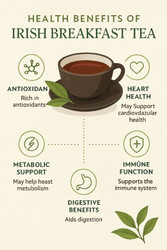
Black tea is one of the better-studied drinks for cardiovascular research. A clinical study published in Circulation found that drinking black tea improved a measure of blood vessel function (flow-mediated dilation) in people with coronary artery disease. In a 2012 randomized trial, 95 adults who drank 3 cups of black tea a day for 6 months had blood pressure about 2–3 mm Hg lower than those who drank a placebo drink. In the large UK Biobank study, people who drank 2 or more cups of tea a day had a 9–13% lower risk of death over about 11 years; this is an association, not proof that tea caused the difference.
Caffeine and L-theanine
Black tea naturally contains both caffeine and the amino acid L-theanine. Studies of this combination have reported effects on alertness and attention, though they often use measured doses rather than an ordinary cup of tea.
Polyphenols
Black tea polyphenols have been studied for antioxidant activity and for how they interact with gut bacteria. Much of this work is early or laboratory-based, and researchers are still learning how it applies to everyday tea drinking.
Overall, the evidence supports black tea as one enjoyable part of a balanced diet, not a remedy for any condition.
Things to Know Before You Brew
| Consideration | What it means |
|---|---|
| Caffeine | Irish Breakfast contains caffeine. People sensitive to stimulants, pregnant individuals, or those with certain heart conditions may want to limit it. |
| Iron absorption | Tannins in black tea can reduce absorption of non-heme iron from plant foods when tea is drunk with meals. |
| Sleep | A late-day cup can interfere with sleep for some people. |
Talk with a qualified healthcare provider if you have questions about caffeine, iron, medications, pregnancy, or an existing health condition.
How to Brew Irish Breakfast Tea
- Use about 1 teaspoon of loose Irish Breakfast tea per 8 oz cup.
- Pour water at a full boil (about 212°F / 100°C).
- Steep 3 to 5 minutes. Go shorter for a lighter cup; longer brews turn brisk and more astringent.
- Remove the leaves, then add a splash of milk if you like, the traditional way to enjoy it.
Try our Irish Breakfast
A bold, malty loose leaf black tea made for strong mornings, with or without milk.
Why We Care About Tea and Health
Tea The World was founded in San Antonio, Texas, after our founder's own health journey, including heart surgery, sparked a deeper interest in what we eat and drink every day. That's why we share research honestly, including its limits, alongside the teas themselves. Read our story.
This article is for general education and is not medical advice. If you have a health condition, are pregnant, or take medication, talk with your doctor before using herbal teas for health reasons.
Sources
- Hodgson JM et al. Effects of black tea on blood pressure: a randomized controlled trial. Archives of Internal Medicine, 2012;172(2):186–188. doi:10.1001/archinte.172.2.186
- Inoue-Choi M et al. Tea consumption and all-cause and cause-specific mortality in the UK Biobank. Annals of Internal Medicine, 2022. NIH summary
- Short- and Long-Term Black Tea Consumption Reverses Endothelial Dysfunction in Patients With Coronary Artery Disease (Circulation)
- Harvard T.H. Chan School of Public Health – Tea: The Nutrition Source
- Health-Promoting Effects of Black Tea: A Narrative Review of Clinical Trials
- Black Tea Consumption and the Risk of Coronary Heart Disease