
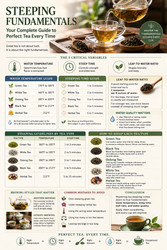
Quick answer: Steep green tea 2–3 minutes, white tea 2–5 minutes, oolong 3–5 minutes, black tea 3–5 minutes and herbal tea 5–10 minutes. Tea bags and sachets with finely broken leaves brew faster than loose leaf, so start at the short end of the range.
Have you ever brewed a cup of tea that tasted bitter, flat or just plain wrong? Perfect tea is not about luck. It comes down to a few fundamentals: steep time, water temperature, how much tea you use and the water itself. This guide covers all of them.
What Does Steeping Tea Mean?
To steep tea means to soak tea leaves or a tea bag in hot water for a set period of time. During that time, the water draws out the flavors, aromas and compounds locked inside the leaves. The result is the cup you drink.
Think of it like making a stock: you let the water slowly pull out everything worth having. Tea works the same way.
Steeping is one step of brewing, which is the whole process from heating the water to pouring the cup. For more on the difference, see Brewing vs. Steeping Tea.
The Science Behind Every Sip
When tea leaves meet hot water, they release caffeine, tannins, amino acids and aromatic compounds. These do not all dissolve at the same rate:
- Aromas release first, usually within 30 to 60 seconds
- Sweeter and smoother flavors follow
- Bitter tannins come later
This is why over-steeping usually leads to a harsh, bitter cup.
The Three Critical Variables
- Steep time controls strength and bitterness
- Water temperature determines how fast flavor is extracted
- Leaf-to-water ratio shapes intensity and body
Master these three and you will dramatically improve your tea.
Steeping Times and Temperatures by Tea Type
| Tea Type | Steep Time (loose leaf) | Water Temperature |
|---|---|---|
| Green Tea | 2 to 3 minutes (1 to 2 for delicate Japanese greens) | 175°F to 185°F (80–85°C); delicate Japanese greens 160°F to 175°F |
| White Tea | 2 to 5 minutes | 175°F to 185°F (80–85°C) |
| Oolong Tea | 3 to 5 minutes | 185°F to 205°F (85–96°C) |
| Black Tea | 3 to 5 minutes | 200°F to 212°F (93–100°C) |
| Herbal Tea | 5 to 10 minutes | 212°F (100°C) |
Use these as starting points, then adjust to your taste, and always follow the directions on your specific tea first. The right time and temperature also depend on the leaf itself: young buds and delicate leaves like the short, cooler end; mature leaves, dark oolongs and aged teas like longer, hotter steeps. Our Tea Temperature Chart explains why in detail.
No thermometer? Bring water to a boil and let it rest with the lid open. As a rough guide, about 1 minute gets you near 200°F for oolong, and about 2–3 minutes gets you into the 175–185°F range for green and white teas.
Tea Bags vs. Loose Leaf: Steeping Differences
Many standard tea bags contain finely broken leaves (often called fannings or dust). The smaller the pieces, the faster they release flavor and tannins. That means:
- Tea bags steep faster. Start at the short end of the ranges above and taste before adding time. Roomy sachets with whole leaves behave more like loose leaf.
- Whole loose leaves need room to unfurl. Use a roomy infuser, a teapot with a removable basket, or a fill-your-own filter such as Tea Pockets or Finum Tea Filters.
- Loose leaf can usually be re-steeped; most tea bags give their best in the first infusion.
How Much Tea to Use
A good starting point is 1 teaspoon of loose leaf (about 2 g) or 1 tea bag per 8 oz of water.
Bulky, open leaves such as many white teas, rolled-open oolongs and some herbal blends take up more space for the same weight, so you may need about 2 teaspoons per cup to get the same strength.
If you want stronger tea, use more leaves instead of steeping much longer. That gives more flavor without extra bitterness.
Water Quality Matters
Water makes up nearly all of your cup, so its quality matters more than most people realize.
- Use filtered or spring water
- Avoid distilled water, which makes tea taste flat
- Avoid very hard water when possible
- Always start with fresh water; don’t re-boil water that has been sitting
How to Steep Each Tea Type
Green Tea
Use cooler water and shorter steeps to preserve delicate flavors. Avoid boiling water. Try India Simply Green Tea or Turkish Apricot & Peach Green Tea.
White Tea
White tea is gentle and forgiving. Bud-heavy whites like the cooler end of the range. It can also be cold brewed for a smooth, naturally sweet cup.
Oolong Tea
Light, green-style oolongs prefer the cooler end; dark or roasted oolongs like hotter water. Oolong rewards multiple infusions.
Black Tea
Black tea handles near-boiling water and delivers a fuller body with a 3 to 5 minute steep. Our Hawaii Passion Fruit Tea, a Ceylon black tea in sachets, recommends a full boil and 1–3 minutes, a good example of why package directions come first.
Herbal Tea
Herbal tea needs boiling water and longer steeps to release flavor from roots, flowers and botanicals. Try Egypt Simply Chamomile or Morocco Simply Tea Peppermint, and see The Ideal Temperature for Herbal Tea and How Long to Steep Chamomile Tea.
Brewing Styles That Matter
Western brewing is the everyday method: a larger vessel, a moderate amount of leaf and a 2 to 5 minute steep.
Gongfu brewing uses more leaves, less water and much shorter steeps (often 10 to 30 seconds), repeated several times, to bring out complex layers of flavor. It works especially well for oolong and pu-erh.
Common Mistakes to Avoid
- Over-steeping green tea
- Under-steeping herbal tea
- Using the wrong water temperature
- Using too many or too few leaves
- Leaving tea bags in too long
Conclusion
Mastering tea steeping comes down to four fundamentals: steep time, water temperature, leaf ratio and water quality. Apply them consistently and every cup will improve. Start with one tea, adjust one variable at a time and taste the difference.
FAQs
Can I reuse tea bags the same way I reuse loose leaf tea?
Technically yes, but loose leaf tea usually gives much better results across multiple infusions.
Does the shape or material of my teapot affect the steeping process?
Yes. Clay and cast iron retain heat, glass lets you watch the brew, and ceramic gives neutral, consistent results.
Is it safe to drink tea that has been steeped overnight?
Not at room temperature. Cold steeping in the refrigerator is a safer option.
How does altitude affect water temperature and tea steeping?
At higher altitudes, water boils at a lower temperature, which can affect extraction and may require slightly longer steeping.
Can I steep different types of tea together in one cup?
Yes, but it works best when the teas have similar water temperature and steep time requirements.
Does adding milk or sweeteners before or after steeping make a difference?
Yes. It is best to steep first, then add milk or sweeteners after brewing.