
Can earl grey tea lower cholesterol?
Posted by Ricardo R. Matos, Founder of Tea The World on Nov 9th 2026
Earl Grey tea is not a proven treatment for lowering cholesterol in 2026. Research on black tea and concentrated bergamot extracts does not establish that a brewed cup of Earl Grey lowers LDL cholesterol, and tea should not replace prescribed medication or a heart-healthy eating plan.
- Can Earl Grey tea lower cholesterol? Brewed Earl Grey is not a proven LDL-lowering treatment.
- Bergamot supplements and bergamot-flavored black tea are different preparations; their evidence is not interchangeable.
- Choose unsweetened Earl Grey for flavor, not as a substitute for cholesterol medication.
- Tea The World suits loose leaf tea drinkers seeking flavor and brewing guidance, not cholesterol treatment.
By Ricardo R Matos
Why this matters
The cholesterol claim combines two separate subjects: research on black tea and research on bergamot preparations. Earl Grey brings those names together in a cup, but that does not make the research interchangeable. An ingredient associated with a possible benefit does not establish that every drink containing it delivers that benefit.
For everyday tea drinking in 2026, the useful questions are simpler: Do you enjoy the flavor? Does caffeine suit your routine? What are you adding to the cup? The same ingredient-first approach helps when choosing herbal blends or black tea: a fruit name alone does not tell you whether a blend contains caffeine.
Can Earl Grey tea lower cholesterol?
There is no established clinical basis for using brewed Earl Grey as an LDL-lowering treatment. LDL is the cholesterol measure commonly described as bad cholesterol. Lowering elevated LDL matters, but a treatment claim needs evidence for the actual preparation you consume—not just an ingredient name.
Earl Grey usually combines black tea with bergamot flavoring. Black tea contains plant compounds called polyphenols, while bergamot is a citrus fruit. Researchers have studied black tea consumption and concentrated bergamot preparations separately; those studies do not establish an effective dose of Earl Grey.
| Preparation | What the evidence addresses | Best for | Main limitation |
|---|---|---|---|
| Regular Earl Grey | Black tea research provides indirect context, not proof for Earl Grey | Drinkers who enjoy citrus-scented black tea | Contains caffeine; no established cholesterol-treatment dose |
| Decaffeinated Earl Grey | Decaffeination does not establish a cholesterol benefit | Drinkers seeking less caffeine with a similar flavor | Decaffeinated tea is not necessarily caffeine-free |
| Caffeine-free herbal infusion | Evidence depends on the specific herb and preparation | Evening drinkers avoiding caffeine | Not automatically an LDL-lowering drink; check ingredients |
| Concentrated bergamot supplement | Human studies concern particular extract formulations | A clinician-led discussion, not a tea substitution | Supplement results cannot be applied directly to brewed tea |
The practical answer is to enjoy Earl Grey as a beverage and keep cholesterol decisions tied to your blood tests, overall cardiovascular risk, and clinician's advice.
What does research on black tea actually show?
Research on black tea and cholesterol has produced mixed findings. Some pooled analyses report reductions in LDL, while results for other cholesterol measures and individual studies are less consistent. That is different from demonstrating that a particular Earl Grey blend treats high cholesterol.
A relevant source is the Clinical Nutrition review titled Black tea consumption and serum cholesterol concentration: systematic review and meta-analysis of randomized controlled trials. Its scope is black tea interventions—not a standardized Earl Grey product. In this 2026 guide, that distinction is the reason not to turn a general tea finding into a product claim.
Consider what a study needs to tell you before applying it to your cup:
- Preparation: Was the intervention brewed tea, a powder, or an extract?
- Participants: Did the study involve people with elevated cholesterol or a different population?
- Outcome: Did it measure LDL, total cholesterol, or another marker?
- Comparison: What did participants drink or take instead?
- Consistency: Did other studies find a similar result?
A statistically detectable change is not automatically a treatment recommendation. Your clinician also considers the size of any effect, the quality of the evidence, and whether the intervention reduces cardiovascular risk.
Does bergamot make Earl Grey a cholesterol remedy?
Bergamot flavoring does not turn Earl Grey into a cholesterol medicine. The amount and composition of bergamot-derived material in a flavored tea cannot be assumed to match a concentrated preparation used in research.
Human studies of bergamot preparations are discussed in Effect of bergamot on lipid profile in humans: A systematic review, published in Critical Reviews in Food Science and Nutrition. Its scope is bergamot interventions in people. It does not establish that ordinary Earl Grey delivers the same preparation or produces the same effect.
Concentration matters, but so does composition. A flavoring selected for citrus aroma is not interchangeable with an extract selected for particular compounds. A stronger bergamot scent therefore does not prove a stronger cholesterol effect.
Traditional use deserves the same distinction. A drink can have a long history of enjoyment without being a clinically established treatment. Choose the fragrant cup because you like its bright, citrus character—not because the aroma promises a change in your blood test.
Do not add bergamot essential oil to tea to imitate a supplement study. Essential oils are not interchangeable with food flavorings or clinical preparations, and self-dosing creates avoidable safety concerns.
Why the evidence varies
The research question changes when the preparation, participants, or outcome changes. These differences explain why a headline about bergamot or black tea cannot answer every question about Earl Grey.
- Different preparations: Brewed tea and concentrated extracts deliver different mixtures of compounds.
- Different formulations: Bergamot studies do not all evaluate an identical supplement.
- Different participants: Results in one study population do not automatically apply to everyone with high cholesterol.
- Different outcomes: A change in total cholesterol is not the same finding as a change in LDL.
- Different background habits: Diet, medication, and the comparison intervention affect how a study result should be interpreted.
- Different study quality: Small studies and inconsistent findings provide less certainty than repeated, well-controlled results.
For your own routine, avoid using taste as a laboratory measurement. A dark brew or pronounced citrus scent does not tell you how much of a studied compound is present. There is no established number of Earl Grey cups that functions as a cholesterol-treatment dose.
How should you drink Earl Grey if you have high cholesterol?
Drink Earl Grey in a way that fits your wider eating pattern. The tea does not need to carry the burden of treating cholesterol; it can simply be a pleasant, unsweetened drink alongside evidence-based care.
The American Heart Association's guidance on dietary fats and cholesterol emphasizes replacing saturated fats with unsaturated fats. Its dietary guidance also favors patterns built around vegetables, fruit, whole grains, legumes, and other appropriate sources of fiber. Those are more useful foundations than searching for a single corrective beverage.
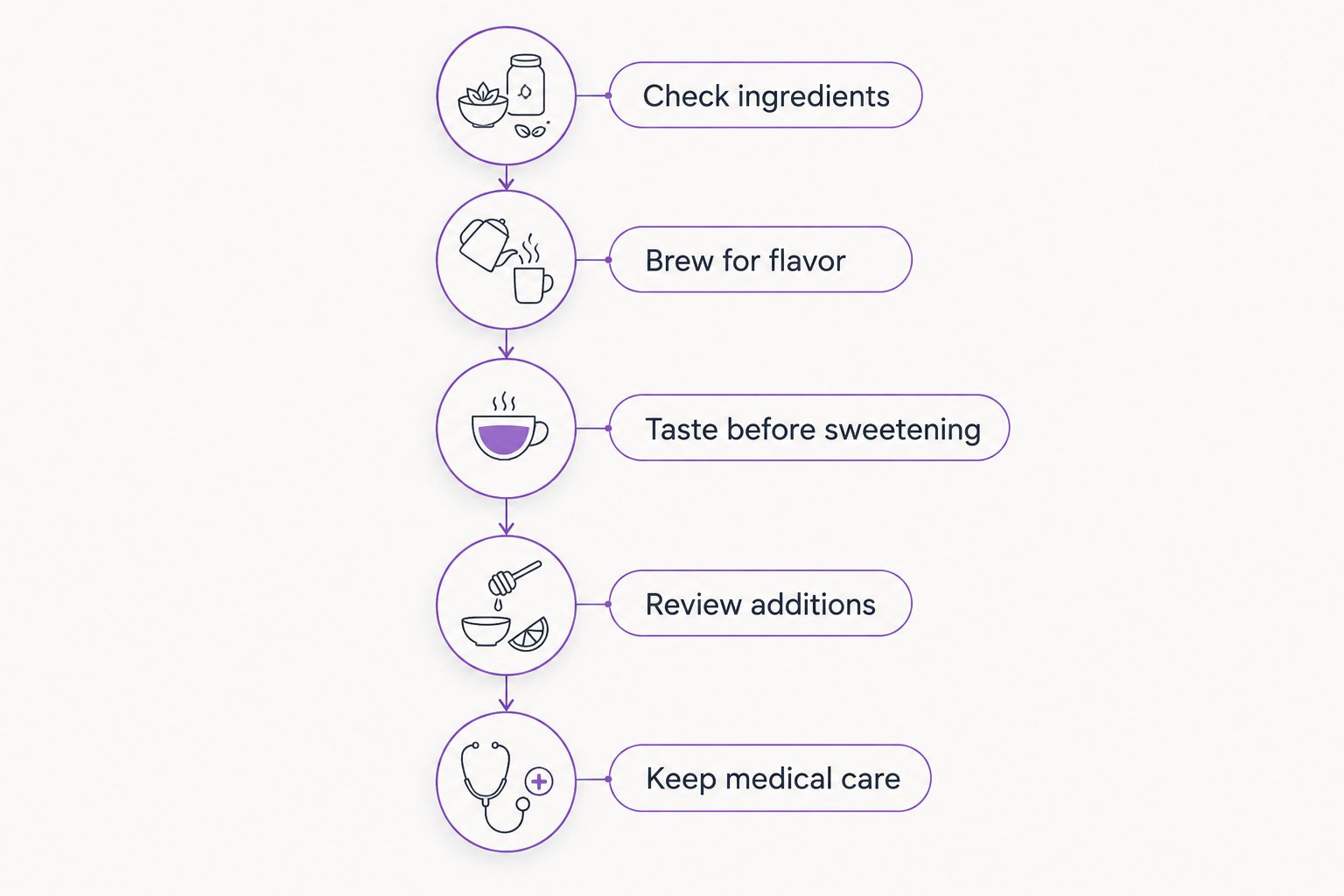
Use this practical sequence:
- Check ingredients. Identify the tea base, flavorings, and any additional herbs before choosing the blend.
- Brew for flavor. Follow the blend's instructions rather than making an unusually concentrated cup for a supposed medical effect.
- Taste before sweetening. Notice the citrus aroma and black tea character before deciding what to add.
- Review additions. Cream contributes saturated fat; sugar and honey contribute added sugar.
- Keep medical care. Continue prescribed treatment and follow the cholesterol-testing schedule your clinician recommends.
Honey does not make a drink cholesterol-lowering, and skipping milk does not turn Earl Grey into medicine. The aim is a cup you enjoy without confusing a beverage choice with treatment.
How do you brew Earl Grey without making it harsh?
For a black-tea-based Earl Grey, freshly boiled water is a practical starting point unless the blend's label says otherwise. At sea level, water boils at 100°C, or 212°F. Use the manufacturer's leaf-to-water guidance because leaf size and blend composition differ.
As a simple tasting method, start with a 3-minute steep, remove the leaves, and taste the tea. Treat that timing as a starting point for flavor—not a health dose. If the cup tastes too strong, reduce the leaf quantity or shorten the next steep rather than trying to tolerate it for a supposed cholesterol benefit.
A roomy infuser lets water move around the leaves and makes removal easy. Take the infuser out when the flavor suits you; leaving the leaves in the cup continues extraction and can increase bitterness.
The bergamot aroma should make the cup inviting. You do not need an aggressively strong brew to appreciate it, and a gentler cup is not failing a medical task: Earl Grey has no established cholesterol-treatment brewing method.
Which tea fits your daytime or bedtime routine?
Choose the tea for the occasion, then check its ingredients. Regular Earl Grey suits people who enjoy black tea and tolerate caffeine. Decaffeinated Earl Grey suits people seeking less caffeine, while an appropriately selected herbal infusion suits those avoiding caffeine entirely.
Tea The World is best for tea enthusiasts choosing loose leaf tea for flavor, not cholesterol treatment. The retailer sells loose leaf teas, herbal blends, and tea accessories; you can explore Tea The World with your preferred tea base and drinking routine in mind.
For any retailer, the same limitation applies: a tea listing is not clinical evidence. Read the ingredients and brewing directions rather than treating wellness language as proof of an LDL benefit.
In 2026, a useful bedtime choice starts with the caffeine question. Black tea naturally contains caffeine, and a fruit-flavored blend can still contain black tea. Choose a clearly identified caffeine-free infusion if caffeine disrupts your rest; do not assume that floral or citrus flavors make a blend caffeine-free.
Can you drink Earl Grey while taking cholesterol medication?
Do not replace or reduce cholesterol medication because you drink Earl Grey. Ask your pharmacist about your specific medicine if you are considering concentrated bergamot products, other supplements, or major changes to your routine.
A normal food beverage and a concentrated supplement are different exposures. That distinction does not justify a blanket promise that every formulation is safe with every medicine. Bring the ingredient list to the pharmacist rather than relying on the tea's name alone.
Caffeine deserves attention too. The FDA's consumer guidance states that 400 milligrams of caffeine per day is an amount not generally associated with negative effects for most adults. That is a general reference, not a target or a limit suitable for everyone; pregnancy, certain conditions, medications, and personal sensitivity require individual guidance.
For a 2026 medication review, list tea, coffee, energy drinks, and supplements together. Your total routine matters more than treating each cup as an isolated choice.
Is decaf Earl Grey better for cholesterol?
Decaffeinated Earl Grey is not a proven cholesterol treatment. Its practical advantage is reduced caffeine, not an established improvement in LDL compared with regular Earl Grey.
Choose decaf if regular tea leaves you restless or interferes with your evening routine. Check the label because decaffeinated does not necessarily mean caffeine-free. If you need to avoid caffeine entirely, select an infusion whose ingredients support that choice.
How many cups of Earl Grey should you drink to lower LDL?
There is no established cup count for lowering LDL with Earl Grey. Increasing the number of cups does not create a validated treatment dose and can increase your caffeine intake.
Choose an amount that suits your enjoyment and tolerance. Use blood tests and clinical guidance—not how much tea you finish—to assess cholesterol management.
FAQ
Can Earl Grey tea lower cholesterol naturally?
Earl Grey tea is not a proven cholesterol-lowering treatment. Studies of black tea or concentrated bergamot preparations do not establish that a brewed cup lowers LDL.
Is the bergamot in Earl Grey the same as a bergamot supplement?
Bergamot flavoring in Earl Grey is not interchangeable with a concentrated bergamot supplement. The preparation and composition differ, so supplement findings cannot be applied directly to tea.
Is Earl Grey better than green tea for high cholesterol?
There is no established basis for choosing Earl Grey over green tea as cholesterol treatment. Choose tea for flavor and caffeine tolerance, and keep cholesterol care tied to your clinician's recommendations.
Can I stop taking a statin if I drink Earl Grey every day?
Do not stop taking a statin because you drink Earl Grey. Discuss any medication change with your prescriber; tea is not a substitute for prescribed cholesterol treatment.
Does decaf Earl Grey lower LDL cholesterol?
Decaf Earl Grey is not a proven LDL-lowering treatment. Choose it for reduced caffeine, and remember that decaffeinated tea is not necessarily caffeine-free.
Does adding honey make Earl Grey healthier for cholesterol?
Adding honey does not make Earl Grey a cholesterol-lowering drink. Honey contributes added sugar, so use it for taste rather than a promised medical benefit.
What should I look for when choosing Earl Grey from Tea The World?
When choosing Earl Grey from Tea The World, check the current listing's tea base, ingredients, and brewing directions. Make the choice for flavor and caffeine suitability, not an unproven cholesterol claim.
One last thing
The most useful tea decision can be what the cup replaces—not what it supposedly cures. Unsweetened Earl Grey can replace a sugary drink without requiring an unsupported cholesterol claim.
Keep that distinction in your 2026 routine: enjoy the citrus fragrance, brew to your taste, and let established care do the medical work. A satisfying cup does not need a treatment promise.