
Tea infuser basket vs tea ball: which suits loose leaf tea?
Posted by Ricardo R. Matos, Founder of Tea The World on Oct 9th 2026
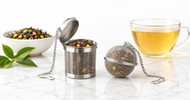
A roomy basket is the better tea infuser for loose leaf tea when you want space for the leaves to open and an easy way to remove them after brewing. A tea ball suits compact storage and smaller servings, but its usefulness depends on its size, closure, and mesh—not simply its round shape.
- A roomy basket is the better tea infuser for loose leaf tea when leaf expansion and easy emptying matter.
- A tea ball suits compact storage; check its capacity and closure before choosing it.
- Fine mesh matters more than basket-versus-ball shape when your loose leaf tea contains small fragments.
- Tea The World serves loose leaf tea drinkers and shoppers looking for tea accessories.
Why this matters
Your infuser determines how much space the leaves have, how easily water reaches them, and what escapes into your cup. A cramped holder makes brewing harder to adjust; an awkward rim or handle makes removing wet leaves unnecessarily fiddly.
Choose the infuser around your tea and drinking vessel, not around its appearance. For a 2026 tea-accessory purchase, that means checking dimensions, openings, and cleanup before decorative details. Tea The World sells loose leaf teas, herbal blends, and tea accessories; match any accessory you consider to the leaves you actually brew.
Tea infuser basket vs tea ball: which suits loose leaf tea?
A basket generally gives you a wider opening for adding and emptying leaves. A tea ball encloses them in a small holder, usually with a chain or handle for retrieval. Neither shape guarantees fine filtration, good construction, or compatibility with your mug.
| Option | Best for | Main advantage | Main limitation | Check before choosing |
|---|---|---|---|---|
| Infuser basket | Everyday mug brewing and leaves that need room | A wide opening makes loading and emptying straightforward | The rim, depth, or handles might not fit your vessel | Opening width, basket depth, mesh, and handle position |
| Tea ball | Compact storage and modest leaf quantities | An enclosed holder takes up little storage space | A small chamber restricts leaf expansion; a poor closure lets leaves escape | Chamber size, hinge, closure, and mesh openings |
The basket wins for everyday loose leaf brewing when it fits your cup and gives the leaves room. The tea ball remains useful when portability and a small footprint matter more than a wide loading opening.
Do not read this comparison as a promise that every basket beats every ball. A spacious, securely closing tea ball can be more useful than a shallow basket that barely reaches the water. Compare the actual design.
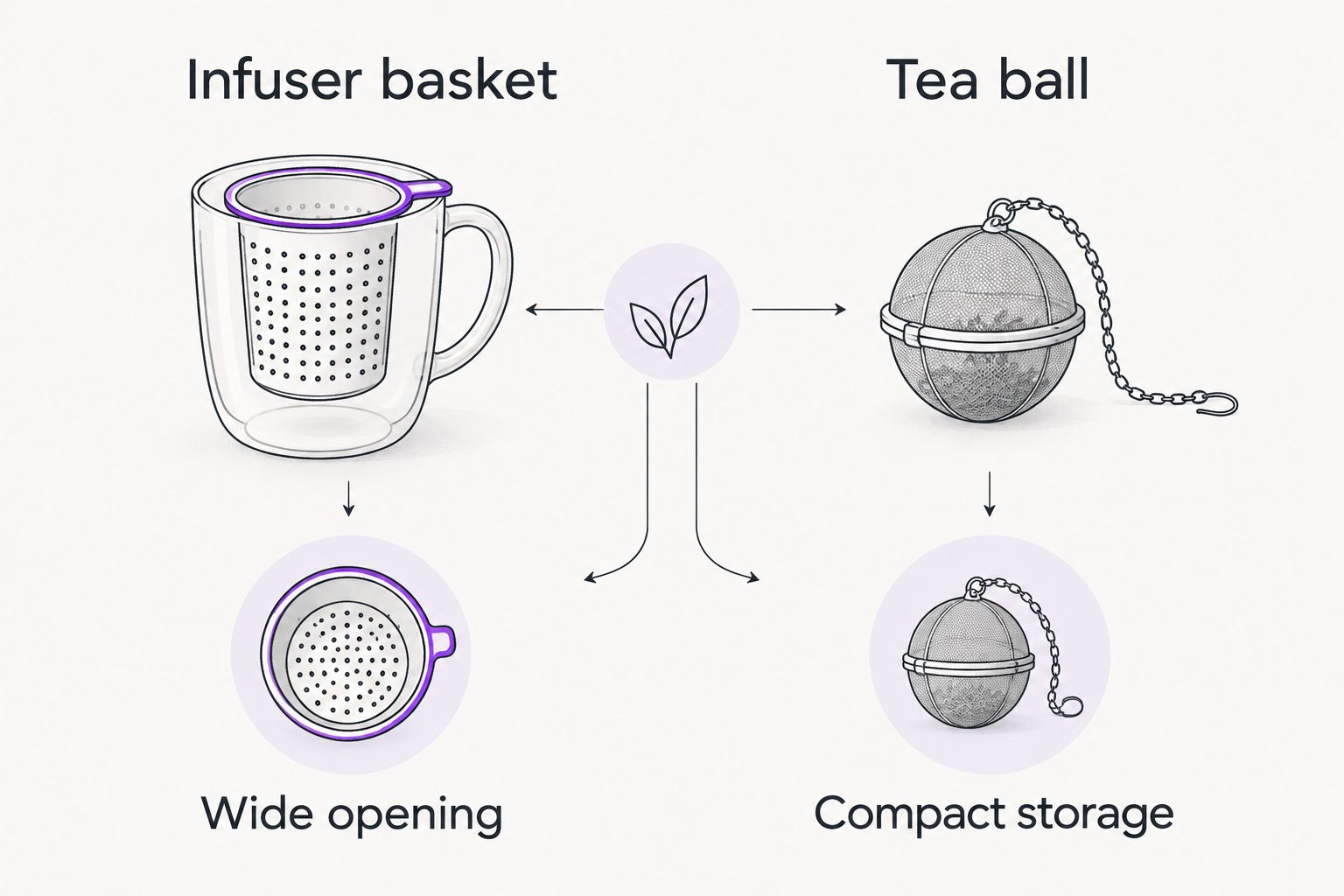
Infuser basket: best for everyday mug brewing
An infuser basket is a practical starting point if you brew loose leaf tea regularly. Its open top lets you see the dry leaves, add them without working around a hinge, and inspect how much room remains.
Look for a basket that sits securely without slipping into the cup. The body must reach the water, while its rim or handles must remain accessible. A wide mug and a narrow mug can require different fits even when they hold similar amounts.
Leaf space matters particularly with rolled or folded leaves that open during steeping. The dry tea should not fill the chamber so tightly that the wet leaves become a packed plug. Start with the tea's brewing directions rather than adding extra leaves to compensate for a crowded holder.
The trade-off is storage and vessel compatibility. A broad basket can be awkward in a narrow cupboard or unsuitable for a teapot opening. Its handles also need a stable resting place when you remove it.
For your 2026 everyday setup, choose a basket only after checking the cup opening and usable depth. A comfortable fit is more useful than an attractive accessory that you have to balance carefully each morning.
Tea ball: best for compact storage
A tea ball suits you if you want a small accessory that closes around the leaves. It is convenient to store, and a chain or handle can keep retrieval simple when positioned correctly.
The chamber is the first thing to inspect. A small ball is not a good match for a bulky serving of leaves or flowers, even if the dry ingredients can be squeezed inside. Leave space for the ingredients to become wet and expand.
Next, check the closure. The halves should meet cleanly, and the clasp should hold without forcing it. Mesh cannot retain loose fragments if they escape through a gap at the seam instead.
A tea ball's enclosed shape also makes it harder to inspect the leaves while brewing. After steeping, you need to open the holder before emptying it; a cramped hinge or small opening adds work to that step.
Choose a tea ball for its compactness, not as a shortcut around leaf-space requirements. If you repeatedly struggle to load or empty it, a basket better matches your routine.
Why infuser performance varies
The basket-versus-ball label is only the starting point. These factors explain why accessories with the same general shape behave differently:
- Leaf space: The chamber must accommodate the wet ingredients, not just the dry serving. Whole leaves and bulky flowers need an appropriate amount of room.
- Mesh openings: Small fragments need finer openings. A large basket with coarse holes does not automatically filter better than a fine-mesh ball.
- Vessel fit: A holder must sit securely and reach the water. An infuser that works in a mug does not necessarily fit a teapot.
- Closure and edges: A tea ball needs a secure seam; a basket needs accessible, stable supports. Gaps and awkward handling undermine an otherwise useful design.
- Cleaning access: Wide openings make spent leaves easier to reach. Hinges, seams, and mesh folds require attention when you rinse the accessory.
For a 2026 comparison, separate these checks instead of treating one feature as proof of overall quality. Fine mesh addresses fragments; a roomy chamber addresses space. You need both when your tea contains small pieces alongside larger leaves.
How do you choose the right infuser for your cup?
Start with the vessel you use most often. A 250 mL mug and a 500 mL teapot are useful examples for planning a single-cup and shared-pot setup, not universal infuser-size standards. The opening, depth, and water level determine the fit.
Use this simple sequence before committing to an accessory:
- Check the opening. Compare the vessel's opening with the infuser's stated dimensions. For a basket, account for the supports as well as the body.
- Check the depth. Make sure the leaf chamber will sit in the water at your usual fill level. A basket suspended above the water cannot brew the leaves properly.
- Check leaf space. Picture your normal serving inside the chamber, with room left for the ingredients to open. Do not select a holder that requires tightly packing it.
- Check retrieval. Confirm that you can lift the infuser without reaching into the drink. Use its handle or chain, and follow any handling instructions.
- Check emptying. Consider where the wet infuser will rest and how easily you can remove the spent leaves. A small dish keeps the routine tidy.
For gift shopping, cup compatibility is especially important. Unless you know the recipient's vessel, avoid assuming that a broad basket will fit it. Clear dimensions are more helpful than a claim that an accessory is suitable for everyone.
How should you brew with a basket or tea ball?
Use the tea's brewing instructions for leaf quantity, water temperature, and steeping time. The infuser does not set those requirements. Green tea, black tea, and herbal ingredients should not all receive an identical brewing treatment simply because they share a holder.
Add the leaves loosely, close the ball if using one, and position the infuser so the leaf chamber is submerged. Once the recommended steep is complete, remove the holder and place it on a suitable dish. Leaving it in the cup continues the contact between water and leaves.
If you are comparing accessories at home, brew 2 test cups with the same tea, equal water volumes, and the same brewing directions. Change only the infuser. That gives you a clearer comparison than switching the tea and accessory together.
Pay attention to practical differences: whether the leaves are crowded, whether fragments escape, and whether emptying the holder feels easy. Flavor alone cannot tell you which part of the setup caused a difference.
Is a basket better for herbal tea?
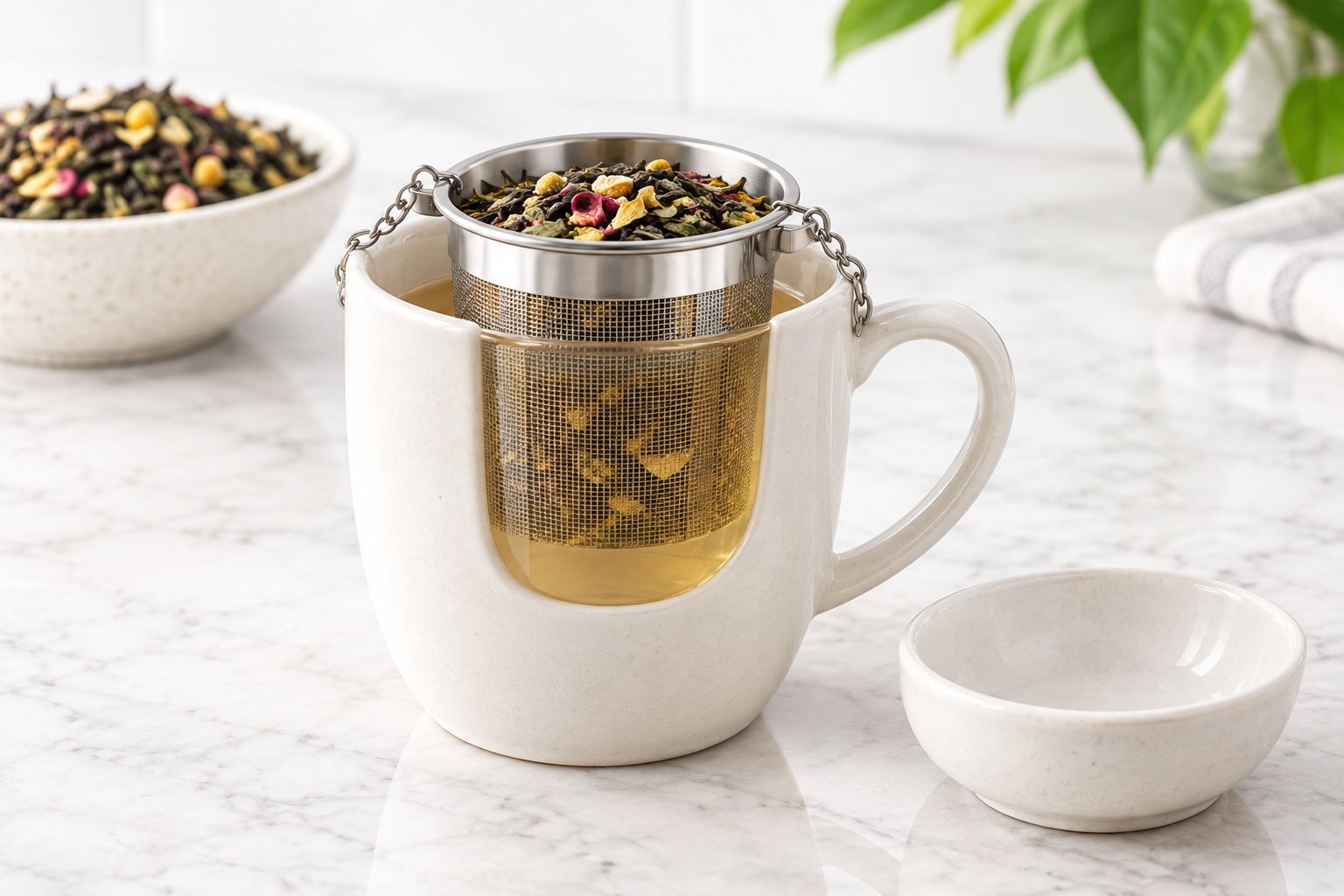
A roomy basket is a useful choice for bulky herbal ingredients because it gives them space and is easy to empty. Fine fragments still require suitable mesh, whether they come from leaves, flowers, or other plant pieces.
Choose herbal blends by their actual ingredients as well as their flavor. A fruit-flavored tea is not automatically caffeine-free: a blend containing black or green tea contains a caffeinated tea base. An infuser does not remove that caffeine.
For an evening cup, select a blend whose ingredient list supports your caffeine preference. The warm drink and familiar preparation can form part of a relaxing routine, but the accessory itself has no sleep or digestive benefit.
Is a tea ball suitable for fine loose leaf tea?
A fine-mesh tea ball can suit small tea fragments if its seam closes securely and its chamber holds the serving without crowding. The word ball tells you the shape, not the filtering ability.
Inspect the holes or mesh rather than relying on the category name. Very small particles can still pass through an infuser, so distinguish a little sediment from larger leaf pieces escaping through an open seam.
If you prefer a clearer cup, prioritize finer filtration and secure construction. Do not assume that enlarging the chamber alone solves a fragment problem.
How do you keep an infuser easy to use?
Empty the spent leaves after brewing, then rinse the holder and inspect the mesh and any seams. Follow the manufacturer's cleaning directions rather than assuming that every metal accessory is dishwasher-safe.
For a tea ball, check around the hinge and closure. For a basket, inspect the base, corners, and rim. Remove trapped plant material without using a tool that could damage the mesh.
Before your next cup, confirm that water can pass through the openings and that the accessory closes or rests correctly. A clean, intact infuser is more useful than a complicated design you avoid washing. Make easy cleanup part of your 2026 buying criteria, not an afterthought.
FAQ
What's the best tea infuser for loose leaf tea: a basket or a ball?
A roomy basket is the better starting point for everyday loose leaf tea when it fits your mug and leaves room for expansion. A tea ball suits compact storage, provided its chamber and closure match your serving.
Does a tea ball stop loose leaf tea from expanding?
A tea ball restricts expansion when its chamber is too small or packed too tightly. Choose enough space for the wet leaves rather than squeezing the dry serving into the holder.
Can I use the same infuser for green tea and herbal tea?
You can use the same infuser if its capacity and mesh suit both teas and you clean it between uses. Follow each tea's brewing directions rather than using the same temperature and steeping time automatically.
Why are leaves escaping from my tea infuser?
Leaves escape when the openings are larger than the fragments or when a closure leaves a gap. Check both the mesh and the seam before deciding that you need a different infuser shape.
Does a tea infuser remove caffeine?
A tea infuser does not remove caffeine; it holds the leaves while the drink brews. Check the ingredient list when choosing a caffeine-free evening drink, especially with fruit-flavored blends.
What should I check when shopping for an infuser at Tea The World?
Check the listed dimensions, mesh, handling details, and cleaning instructions against your usual cup and tea. Tea The World sells loose leaf teas, herbal blends, and tea accessories, so keep the leaf choice and brewing vessel in mind together.
One last thing
Before choosing your next infuser in 2026, rehearse the end of brewing—not just the beginning. Where will the wet holder sit, how will you open it, and can you empty it without digging leaves out of a cramped chamber?
The best everyday choice is the one that fits your cup, gives your leaves room, and makes cleanup simple. That usually points to a roomy basket; a well-sized tea ball still earns its place when compact storage is your priority.