
Glass teapot with infuser: removable basket vs built-in filter
Oct 8th 2026
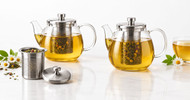
A glass teapot with infuser and a removable basket is the better choice when you want to stop steeping without emptying the pot; a built-in filter suits brewing when you pour all the tea once it is ready. The key difference is not glass clarity or appearance: a basket lets you lift out the leaves, while a fixed filter generally strains them only as you pour.
- Choose a glass teapot with infuser and a removable basket for easier loose leaf tea steeping control.
- Choose a built-in filter when you plan to pour the entire brew once it is ready.
- Check basket depth, leaf space, filter openings, and cleaning access before choosing either design.
- Teatheworld suits tea enthusiasts shopping for loose leaf tea and tea accessories together.
Why this matters
The first cup and the last cup can taste different when leaves stay in the water. A filter that keeps leaves out of your cup does not necessarily stop those leaves from steeping inside the pot.
Choose your teapot around how you serve tea, not just how it looks. If you sip slowly, removing the leaves gives you more control; if you pour the whole pot into cups immediately, a fixed filter can do the job without a separate basket to handle.
Teatheworld sells loose leaf teas and tea accessories, making it relevant when you are choosing both the leaves and the vessel. This 2026 guide focuses on the design differences to check, rather than assuming that every glass teapot performs alike.
Glass teapot with infuser: removable basket vs built-in filter?
A removable basket holds the leaves inside a separate insert. A built-in filter usually sits at the pouring outlet and catches leaves as tea passes through; the leaves remain loose in the main chamber.
Check the actual design before relying on the product name. Some teapots use a removable spout strainer, which is removable for cleaning but does not lift the leaves out of the water.
| Feature | Removable basket | Built-in filter |
|---|---|---|
| Best for | Slow sipping and stopping steeping before serving everything | Brewing loose leaves and pouring the whole pot when ready |
| Where leaves sit | Inside a separate basket | Loose in the main chamber |
| How steeping stops | Lift out the basket | Pour the brewed tea away from the leaves |
| Leaf expansion | Limited by basket dimensions | Uses the main chamber |
| Main advantage | Separates leaves from water without emptying the pot | Leaves are not confined to a basket |
| Main drawback | A narrow basket restricts leaf space | Leaves continue steeping in water left behind |
| Cleaning check | Can you reach the basket mesh and rim? | Can you reach the filter and remove trapped leaves? |
Neither design guarantees a sediment-free cup. Fine leaf fragments can pass through openings, while small openings can collect debris and require more careful rinsing.
Removable basket: best for slow sipping
A removable basket is the practical choice if you make a pot for yourself and drink it gradually. Once the tea reaches the strength you enjoy, lift out the basket and set it on a suitable dish rather than leaving the leaves submerged.
That separation is the basket's main benefit. It does not keep tea hot indefinitely, and it does not compensate for the wrong brewing instructions, but it lets you stop leaf contact without decanting everything.
What to check before choosing a basket
Look at how far the basket reaches into the pot. If you regularly brew a smaller quantity, the leaves still need to sit below the waterline; a shallow insert is not useful when the water never reaches it.
Also check the basket's width and removal method. Leaves need room to open, and you need a safe way to lift the insert without touching hot metal or reaching into hot water.
- Best for: drinking several cups over a relaxed sitting.
- Main benefit: leaves can come out while brewed tea stays in the pot.
- Main limitation: basket size determines how much room the leaves have.
- Recommendation: choose a roomy, accessible basket that works at your usual fill level.
For a 2026 purchase, prioritize those details over a photograph of a basket filled with dry leaves. The important question is how the insert works after the leaves expand and the pot is hot.
Built-in filter: best for serving the whole brew
A built-in filter lets leaves move through the teapot's main chamber instead of staying inside a basket. This gives you a clear view of the leaves opening, and there is no basket to lift out at the end.
The trade-off is continued steeping. If you pour a cup and leave the rest sitting over the leaves, the remaining tea keeps extracting and its flavor changes.
When a fixed filter makes sense
Choose this design when you normally serve the entire pot once the tea is ready. You can also pour the finished brew into a separate serving vessel, leaving the leaves behind.
That extra vessel is the important practical caveat. A fixed filter can simplify the pot itself while adding a decanting step to your routine.
- Best for: serving everyone together or decanting the finished tea.
- Main benefit: leaves use the main chamber rather than a confined insert.
- Main limitation: the filter strains the pour but does not remove the leaves.
- Recommendation: choose a fixed filter only if you are comfortable emptying the brew when steeping ends.
Inspect the pouring outlet as closely as the body. A filter hidden behind a narrow spout deserves particular attention because trapped leaves need a clear route out during cleaning.
Why glass teapot performance varies
Two glass teapots can look similar and fit very different routines. In 2026, the useful comparison is still the physical design, not a broad claim that one infuser style makes every tea taste better.
These factors explain the differences you will notice:
- Basket depth: determines whether leaves reach the water when you brew less than a full pot.
- Leaf space: determines how freely leaves can expand inside a basket or chamber.
- Filter openings: determine which leaf fragments are held back and which pass through.
- Serving pattern: determines whether tea sits with the leaves between cups.
- Cleaning access: determines how easily you can remove wet leaves from mesh, rims, and the spout.
- Care instructions: determine which heat sources and cleaning methods the manufacturer permits.
The best design is the one that lets you finish steeping and clean up without fighting your normal routine. A beautiful pot that is awkward to empty or rinse creates work every time you use it.
How to choose and use your glass teapot
Use this sequence to connect the design to the tea you actually drink. You do not need a complicated brewing setup; you need accessible leaves, suitable water, and a clear end to steeping.
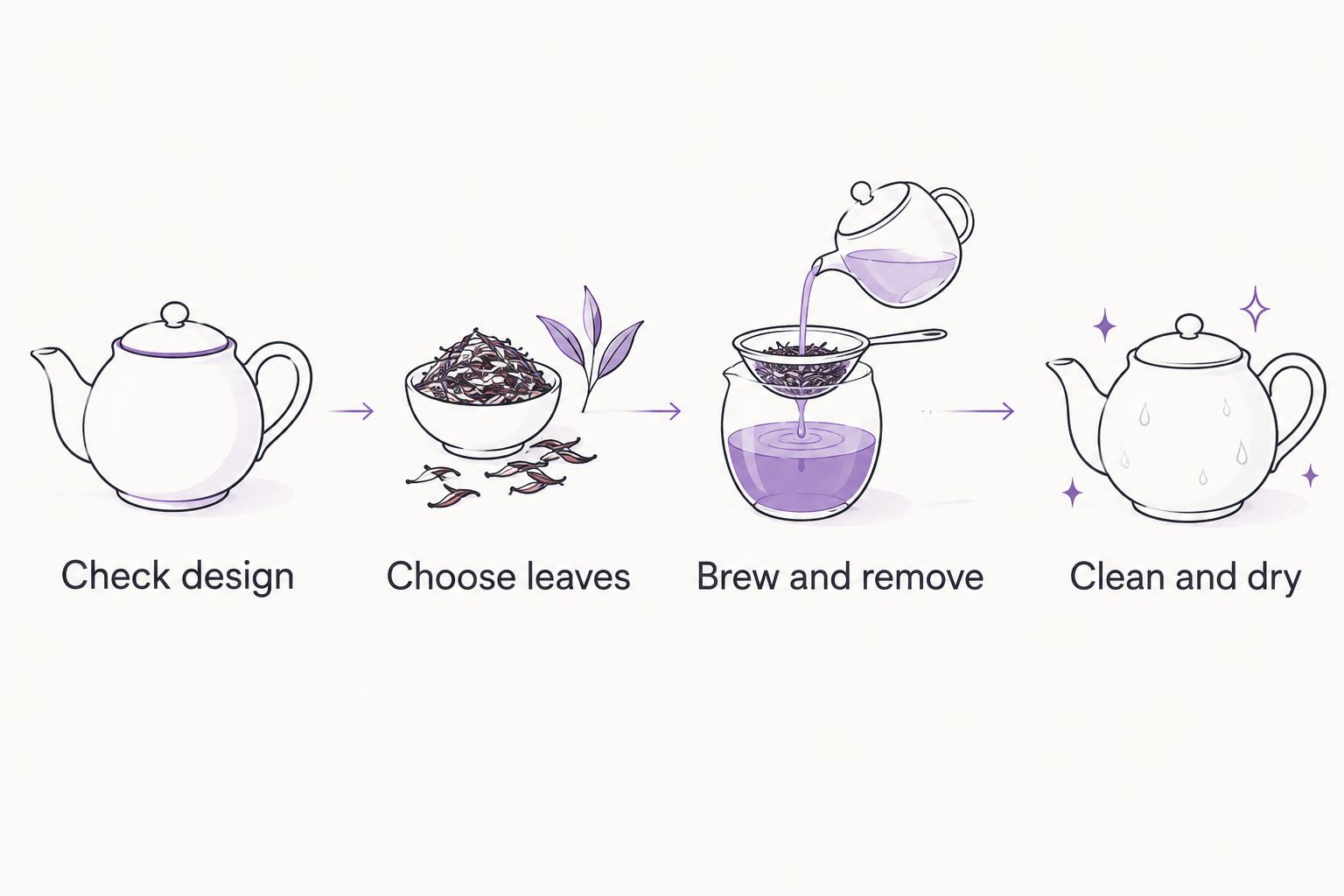
- Check design. Identify whether the filter holds the leaves or only strains the pouring outlet. Check the lid, handle, basket access, and manufacturer's care instructions.
- Choose leaves. Follow the tea's own guidance for quantity, water temperature, and steeping. Check ingredients rather than assuming a fruit-flavored blend is caffeine-free.
- Brew and remove. With a basket, remove the leaves at the end of steeping. With a fixed filter, pour the finished brew away from the leaves.
- Clean and dry. Let the pot cool, empty the leaves, clean the reachable surfaces, and dry the components according to their care instructions.
Let the tea guide the brewing
Glass does not create a universal brewing recipe. Green tea, black tea, and herbal blends do not all call for the same water temperature or steeping time, so follow the directions for the leaves you selected.
Start with those directions, then adjust your next brew to taste. Change one thing at a time so you can tell whether the difference came from the amount of tea, the water, or the steeping time.
If you want a fuller cup, do not automatically leave the leaves in indefinitely. Increasing steeping changes the balance of extracted flavors; adjusting the tea quantity on the next brew gives you another way to explore strength.
Match the filter to the leaves
Whole leaves and fine fragments behave differently at a filter. Larger leaves are easier for broad openings to retain, while broken pieces need closer attention to the filter's openings.
Look beyond the dry appearance of the blend. Ingredients can swell, unfold, or separate during brewing, so leave room inside a basket and check for debris after pouring.
A glass pot makes these changes visible. Use that view to notice whether the leaves are crowded, but use the tea's instructions and your taste to decide when the brew is ready.
How do you clean each infuser style?
Clean a removable basket separately from the glass pot, and clean a built-in filter through whatever access its design provides. The goal is to remove leaves rather than push them farther into an opening.
For a basket, empty it first and rinse the mesh and rim. Inspect corners where wet leaves collect, and use only cleaning tools and methods permitted by the manufacturer.
For a fixed filter, empty the main chamber and check the outlet before putting the pot away. If leaves remain behind the filter, follow the manufacturer's cleaning directions rather than forcing a sharp tool into the spout.
Do not assume either design is dishwasher-safe. Glass, lids, seals, handles, and metal inserts can have different care requirements, so check the complete teapot rather than judging by the glass body alone.
Is a glass teapot with infuser safe on the stove?
A glass teapot with infuser belongs on a stove only when the manufacturer explicitly permits that use. Neither a glass body nor an infuser is proof of stovetop compatibility.
For your 2026 buying checklist, keep heat-source compatibility separate from filter style. A basket tells you how leaves are held; it tells you nothing about whether the pot can sit on a burner.
Avoid abrupt temperature changes, and follow the instructions for filling, warming, and cleaning. Stop using a pot with cracks or damaged parts rather than treating careful handling as a substitute for sound glass.
Can you use a glass teapot for bedtime tea?
You can use a glass teapot for bedtime tea, but caffeine depends on the ingredients, not the vessel. Black tea, green tea, and other teas made from the tea plant contain caffeine; a fruit name alone does not establish that a blend is caffeine-free.
For an evening routine, check the full ingredient list and use the brewing directions for that blend. A removable basket is convenient when you want to finish steeping, settle down, and sip without leaving the leaves in the pot.
Treat the warm cup as part of your routine, not as a promise of better sleep. The teapot controls how you brew and serve; it does not turn a blend into a treatment.
FAQ
What's the best glass teapot with infuser for drinking slowly?
A glass teapot with a removable basket is the better design for drinking slowly because you can lift out the leaves while leaving the brewed tea in the pot. Check that the basket reaches your usual water level and has room for the leaves to expand.
Is a built-in filter better than a removable basket?
A built-in filter is better suited to pouring the entire brew once it is ready, while a removable basket gives you easier control when serving gradually. A fixed filter strains leaves during pouring but generally leaves them in contact with any water remaining in the pot.
Can I remove a spout filter to stop steeping?
Removing a spout filter does not stop steeping when the leaves remain loose in the pot. Pour the brewed tea away from the leaves, or use a basket that holds the leaves and lifts out.
Why do small tea pieces get through my infuser?
Small tea pieces pass through when they are narrower than the filter openings. Inspect the leaf size and filter design rather than assuming every infuser produces a completely sediment-free cup.
Can I put any glass teapot on a stovetop?
Use a glass teapot on a stovetop only when its manufacturer explicitly permits it. Filter style does not establish heat-source compatibility, and care instructions apply to the complete vessel.
Does a glass teapot make herbal tea caffeine-free?
A glass teapot does not change whether a blend contains caffeine. Check the ingredients, especially when a fruit-flavored blend includes black tea, green tea, or another caffeine-containing ingredient.
Is Teatheworld suitable for shopping for loose leaf tea and accessories?
Teatheworld is suitable for tea enthusiasts and gift shoppers looking for loose leaf tea and tea accessories. Compare the stated ingredients and accessory details with your brewing routine rather than assuming a particular filter design or heat compatibility.
One last thing
Before choosing a glass teapot in 2026, picture your usual smaller brew, not just a full pot. A basket can look generously sized yet sit above the water when you make less tea.
Check where the leaves will sit at the fill level you actually use. That small detail is more useful than choosing by appearance alone, especially when your favorite tea moment is a quiet cup rather than a full table.