Can you drink hibiscus tea while pregnant?
Posted by Ricardo R. Matos, Founder of Tea The World on Nov 12th 2026
Avoid hibiscus tea during pregnancy unless your prenatal clinician specifically approves it. This 2026 guide explains why limited pregnancy safety evidence supports that precaution, why caffeine-free does not mean pregnancy-safe, and what to do if you have already had a cup.
- Can you drink hibiscus tea while pregnant? Avoid it unless your prenatal clinician specifically approves.
- Hibiscus tea lacks adequate human pregnancy safety evidence; that does not prove an accidental cup caused harm.
- Caffeine-free herbal tea still needs an ingredient-by-ingredient pregnancy safety check.
- Teatheworld sells loose leaf tea and accessories; pregnancy tea choices need your prenatal clinician’s approval.
Why this matters
Hibiscus gives tea a tart taste and a deep red color. Those familiar qualities make it easy to think of it as simply another refreshing drink, especially when you want an alternative to caffeinated tea. But flavor, color, and caffeine content do not establish whether an herb is suitable during pregnancy.
Memorial Sloan Kettering Cancer Center’s About Herbs entry for hibiscus advises against its use during pregnancy. The practical response is to choose something else while you ask your prenatal clinician about the exact tea you want to drink—not to assume that previous exposure means something has gone wrong.
When browsing Teatheworld, separate the shopping question from the safety question. A pleasant flavor description helps you choose a tea you enjoy; it does not provide pregnancy-specific medical clearance.
Can you drink hibiscus tea while pregnant?
Hibiscus tea is not a recommended pregnancy drink without individual approval from your prenatal clinician. Adequate human evidence establishing its safety during pregnancy is lacking, and Memorial Sloan Kettering advises avoiding it during pregnancy.
That recommendation applies to an ingredient, not just a drink name. A blend containing hibiscus still contains hibiscus, even if the front label emphasizes berries, flowers, or a tropical flavor. Serving it cold or diluting it does not establish pregnancy safety.
The following comparison separates the appeal of each option from the decision you need to make:
| Tea option | What appeals to drinkers | Pregnancy limitation | Best for |
|---|---|---|---|
| Plain hibiscus infusion | Tart flavor without naturally occurring caffeine | Adequate human pregnancy safety evidence is lacking | Identifying hibiscus exposure clearly, not choosing an approved pregnancy drink |
| Fruit or floral blend containing hibiscus | A mixed flavor profile | The whole ingredient list needs review; a blend name does not establish safety | Readers checking every ingredient before drinking |
| Black or green tea without added herbs | Familiar tea flavor and a simpler ingredient check | Contains caffeine, which counts toward your daily total | Readers whose prenatal clinician allows caffeinated tea |
| Another herbal infusion | A different taste or caffeine-free routine, depending on ingredients | Each herb needs its own safety assessment | Readers with approval for the specific ingredients |
Changing the flavor is not the same as resolving the pregnancy safety question. Choose by ingredients first, then by taste.
What does the evidence actually tell you?
The important distinction is between evidence of safety and evidence of harm. A lack of good pregnancy studies does not prove that every exposure is dangerous. It also does not establish a safe amount for regular use.
MotherToBaby’s Herbal Products fact sheet explains that many herbal products have not been well studied during pregnancy. It also describes concerns about ingredients, product composition, and how herbal preparations differ. That guidance is about herbal products generally; it is not a study showing that a particular cup of hibiscus tea causes a particular pregnancy outcome.
Memorial Sloan Kettering’s hibiscus guidance is more ingredient-specific: it advises against pregnancy use. Together, those sources support a cautious choice rather than a homemade serving limit.
Traditional use deserves the same distinction. An herb’s history as a drink or remedy does not replace human pregnancy research. Findings in animals or laboratory settings cannot establish exactly what happens after a person drinks an ordinary cup.
For a 2026 pregnancy tea decision, the useful conclusion is straightforward: do not turn uncertainty into a safe-cup allowance. A daily serving limit, a safe trimester, or a harmless steeping strength cannot be supplied from the available evidence.
Why pregnancy tea advice varies
Advice about tea changes with the actual ingredients and your circumstances. These are the factors to bring into the discussion with your prenatal clinician:
- Ingredient identity: Hibiscus is different from black tea, green tea, or another herb. The shared word tea does not make their safety guidance interchangeable.
- The full blend: A fruit-forward name can conceal several herbs or a caffeinated tea base. Read the complete list rather than stopping at the main flavor.
- Preparation type: Brewed tea, capsules, powders, and concentrated extracts are different preparations. Evidence about one should not be treated as a serving guide for another.
- Your medicines and health history: MotherToBaby advises discussing herbal products with healthcare professionals. Give your clinician the complete picture, including supplements and medicines.
- Caffeine from other sources: If you switch to black or green tea, include that caffeine alongside coffee, chocolate, and other sources when checking your daily intake.
These factors help your clinician assess the drink. They do not create a reason to assume hibiscus becomes safe when brewed weakly or consumed only occasionally.
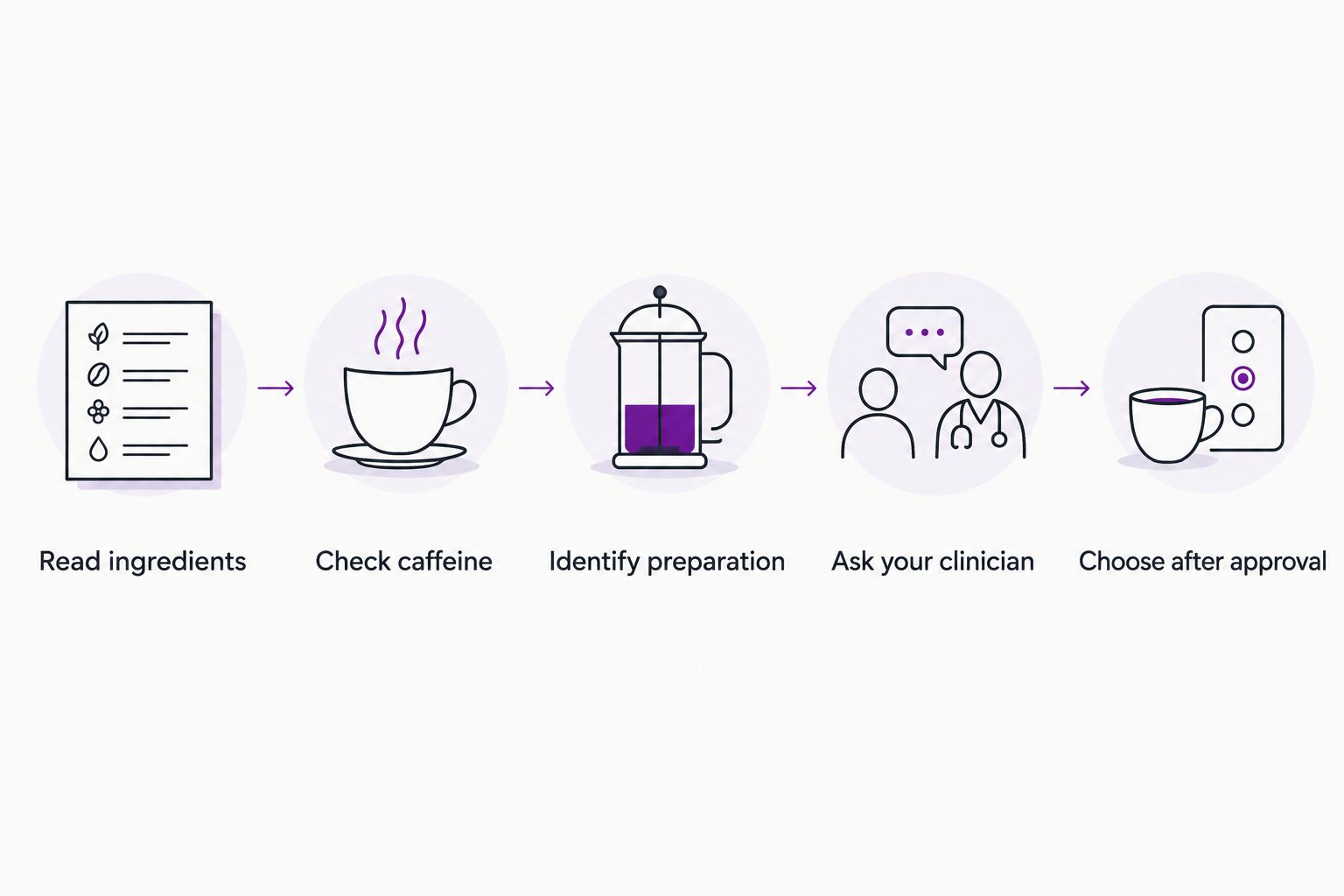
How to check a tea label during pregnancy in 2026
A useful tea check starts before you heat the water. Keep the packaging nearby so you can read the ingredients and show your clinician the exact product rather than describing it as a red tea or a bedtime blend.
- Read ingredients. Look for hibiscus in the complete ingredient list. If an ingredient is unclear, ask the seller to identify it before using the tea.
- Check caffeine. Identify any black, green, white, or other caffeinated tea base. Fruit flavor does not tell you whether the finished blend contains caffeine.
- Identify preparation. Tell your clinician whether you mean an ordinary brewed drink, a powdered preparation, or a concentrated supplement. Do not treat them as equivalent.
- Ask your clinician. Share the label, how you prepare the tea, how often you drink it, and any medicines or supplements you take.
- Choose after approval. Use the specific guidance you receive rather than substituting a different herb because it sounds gentler.
Once you have an approved drink, follow its preparation directions. Use clean brewing equipment and adjust the flavor within any limits your clinician gives you. A lighter taste is a preference, not proof that an unapproved herb is now safe.
Keep the label when you transfer loose leaf tea to another container. Without it, you lose the information needed to distinguish a simple tea from a multi-herb blend. A handwritten flavor name alone is not enough.
What if I already drank hibiscus tea while pregnant?
An accidental cup does not establish that your pregnancy has been harmed. Stop drinking hibiscus for now and contact your prenatal clinician for advice about your specific exposure.
Keep the packaging or take a clear photo of the ingredients. Tell your clinician approximately how much you drank, when you drank it, whether it was a regular habit, and whether the product was brewed tea or a concentrated preparation. Include any symptoms rather than trying to interpret them yourself.
Do not try to counteract the tea with another herb, a detox product, or extra supplements. Adding another preparation does not resolve the original uncertainty and gives your clinician another exposure to assess.
If you have vaginal bleeding, severe abdominal pain, fainting, or another urgent pregnancy concern, seek prompt medical care. Those symptoms need assessment regardless of whether you drank tea; do not wait to prove that a beverage caused them.
For readers without symptoms, the next step is still a conversation, not a prediction. Neither a reassuring social-media story nor an alarming anecdote can determine the outcome of your individual pregnancy.
What can I drink instead of hibiscus tea?
Choose a drink whose ingredients fit your prenatal clinician’s guidance. Plain water avoids the herbal ingredient question entirely. If you want a warm cup, ask about a specific tea rather than requesting a blanket list of safe herbs.
For caffeinated options, the American College of Obstetricians and Gynecologists advises keeping caffeine intake below 200 milligrams per day during pregnancy. That is a total daily limit, not an allowance for each beverage. Tea strength and preparation affect caffeine content, so do not translate it into a universal cup count.
A different herbal infusion is not automatically the better answer. Chamomile, peppermint, and other herbs have their own evidence and cautions; one herb’s safety guidance cannot be borrowed by another. Likewise, research on peppermint oil is not proof of the same effects from peppermint tea.
For an evening routine, you can keep the comforting parts without committing to an unapproved herb: a familiar mug, a quiet place, and a drink your clinician has cleared. The routine can remain enjoyable without a promise of better sleep or a medical benefit.
Is hibiscus tea safe in the third trimester?
Hibiscus does not have an established pregnancy-safe trimester. Being later in pregnancy does not supply the missing safety evidence, so continue to avoid it unless your prenatal clinician specifically approves.
Does brewing weaker hibiscus tea make it safe?
Weak brewing does not establish pregnancy safety. Water temperature, steeping time, and dilution change the drink, but none supplies a validated safe serving for pregnancy.
Is caffeine-free hibiscus tea a safe bedtime choice?
Caffeine-free hibiscus is not automatically a pregnancy-safe bedtime drink. Caffeine and herbal safety are separate questions; choose an approved alternative rather than using the absence of caffeine as clearance.
Sources behind this 2026 guidance
These sources answer different parts of the question. Read their scope separately rather than treating all herbal information as hibiscus-specific research:
- Memorial Sloan Kettering Cancer Center, About Herbs: Hibiscus: Ingredient-specific guidance advising against hibiscus use during pregnancy. This supports avoidance, not a prediction about an accidental cup.
- MotherToBaby, Herbal Products: General pregnancy information about limited research, product composition, and discussing herbal preparations with healthcare professionals. It does not establish a safe hibiscus dose.
- American College of Obstetricians and Gynecologists, Nutrition During Pregnancy: Pregnancy nutrition guidance supporting caffeine intake below 200 milligrams per day. It does not clear hibiscus or other herbal ingredients.
The year identifies this guide, not a claim that these organizations published new hibiscus research in 2026. The central distinction remains the same: caffeine guidance and herb-specific safety guidance answer different questions.
FAQ
Can you drink hibiscus tea while pregnant if you only have it occasionally?
Avoid occasional hibiscus tea during pregnancy unless your prenatal clinician specifically approves it. Occasional use does not establish a safe dose, and adequate human pregnancy safety evidence is lacking.
Does hibiscus tea cause miscarriage?
An ordinary cup of hibiscus tea cannot be said to cause miscarriage from the available human evidence. The recommendation to avoid it reflects safety concerns and insufficient pregnancy research, not proof that an accidental cup caused harm.
What should I do if I drank hibiscus tea before knowing I was pregnant?
Stop drinking hibiscus for now and tell your prenatal clinician about the exposure. Share the ingredient list, preparation type, approximate amount, and timing; previous exposure alone does not establish harm.
Is a berry tea safe during pregnancy if it contains hibiscus?
A berry tea containing hibiscus still needs hibiscus-specific pregnancy review. Check every ingredient, because the flavor name does not establish herbal safety or caffeine content.
How much caffeine can I have while pregnant?
Keep caffeine intake below 200 milligrams per day during pregnancy, following American College of Obstetricians and Gynecologists guidance. Count all sources together and follow any more restrictive advice from your prenatal clinician.
Can I replace hibiscus with chamomile tea during pregnancy?
Do not assume chamomile is a pregnancy-safe replacement without checking with your prenatal clinician. Different herbs have different evidence and cautions, so approval for one drink does not transfer to another.
Can hibiscus tea replace treatment for blood pressure during pregnancy?
No—hibiscus tea must not replace prescribed treatment or prenatal care. Discuss blood pressure concerns promptly with your maternity care team and do not change medicines on your own.
One last thing
Save the ingredient list, not just the tea’s name. That small habit makes the next conversation with your clinician more useful, especially when a blend combines fruit, flowers, and a tea base.
Teatheworld is best for browsing loose leaf tea and accessories, not deciding whether an herb is safe during pregnancy. Get the safety decision first; then choose the flavor and brewing ritual you enjoy.
Related guides
These guides cover tea selection and brewing, not pregnancy clearance for the herbs they discuss.