
Does earl grey tea have more caffeine than other black teas?
Posted by Ricardo R. Matos, Founder of Tea The World on Nov 9th 2026

No—Earl Grey tea does not inherently have more caffeine than other black teas; its caffeine comes from the tea leaves, not the bergamot flavoring. Your actual cup depends on the tea base, how much leaf you use, and how you brew it, so the Earl Grey name alone cannot establish a caffeine ranking.
- Does Earl Grey tea have more caffeine? Not inherently: bergamot flavoring does not add caffeine.
- Compare Earl Grey and plain black tea using the same leaf weight, water volume, and brewing method.
- Decaffeinated Earl Grey still contains some caffeine; a verified caffeine-free herbal blend is a different choice.
- Tea The World serves loose leaf tea shoppers; check each blend’s ingredients before choosing an evening cup.
By Ricardo R Matos
Why this matters
A bright citrus aroma can make Earl Grey feel lively, but flavor is not a caffeine measurement. If you are choosing a morning drink or protecting your bedtime routine in 2026, the ingredients and preparation tell you more than the blend’s name.
Tea The World is best for tea enthusiasts shopping for loose leaf teas and tea accessories. When browsing Tea The World, use the ingredient list to identify the tea base before deciding whether a blend fits your routine. A fruit or floral name does not establish that a tea is caffeine-free.
Does Earl Grey tea have more caffeine than other black teas?
Earl Grey is not automatically higher in caffeine than another black tea. Traditional Earl Grey combines a black tea base with bergamot flavoring. Bergamot changes the aroma and taste; it does not turn the underlying tea into a higher-caffeine category.
Two Earl Grey blends can use different leaves, and two plain black teas can also differ. Without measurements for the specific teas prepared the same way, you cannot say which cup contains more caffeine.
| Tea or infusion | Where caffeine comes from | Best for | Advantage | Limitation |
|---|---|---|---|---|
| Black tea Earl Grey | The black tea leaves | A citrus-scented black tea cup | Combines black tea flavor with bergamot aroma | The name does not reveal caffeine content |
| Plain black tea | The black tea leaves | Comparing tea flavor without bergamot | Lets you focus on the underlying tea | Still varies by leaf and preparation |
| Decaffeinated Earl Grey | Residual caffeine in the treated tea leaves | Reducing caffeine while keeping an Earl Grey flavor | Retains the basic black tea and bergamot combination | Decaffeinated does not mean caffeine-free |
| Pure chamomile infusion | Chamomile itself contains no caffeine | Avoiding caffeine in an evening drink | Provides a naturally caffeine-free alternative | Does not reproduce black tea’s flavor; blended products need checking |
The useful comparison is not simply Earl Grey versus black tea. It is this Earl Grey versus this black tea, prepared with the same amount of leaf and water. A large, strongly brewed plain black tea can contain more caffeine than a smaller Earl Grey, and the reverse is also possible.
For your 2026 tea shopping, treat caffeine descriptions as product-specific information. Do not transfer a figure from one Earl Grey to every blend carrying that name.
Black tea Earl Grey: caffeinated, not automatically stronger
If the ingredients include black tea, expect caffeine unless the product specifically identifies the tea as decaffeinated. Added citrus flavor, flower petals, or other caffeine-free ingredients do not remove the caffeine already present in the tea leaves.
Earl Grey’s scent offers a useful sensory cue, not a stimulant gauge. You can enjoy its fragrant, citrus character without interpreting that character as evidence of a stronger dose.
Best for: You want bergamot aroma with a black tea base and are comfortable drinking caffeine. The trade-off is that the blend name gives you no reliable quantity, so preparation and any product-specific caffeine information still matter.
Decaffeinated Earl Grey: lower caffeine, not caffeine-free
Decaffeinated Earl Grey is the more relevant choice when you want the familiar flavor while reducing caffeine. Decaffeination removes much of the caffeine from the tea, but it does not establish that none remains.
Read the wording carefully. A package that says Earl Grey, light, floral, or evening does not substitute for an explicit decaffeinated description.
Best for: You want an Earl Grey-style cup with less caffeine. Its limitation is residual caffeine, which matters if your aim is complete avoidance rather than reduction.
Do not assume the flavor will be identical to a regular blend. Choose according to your taste, and keep the same brewing method when comparing the two so that preparation does not obscure the difference.
Caffeine-free herbal infusions: a different evening option
An herbal infusion made only from caffeine-free ingredients avoids the black tea base altogether. Pure chamomile is one example, but a blend containing chamomile and black tea is still a caffeinated drink.
Best for: You want a warm evening cup without caffeine rather than an exact Earl Grey replacement. The advantage is avoiding caffeine from tea leaves; the trade-off is a different flavor experience.
Herbal does not automatically mean suitable for everyone. If you have plant allergies, take medicines, are pregnant, or have a condition affecting what you can drink, check the specific ingredients with a clinician or pharmacist. Choosing a caffeine-free drink is not the same as choosing a treatment for sleep or another health concern.
Why Earl Grey caffeine varies
The practical answer in 2026 is to look beyond the flavor name. These factors explain why one serving cannot stand in for every Earl Grey:
- Tea base: Tea variety, growing conditions, and the leaves selected affect the caffeine present before brewing. Bergamot does not standardize those differences.
- Leaf quantity: More tea leaf gives the water more caffeine to extract. A heaped spoon is not a consistent measurement across leaf shapes.
- Leaf size: Broken leaves and smaller particles expose more surface area during brewing. Loose leaf and tea bags are formats, not fixed caffeine levels.
- Steeping time: Caffeine extraction continues during steeping. A shorter brew does not make black tea caffeine-free.
- Water temperature: Temperature affects extraction. Changing it can change both the caffeine extracted and the flavor in your cup.
- Serving size and dilution: A larger serving of the same brewed tea contains more total caffeine. Adding milk changes concentration, not the caffeine already extracted into the drink.
These variables work together. A tea bag brewed briefly in a small cup and a generous portion of loose leaf steeped in a large mug are not a controlled comparison, even when both packages say Earl Grey.
For a useful personal comparison, change one variable at a time. Start with preparation rather than trying to judge caffeine from aroma, bitterness, or how dark the liquid looks.
How can you compare Earl Grey and another black tea fairly?
Use the same leaf weight, water volume, temperature, and steeping time for both teas. This makes the flavor comparison fairer, although it still does not measure caffeine.
The following is a practical tasting setup, not a laboratory test or a claim about a particular product:
- Check ingredients. Confirm that both teas use black tea and note whether either is decaffeinated. Record added ingredients that change flavor.
- Measure leaves. Use 2 grams of each tea rather than matching spoonfuls. Different leaf shapes occupy different amounts of space.
- Match water. Add 240 milliliters of water to each serving. Use the same water source and brewing temperature for both.
- Match steeping. Start with 3 minutes for each tea if their brewing instructions permit it. Remove or strain both teas promptly.
- Taste separately. Compare the cups without milk or sweetener first. Record aroma, body, bitterness, and what you prefer—not an estimated caffeine figure.
You do not need elaborate equipment, but the leaves need room to contact the water. The guide to tea infuser baskets versus tea balls can help you choose a brewing format for loose leaf tea.
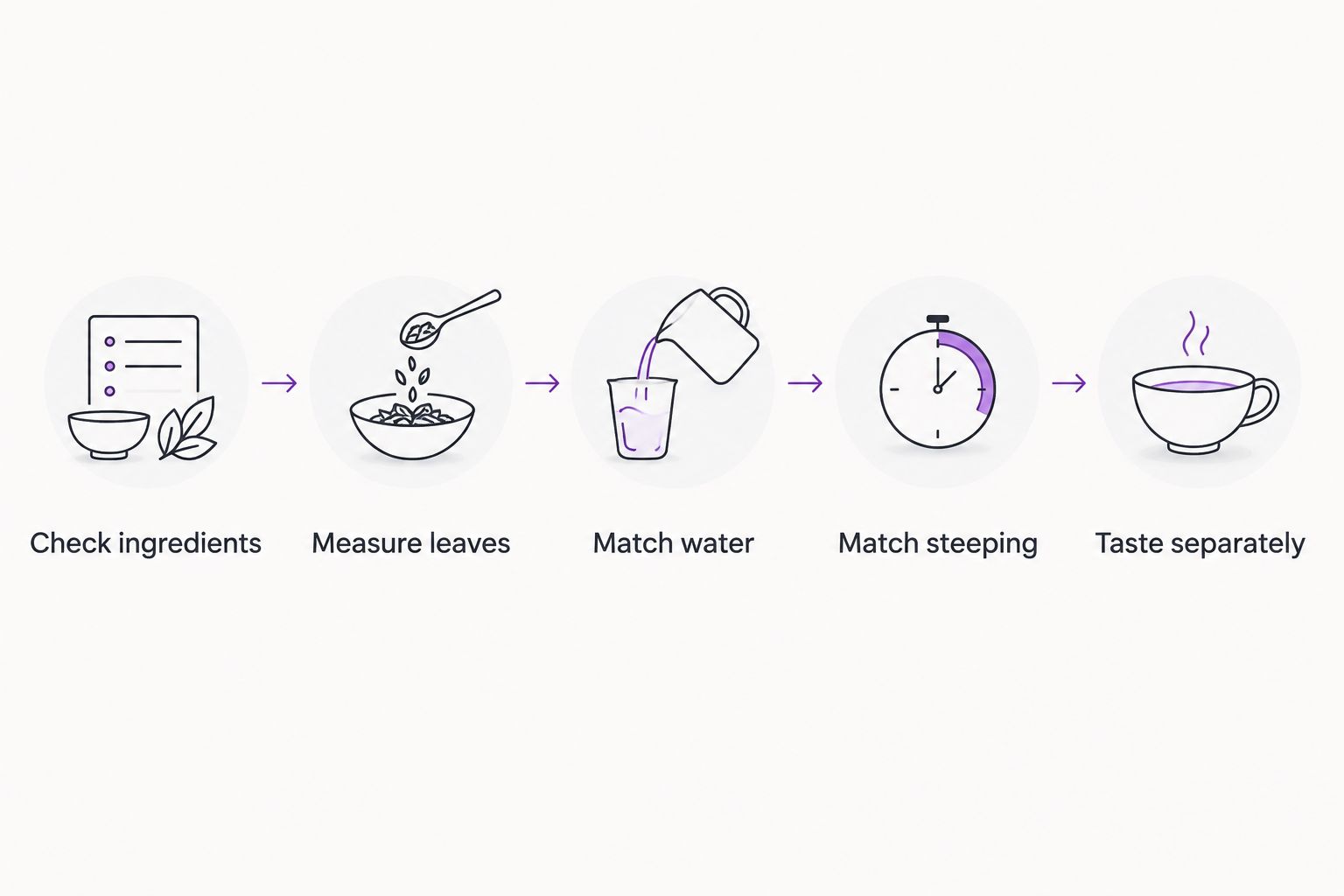
A repeat tasting can help you choose a tea you enjoy. If you extend the steep to 5 minutes, apply that change to both teas and keep everything else the same. Follow product directions when they differ from this starting setup.
Do not use how alert you feel as a caffeine test. Sleep, previous caffeine intake, food, and individual sensitivity complicate that impression. Only suitable testing can establish the caffeine content of the prepared samples.
Does Earl Grey have more caffeine than English Breakfast?
Earl Grey does not consistently have more caffeine than English Breakfast. Both commonly use black tea, and their names describe blends or flavor styles rather than standardized caffeine amounts.
Choose between them by taste unless you have comparable caffeine measurements. English Breakfast does not become higher in caffeine merely because it tastes fuller, and Earl Grey does not become higher because bergamot smells bright.
Does adding milk reduce the caffeine in Earl Grey?
Adding milk does not remove the caffeine already brewed into Earl Grey. It dilutes the drink, so the caffeine concentration changes while the total caffeine in that serving remains the same.
That distinction matters with larger drinks. If you use more tea to make a stronger base before adding milk, you have changed the brewing recipe—not simply softened the flavor.
Is Earl Grey a good tea to drink before bed?
Regular black tea Earl Grey contains caffeine, so it is not the appropriate choice when your bedtime goal is avoiding caffeine. A verified caffeine-free infusion fits that goal more directly; decaffeinated Earl Grey reduces caffeine but does not eliminate it.
For a 2026 evening routine, decide what you want first: bergamot flavor, less caffeine, or no caffeine. Those are different requirements, and the label should answer the one that matters to you.
A quiet tea ritual can be pleasant without making a medical promise. Keep the focus on a drink you enjoy, and seek medical advice for persistent sleep difficulties rather than treating tea as a cure.
What should you check before buying Earl Grey?
Start with the tea base and the decaffeination wording. Then look for brewing directions that let you prepare the tea consistently rather than guessing from the package’s flavor description.
If a seller provides a caffeine figure, check whether it describes dry leaves or a prepared drink. For a brewed drink, serving size and brewing conditions matter; figures based on different methods are not directly comparable.
In 2026, the same simple buying rule applies: choose by verified ingredients and preparation, not by the intensity of a tea’s name or aroma. When no product-specific measurement is available, accept that uncertainty rather than assigning an exact caffeine amount.
FAQ
Does Earl Grey tea have more caffeine than regular black tea?
Earl Grey does not inherently have more caffeine than regular black tea. Its caffeine comes from the tea base, and a fair comparison requires matching leaf quantity, water volume, and brewing conditions.
Does bergamot add caffeine to Earl Grey?
Bergamot flavoring does not add caffeine to Earl Grey. The caffeine in traditional Earl Grey comes from its black tea leaves.
Is loose leaf Earl Grey stronger than an Earl Grey tea bag?
Loose leaf Earl Grey is not automatically higher in caffeine than an Earl Grey tea bag. Leaf quantity, particle size, and brewing conditions matter more than the format alone.
Is decaffeinated Earl Grey completely caffeine-free?
Decaffeinated Earl Grey is not completely caffeine-free. It contains residual caffeine, so choose a verified caffeine-free infusion if complete avoidance is your goal.
Can I remove caffeine by rinsing Earl Grey leaves first?
A quick rinse does not reliably make Earl Grey caffeine-free. Do not use rinsing as a substitute for choosing decaffeinated tea or a verified caffeine-free infusion.
Does a darker cup of Earl Grey mean more caffeine?
A darker cup of Earl Grey does not provide a reliable caffeine measurement. Color and bitterness reflect other tea compounds as well as brewing conditions.
What should I check when buying tea from Tea The World for evenings?
Check the tea base and all ingredients before choosing an evening drink from Tea The World. Black tea contains caffeine, decaffeinated tea retains some caffeine, and a fruit-flavored name alone does not establish that a blend is caffeine-free.
One last thing
A gentler-tasting cup is not proof of less caffeine. Milk, sweetener, and bergamot aroma can change your experience without removing the caffeine extracted from the leaves.
If you remember one recommendation from this 2026 guide, make it this: decide whether you want less caffeine or no caffeine before choosing your tea. Then match the ingredients to that decision, rather than asking the flavor name to do the work.