
Does peppermint tea help with bloating and gas?
Posted by Ricardo R. Matos, Founder of Tea The World on Nov 13th 2026
Peppermint tea is traditionally used for bloating and gas, but human research does not establish it as a reliable treatment; the stronger clinical evidence concerns peppermint oil, not brewed tea. The practical answer in 2026 is to enjoy peppermint tea for comfort if it agrees with you, while recognizing that it can worsen heartburn and does not address every cause of bloating.
- Does peppermint tea help with bloating? Traditional use supports digestive comfort, but clinical evidence for brewed tea remains limited.
- Peppermint oil research does not prove that peppermint tea treats bloating or gas.
- Pure peppermint leaf tea is caffeine-free; blends require an ingredient check.
- Teatheworld sells loose leaf tea and accessories; choose herbal tea by ingredients, not promises of digestive relief.
- Skip peppermint if it worsens heartburn, and seek medical advice for persistent or severe symptoms.
Does peppermint tea help with bloating and gas?
Peppermint tea has a history of use for digestive discomfort, but that history is not proof of effectiveness. The European Medicines Agency describes peppermint leaf preparations as traditional herbal medicines for digestive complaints such as indigestion and flatulence. That classification rests on longstanding use rather than sufficient clinical trials establishing the claimed effects.
When choosing herbal tea at Teatheworld, read the ingredients before relying on the flavor name. A peppermint-containing blend is not necessarily pure peppermint or caffeine-free.
The distinction matters in 2026 because evidence about peppermint capsules often appears in discussions of peppermint tea. These are different preparations. A cup of steeped leaves does not deliver the same preparation or studied dose as an enteric-coated peppermint oil capsule.
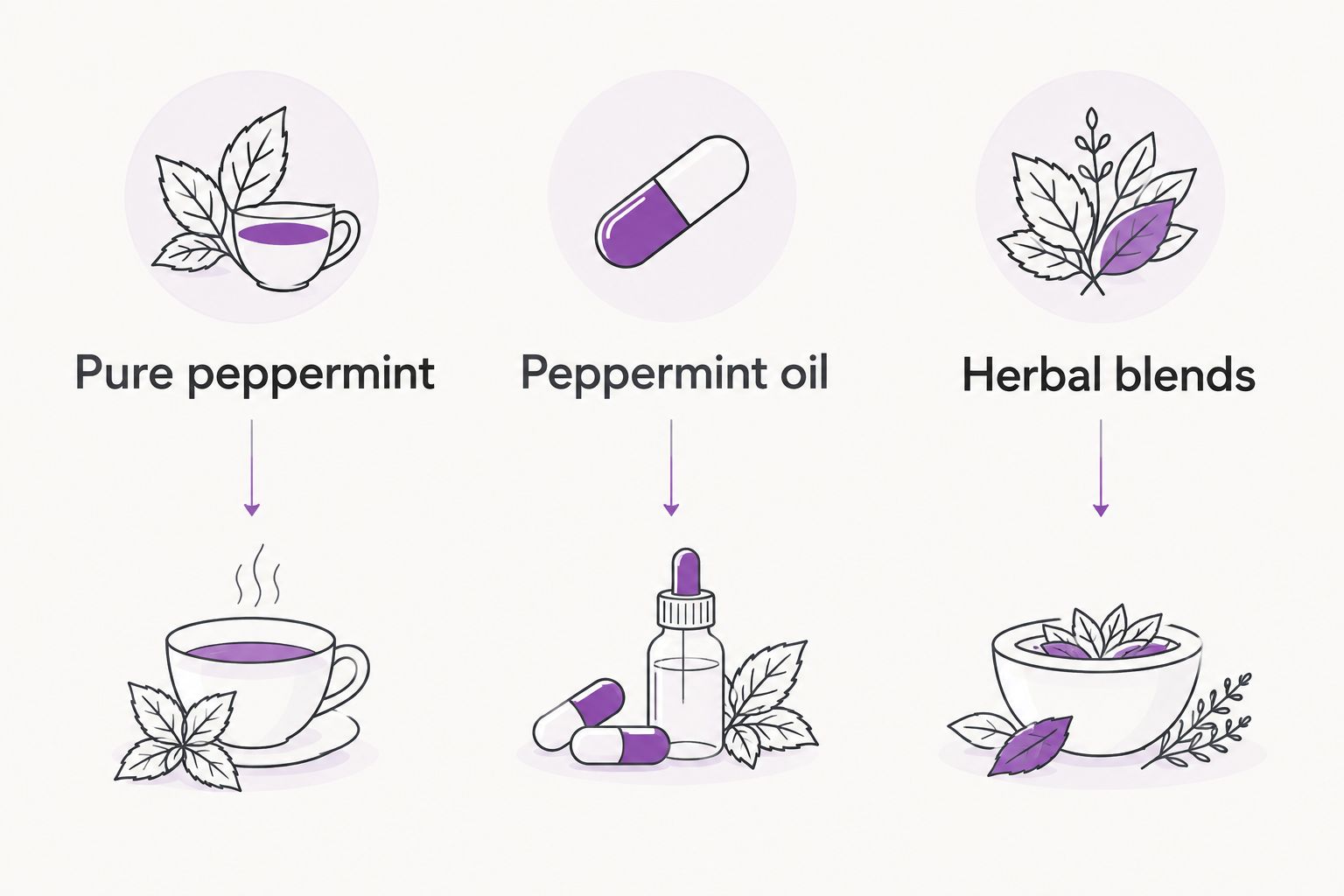
| Option | Best for | Useful feature | Main limitation |
|---|---|---|---|
| Pure peppermint leaf tea | Tea drinkers seeking a caffeine-free, minty drink | Familiar herbal infusion with traditional digestive use | Clinical evidence for treating bloating is limited; it can aggravate heartburn |
| Enteric-coated peppermint oil capsules | People discussing IBS treatment with a clinician | Studied for overall IBS symptom relief | Not equivalent to tea; side effects and suitability need consideration |
| Peppermint-containing herbal blends | Drinkers choosing a particular flavor combination | Offer different aromas and tastes | Other ingredients change caffeine content and safety considerations |
This comparison is not a recommendation to switch from tea to capsules. It explains why an encouraging result for one preparation cannot automatically become a health claim for another.
Why this matters
Bloating is a feeling of fullness or swelling in your abdomen. Visible abdominal enlargement is called distention, and the two do not always occur together. You can feel bloated without producing unusually large amounts of gas.
The National Institute of Diabetes and Digestive and Kidney Diseases explains that swallowed air and the breakdown of certain carbohydrates contribute to digestive gas. Constipation, food intolerances, and disorders involving the gut and brain can also contribute to symptoms.
A warm cup can fit into a quiet after-meal routine. It cannot tell you whether constipation, reflux, a food intolerance, or another condition is behind your discomfort. Choose tea for the drinking experience; investigate symptoms that keep returning.
Peppermint tea: traditional use, limited human evidence
Peppermint tea offers a fresh aroma and a cooling taste. Those sensory qualities are reasons to enjoy it without assigning it a medical benefit.
The National Center for Complementary and Integrative Health reports that very little research has been conducted on peppermint leaf. It does not identify enough evidence to establish peppermint leaf as useful for a particular health condition.
That leaves an important gap between traditional use and proven treatment. If you feel better after a cup, the experience is real, but it does not show which part of the routine helped. Symptoms can change during the same period for reasons unrelated to the tea.
There is no established peppermint-tea dose for treating bloating. Stronger brewing is not a substitute for better evidence, and repeated cups should not become a reason to delay assessment of ongoing symptoms.
Peppermint oil: different evidence, different cautions
The American College of Gastroenterology's IBS guideline suggests peppermint oil for relief of overall IBS symptoms. This is a conditional recommendation supported by low-quality evidence, not a guarantee that every person with gas will benefit.
Much of the research concerns specially formulated capsules. Their coating is intended to control where the contents are released. Loose leaves steeped in hot water are not an interchangeable version of that treatment.
Peppermint oil can cause side effects, including heartburn. Capsule instructions, formulation, medical history, and other medicines matter, so discuss treatment with a clinician or pharmacist rather than converting a tea recipe into an oil dose.
Do not add concentrated peppermint essential oil to your cup as a shortcut. A concentrated oil is not a culinary replacement for peppermint leaves, and a product intended for fragrance is not intended for ingestion.
Why your response to peppermint tea varies
Your response depends on more than whether the drink tastes minty. These factors explain why the same cup is not a dependable answer for every person:
- The cause of the bloating. Swallowed air, constipation, carbohydrate intolerance, and IBS require different approaches. Tea does not identify the cause.
- The preparation. Peppermint leaf tea, mixed herbal blends, and peppermint oil capsules contain different preparations and have different evidence.
- Reflux sensitivity. Peppermint can worsen heartburn, making a drink chosen for digestive comfort uncomfortable instead.
- Other ingredients. Black tea, green tea, or other caffeine-containing ingredients change a blend's caffeine profile. Additional herbs also bring their own cautions.
- Meal and bowel patterns. Rapid eating, carbonated drinks, and constipation can contribute to gas-related symptoms independently of your tea choice.
Avoid changing several habits at once if you want to understand what agrees with you. Keep your usual meals broadly consistent while trying the drink, and notice both abdominal comfort and heartburn. This is observation, not a diagnostic test.
How to brew peppermint tea for a comfortable routine
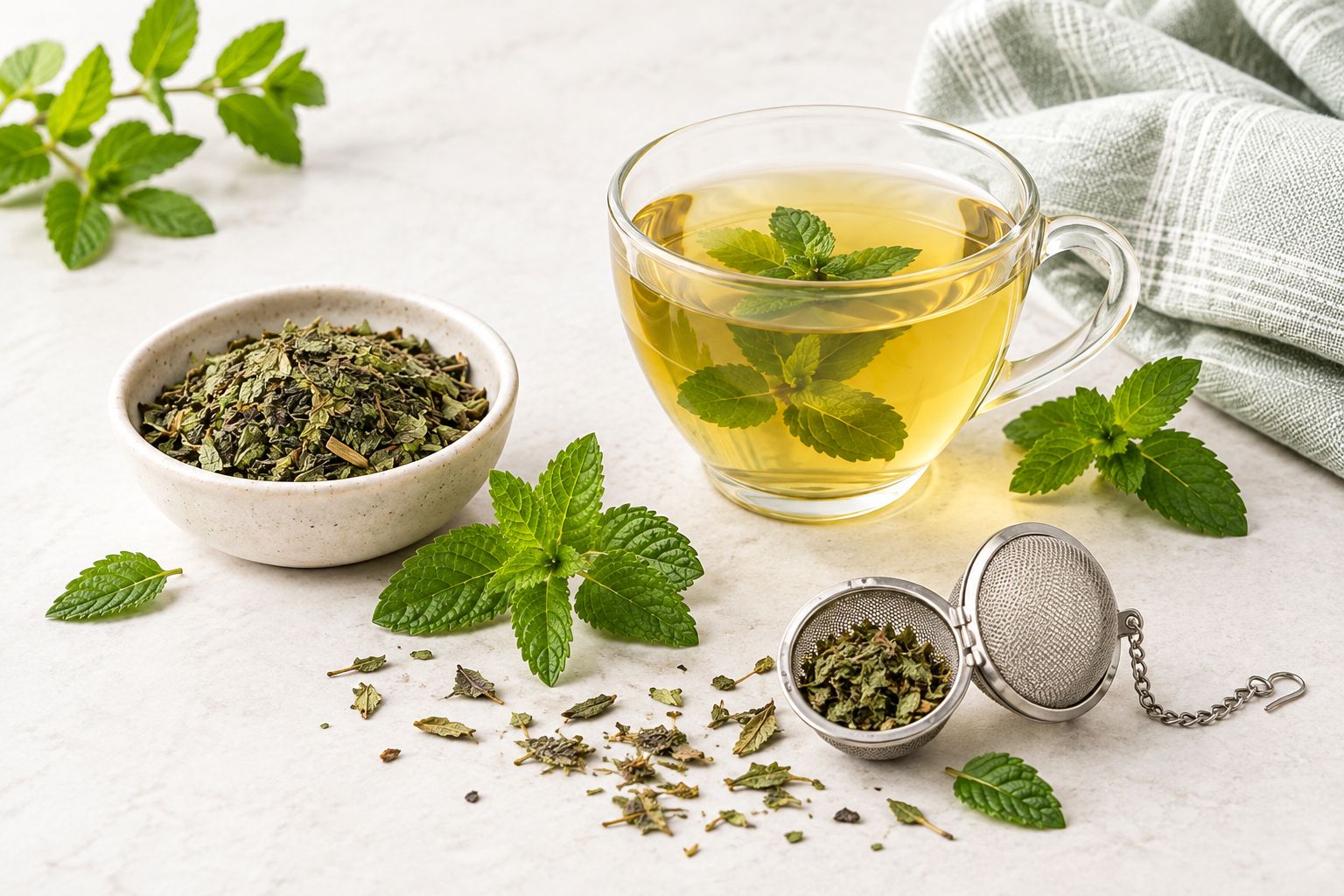
Use this as a simple kitchen starting point, not a treatment dose: 1 teaspoon of dried peppermint leaves, 8 fluid ounces of freshly boiled water, and a 5-minute steep. Follow the package instructions when they differ, because leaf size and blend composition affect the result.
- Read the ingredients. Look for peppermint leaf if you want a straightforward peppermint infusion. Check a blend for tea leaves and any herbs you need to avoid.
- Measure the leaves. Put 1 teaspoon into an infuser or strainer. The purpose is a repeatable cup, not a medicinal dose.
- Add the water. Pour 8 fluid ounces of freshly boiled water over the leaves in a heat-safe mug or teapot.
- Cover and steep. Start with 5 minutes, then remove the leaves. Covering the cup helps keep the mint aroma in the brewing vessel.
- Let it cool and taste. Drink at a comfortable temperature. Adjust later cups for flavor rather than assuming a stronger infusion provides stronger relief.
- Notice your response. Stop if the drink brings on burning, regurgitation, or other discomfort. There is no need to persist with a tea that disagrees with you.
You do not need lemon, sweetener, or another herb to make the tea useful as a routine. Keeping the first cup simple also makes its ingredients easier to track.
When should you drink peppermint tea for bloating?
There is no established best time to drink peppermint tea for bloating. After a meal is a practical time to enjoy the flavor, but research has not established an after-meal schedule that reliably prevents gas.
For an evening routine, pure peppermint leaf tea avoids caffeine. That makes it a caffeine-free drink, not a proven sleep aid. If peppermint triggers reflux, it is a poor choice before lying down, regardless of its caffeine content.
Let comfort guide the routine rather than a promised timetable. There is no evidence-backed deadline by which a cup should relieve your symptoms.
Is peppermint tea better than peppermint oil for gas?
Peppermint tea is not proven better than peppermint oil for gas. Peppermint oil has clinical research for overall IBS symptoms, while brewed peppermint tea lacks comparable evidence for treating bloating.
That does not make capsules the right choice for everyone. Occasional gas, diagnosed IBS, and ongoing unexplained abdominal symptoms are different situations; a clinician can help determine whether an IBS treatment is relevant.
If your goal is simply a pleasant drink, choose tea on taste and tolerance. If your goal is treatment, do not let a beverage comparison replace medical advice.
Is peppermint tea caffeine-free?
Pure peppermint leaf tea is naturally caffeine-free. Peppermint is an herb, not the tea plant used to make black, green, white, and oolong tea.
A mint-flavored blend can still contain caffeine when it includes those tea leaves or other caffeine-containing ingredients. The word peppermint on the front of the package does not settle the question.
For your 2026 tea cupboard, make ingredient checks the habit that stays consistent across flavors. Teatheworld's loose leaf tea and accessories serve tea enthusiasts and gift shoppers; the ingredient list remains the basis for choosing a caffeine-free drink.
Who should be cautious with peppermint tea?
People with heartburn or gastroesophageal reflux should be particularly careful. Peppermint can aggravate reflux symptoms, so a soothing aroma does not necessarily mean a soothing effect on your upper digestive tract.
The European Medicines Agency's peppermint leaf guidance also flags caution for people with gallstones or other bile-related problems. Ask a clinician before using peppermint regularly for digestive symptoms if that applies to you.
Pregnancy, breastfeeding, childhood, and regular medicine use deserve an individual safety check when you intend to use an herb as a remedy. Safety information for normal food use does not establish the safety of concentrated preparations or frequent medicinal use.
Stop using peppermint if you develop a reaction. Do not give concentrated peppermint oil to a child or assume that adult capsule guidance applies to children.
When bloating needs medical attention
Get urgent medical help for severe or worsening abdominal pain, especially with repeated vomiting or an inability to pass stool or gas. These symptoms need assessment rather than another cup of tea.
Arrange a medical appointment for persistent bloating, unexplained weight loss, blood in the stool, or a lasting change in bowel habits. A new pattern that interferes with eating or daily activities also deserves attention.
For the appointment, describe when the bloating occurs, whether your abdomen visibly enlarges, and whether constipation, diarrhea, or heartburn accompanies it. Bring the names of medicines, supplements, and herbal preparations you use. That information is more useful than assuming all digestive discomfort has the same cause.
Evidence sources and scope for 2026
These sources support different parts of the answer. None should be read as proof that a brewed cup reliably treats bloating:
- National Center for Complementary and Integrative Health, Peppermint Oil: evidence and safety information about peppermint, including the limited research on peppermint leaf.
- European Medicines Agency, peppermint leaf herbal monograph and public summary: traditional use for digestive complaints and relevant precautions.
- American College of Gastroenterology, clinical guideline on IBS management: the conditional recommendation for peppermint oil for overall IBS symptoms, not peppermint tea.
- National Institute of Diabetes and Digestive and Kidney Diseases, Gas in the Digestive Tract: causes of gas, symptom patterns, and reasons to seek medical assessment.
The central limitation is preparation-specific: research on an oil capsule cannot establish the effectiveness of a leaf infusion. Traditional use explains why people choose peppermint tea; it does not remove that evidence gap.
FAQ
Does peppermint tea help with bloating in 2026?
Peppermint tea has traditional use for digestive discomfort, but the 2026 answer remains that clinical evidence for brewed tea is limited. Better-studied peppermint oil preparations are not equivalent to a cup of tea.
How quickly does peppermint tea work for gas?
There is no established time for peppermint tea to relieve gas. Do not expect a guaranteed result within minutes or use that expectation to delay care for severe symptoms.
Can peppermint tea make bloating or heartburn worse?
Peppermint tea can worsen heartburn in susceptible people. If a cup causes burning or regurgitation, stop drinking it rather than brewing it more strongly.
How much peppermint tea should I drink for bloating?
There is no established therapeutic amount of peppermint tea for bloating. Follow package brewing directions for an ordinary cup and discuss persistent symptoms with a clinician.
Is peppermint tea good to drink before bed?
Pure peppermint leaf tea is caffeine-free, but it is not a proven sleep treatment. Avoid it before lying down if peppermint triggers your reflux.
Can I use peppermint oil instead of peppermint tea?
Peppermint oil is not a direct substitute for peppermint tea. Studied capsules have specific formulations; do not add concentrated essential oil to a drink as a home remedy.
What should I look for when buying peppermint tea?
Look for a clear ingredient list identifying peppermint leaf and any additional ingredients. Check for caffeine-containing tea leaves, especially if you want a caffeine-free evening drink.
One last thing
The most useful change is not necessarily a stronger cup. Before reaching for peppermint again, notice whether your bloating comes with constipation, heartburn, or a consistent food trigger; those details help determine the next step.
Teatheworld is for tea enthusiasts and gift shoppers choosing loose leaf tea and accessories. Keep that shopping decision separate from a treatment decision: enjoy the minty aroma if it suits you, and give recurring symptoms the attention they deserve.