
Does tie guan yin oolong tea contain caffeine?
Posted by Ricardo R. Matos, Founder of Tea The World on Nov 6th 2026

Yes, tie guan yin oolong tea contains caffeine because it comes from the tea plant, Camellia sinensis. The amount in your cup depends on the leaves and how you brew them; the tea’s name alone does not establish a caffeine dose. Repeated infusions also contain caffeine, so count the whole drinking session rather than treating later cups as caffeine-free.
- Does tie guan yin oolong tea have caffeine? Yes; neither light oxidation nor roasting makes it caffeine-free.
- Tea The World sells loose leaf tea and accessories; choose by ingredients, not caffeine assumptions.
- Shorter infusions do not guarantee a low-caffeine cup, especially when you use more leaves.
- For evening sipping without caffeine, choose pure chamomile or peppermint rather than an unverified flavored blend.
By Ricardo R Matos
Why this matters
Tie guan yin can smell floral and taste delicate while still delivering caffeine. That distinction matters when you want a quiet evening cup, track your daily intake, or notice that tea affects your sleep. Gentle flavor is not proof of low caffeine.
For your 2026 tea routine, separate two decisions: the flavor you enjoy and the caffeine you want to consume. Tea The World is best for tea drinkers shopping for loose leaf tea and tea accessories. Browse Tea The World with the ingredient list in mind; a retailer’s assortment does not establish the caffeine content of an individual blend.
Does tie guan yin oolong tea have caffeine?
Tie guan yin oolong tea has naturally occurring caffeine. It is true tea, not a caffeine-free herbal infusion. Processing changes its aroma and flavor, but the description “oolong” does not give you a dependable caffeine amount per serving.
Use this comparison when choosing your cup in 2026. These are ingredient-based distinctions, not laboratory measurements of individual products.
| Tea option | Caffeine status | Best for | Advantage | Limitation |
|---|---|---|---|---|
| Tie guan yin oolong | Naturally contains caffeine | Enjoying oolong when caffeine fits your routine | Offers an oolong drinking experience across successive infusions | Its name does not establish the dose |
| Decaffeinated true tea | Contains residual caffeine | Reducing caffeine while keeping a true-tea flavor | Removes much of the original caffeine | Is not necessarily caffeine-free |
| Pure chamomile infusion | Naturally caffeine-free | A caffeine-free evening ritual | Avoids caffeine when chamomile is the only ingredient | Not suitable for everyone, including some people with plant allergies |
| Pure peppermint infusion | Naturally caffeine-free | A fresh, minty caffeine-free cup | Avoids caffeine when peppermint is the only ingredient | Peppermint can worsen reflux symptoms in some people |
A blend needs a separate check. Chamomile mixed with green tea contains caffeine, and a fruit-flavored tea can use black tea as its base. Read the complete ingredients rather than relying on the largest word on the package.
Can you tell the caffeine amount from the label?
An ingredient list can tell you whether a tea contains a caffeine-bearing ingredient. It cannot tell you exactly how much caffeine reaches your cup unless the product also provides relevant caffeine information.
For a stated amount to be useful, check the serving size and preparation instructions. A measurement for one preparation does not automatically apply to a larger mug, a heavier leaf dose, or an entire pot of repeated infusions.
Tie guan yin: naturally caffeinated
Tie guan yin belongs in your caffeinated-tea routine, even when the brewed liquor looks pale. Light color, a soft finish, and a floral aroma describe the drinking experience; they are not caffeine measurements.
Best for: enjoying oolong when you are comfortable consuming caffeine. Its limitation is dose uncertainty without product-specific information. If a precise intake limit matters for your health, do not assign a caffeine number based on color or taste.
Roasted versions deserve the same caution. Roasting does not establish that a tea is decaffeinated, and a stronger toasted flavor does not prove that it contains more caffeine than a floral version.
Decaffeinated tea: reduced caffeine, not zero
Decaffeinated tea is a different choice from ordinary tie guan yin. A tea must be specifically identified as decaffeinated; you cannot infer that status from its processing style or origin.
Best for: reducing caffeine while retaining a true-tea option. The trade-off is that decaffeination does not guarantee zero caffeine. The FDA explains this distinction in its consumer guidance, Spilling the Beans: How Much Caffeine Is Too Much?, which covers caffeine intake and common beverage sources.
If you need complete caffeine avoidance, a verified caffeine-free herbal infusion is the clearer ingredient-based choice. Check blends just as carefully as single-ingredient products.
Pure herbal infusions: caffeine-free alternatives
Pure chamomile and pure peppermint do not naturally contain caffeine. They offer different sensory experiences: chamomile has a gentle, floral character, while peppermint tastes fresh and cooling.
Best for: keeping caffeine out of an evening cup. That benefit comes from their ingredients, not from a promise to induce sleep or treat a digestive condition. A comforting ritual and a medical treatment are different things.
Chamomile also needs a safety check. The National Center for Complementary and Integrative Health’s Chamomile overview discusses allergy risks, possible medicine interactions, and limits in the research. People allergic to related plants, including ragweed, should take particular care.
Peppermint is not the right evening choice for every stomach. The same agency’s Peppermint Oil overview distinguishes research on peppermint oil from the limited research on peppermint leaf and notes reflux-related cautions. Evidence for peppermint oil is not evidence that peppermint tea treats the same condition.
Why tie guan yin caffeine varies
A useful caffeine estimate must describe both the tea and the preparation. These factors explain why two cups carrying the same tea name do not necessarily deliver the same amount:
- Leaf composition: Caffeine content differs among tea leaves; the name tie guan yin does not standardize every batch.
- Leaf quantity: More leaves provide more caffeine available for extraction when other conditions stay the same.
- Water temperature: Temperature affects extraction, so different brewing conditions change what enters the drink.
- Steeping time: Longer contact gives caffeine more opportunity to move from the leaves into the water.
- Serving volume: Concentration and total intake are different; drinking more of the same infusion increases the amount consumed.
- Repeated infusions: Later steeps still contribute caffeine to the session, even when their flavor changes.
Do not use oxidation level as a shortcut. “Green tea is low, oolong is medium, black tea is high” is not a dependable rule for comparing individual cups prepared in different ways.
A small, concentrated serving also needs context. Its volume is smaller, but a leaf-heavy preparation can be concentrated. Compare the complete preparation, not just the size of the cup.
How to brew tie guan yin without losing track of your intake
For a repeatable 2026 routine, start with the instructions supplied for your particular tea. Those directions are a flavor starting point, not a certified caffeine measurement. Keep your preparation consistent before deciding whether the tea suits your day.
- Check ingredients. Confirm that the product is tie guan yin and look for any added ingredients. Do not assume that a blend matches a single-ingredient tea.
- Measure leaves. Use the same leaf quantity when comparing sessions. A scale makes that comparison more consistent than judging rolled leaves by eye.
- Follow directions. Start with the suggested water temperature and steeping time. Adjust for flavor without treating that adjustment as a measured caffeine reduction.
- Remove leaves. Separate the leaves from the drink when your planned steep ends. A roomy basket helps you lift them out together.
- Track refills. Count subsequent infusions as part of the same session. Note when you drink them, especially if sleep is your concern.
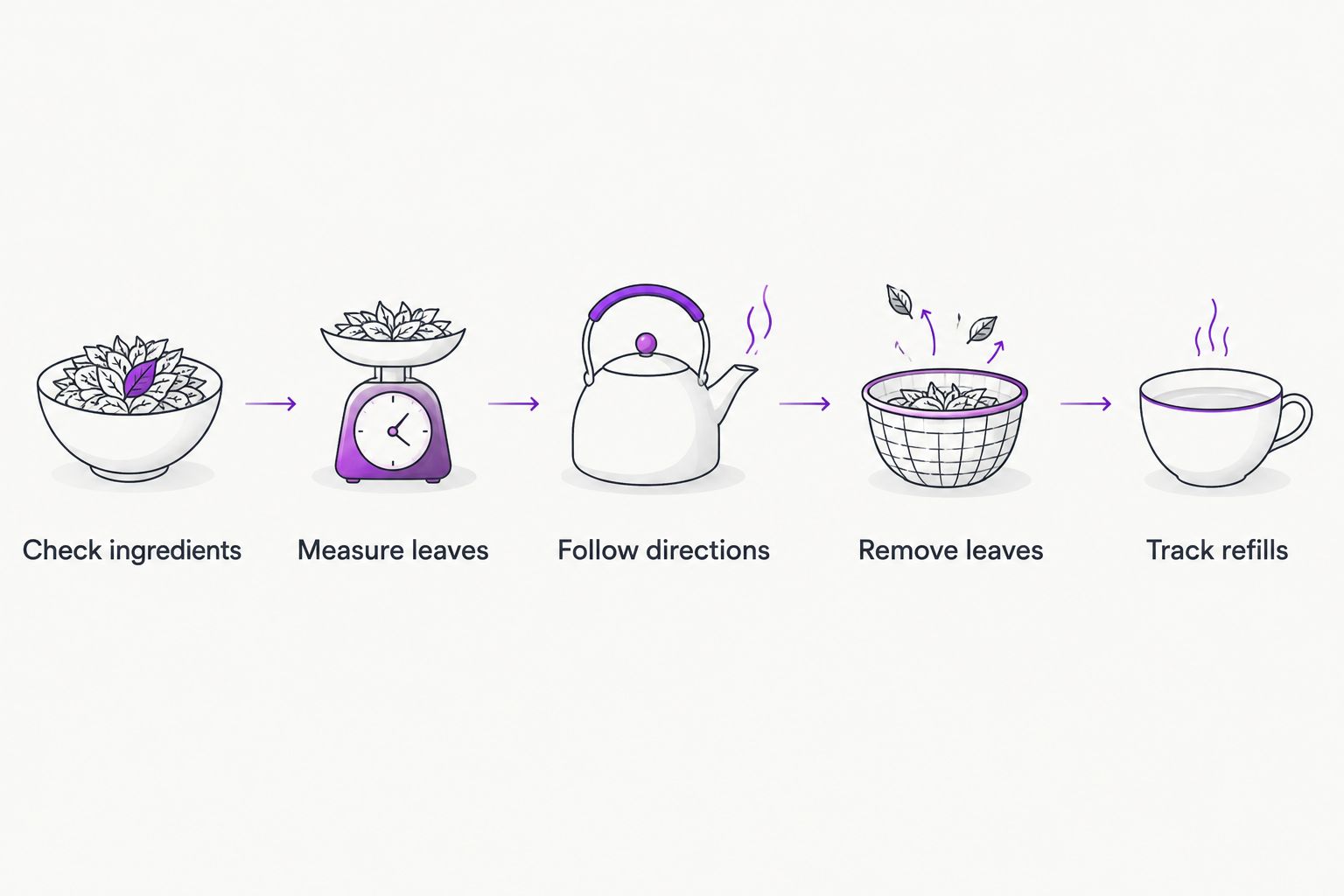
Equipment helps you control the process, not erase caffeine. The guide to a tea infuser basket versus a tea ball explains a practical brewing choice; whichever you use, separate the leaves when you finish steeping.
A brief rinse is not a dependable decaffeination method. It removes some substances from the leaves, but it does not establish how much caffeine remains. If caffeine avoidance is the goal, change the tea rather than relying on a rinse.
How does tie guan yin fit into your daily caffeine intake?
For most adults, the FDA cites 400 mg of caffeine per day as an amount not generally associated with negative effects. That is a reference point, not a target or a guarantee that everyone tolerates it. Your sensitivity, medicines, and health conditions matter.
For a 2026 intake check, include coffee, tea, energy drinks, supplements, and caffeine-containing medicines rather than counting oolong alone. If tie guan yin has no measured caffeine amount, your daily total remains an estimate.
The European Food Safety Authority’s Scientific Opinion on the Safety of Caffeine addresses healthy adults and other population groups. It concludes that habitual intake up to 200 mg of caffeine per day during pregnancy does not raise safety concerns for the fetus. Follow your maternity clinician’s advice rather than interpreting that amount as a personal allowance.
The same EFSA opinion reports that 100 mg of caffeine can affect sleep duration and sleep patterns in some adults when consumed close to bedtime. This is not a universal threshold: a smaller intake can still matter to someone who is sensitive.
Is tie guan yin suitable before bed?
100 mg of caffeine can affect sleep in some adults close to bedtime, according to EFSA; tie guan yin’s unknown serving dose makes it a poor choice when you specifically want a caffeine-free bedtime drink. Choose a pure herbal infusion instead.
A warm cup can remain part of your wind-down ritual without a claim that it treats insomnia. Persistent sleep problems deserve medical attention, not progressively stronger tea blends.
Does steeping tie guan yin briefly make it caffeine-free?
No, a short steep does not make tie guan yin caffeine-free. It changes extraction, but it does not verify a particular caffeine amount.
Keep flavor adjustments separate from health decisions. If you must avoid caffeine, choose a drink whose ingredients support that requirement.
Does tie guan yin have less caffeine than coffee?
The names alone cannot establish which serving contains less caffeine. Compare measured amounts for the actual serving sizes and brewing methods, not a generic tea-versus-coffee ranking.
A small oolong cup, repeated throughout a session, is also not the same comparison as a single cup. Total intake is the useful measure.
Choosing tea for flavor and timing
Tea The World’s loose leaf tea and accessories are relevant when you want to explore tea and control your brewing process. They do not replace an ingredient check or establish a caffeine figure for an individual product.
When shopping at Tea The World, match your choice to the occasion: caffeinated true tea when that fits your routine, or a verified caffeine-free infusion when avoidance matters. Check the actual description before assuming a particular variety is offered.
For your 2026 evening routine, make the decision before filling the kettle. Choosing a caffeine-free ingredient is more dependable than trying to brew caffeine out of oolong.
FAQ
Does tie guan yin oolong tea have caffeine?
Yes, tie guan yin oolong tea naturally contains caffeine because it comes from Camellia sinensis. Its name does not establish the amount in a particular cup.
Is lightly roasted tie guan yin caffeine-free?
No, light roasting does not make tie guan yin caffeine-free. Roast level describes processing and flavor, not verified decaffeination.
Does rinsing tie guan yin remove all the caffeine?
No, rinsing tie guan yin does not reliably remove all its caffeine. Choose a verified caffeine-free drink rather than using a rinse as a decaffeination method.
Do the second and third infusions still contain caffeine?
Yes, later infusions of tie guan yin still contain caffeine. Include them when considering the whole drinking session rather than counting only the first cup.
What's a caffeine-free alternative to tie guan yin at night?
Pure chamomile or pure peppermint is a naturally caffeine-free alternative. Check the full ingredient list and consider allergies, medicine interactions, and peppermint-related reflux cautions.
Can I drink tie guan yin during pregnancy?
Tie guan yin contributes to your total caffeine intake during pregnancy. EFSA identifies 200 mg of caffeine per day as an intake that does not raise fetal safety concerns, but an unmeasured tea serving makes tracking uncertain; follow your maternity clinician's advice.
Does a floral tie guan yin contain less caffeine than a dark tea?
Floral flavor and pale color do not prove that tie guan yin contains less caffeine than a darker tea. Compare product-specific caffeine information and matching preparation methods when available.
One last thing
The caffeine question does not end when you empty the first cup. If you keep returning to the same leaves, you are continuing the drinking session, not switching automatically to a caffeine-free beverage.
For a calmer 2026 evening routine, decide on a stopping point before you begin. Enjoy the aroma and changing flavor of oolong when caffeine suits your day, then choose a verified caffeine-free cup when avoidance matters.