
How much peppermint tea is safe to drink in a day?
Posted by Ricardo R. Matos, Founder of Tea The World on Nov 11th 2026

Most healthy adults can drink 3 to 4 cups of peppermint tea a day — roughly 24 to 32 ounces — without running into safety problems, based on the general herbal-safety guidance most wellness and integrative-health resources still point to in 2026. The number everyone quotes leaves out the real catch: peppermint relaxes the muscle that keeps stomach acid where it belongs, so the same cup that settles one person's stomach can trigger heartburn in another.
- 3 to 4 cups (24-32 oz) of peppermint tea a day is the general safe range for most healthy adults in 2026.
- Pure peppermint tea has 0mg caffeine, unlike many peppermint-black tea blends.
- People with GERD or acid reflux should drink less, or skip it, since peppermint can relax the esophageal sphincter.
- Pregnant or breastfeeding drinkers should check with a doctor before making it a daily habit.
- Steep time and leaf quality change strength more than cup count does — picking [quality peppermint loose leaf tea](https://teatheworld.com/blog/how-to-choose-peppermint-loose-leaf-tea-for-fresh-flavor/) matters.
Why this matters
Peppermint tea gets reached for constantly — after a heavy meal, before bed, mid-afternoon when coffee feels like too much. It's caffeine-free, it smells like dessert, and it has centuries of traditional use behind it for digestive comfort. None of that means unlimited amounts are automatically fine for every person drinking it in 2026, which is why the daily range matters more than the vague idea that herbal tea is "always safe."
Much of the clinical research on peppermint and digestion has actually studied peppermint oil capsules, not brewed tea. Tea delivers a milder, more diluted dose of the same plant compounds, so effects tend to be gentler and less consistently studied on their own. Traditional use and lab-grade evidence are two different things, and it's worth keeping that distinction straight before assuming a cup of tea works like a supplement.
How much peppermint tea is safe per day?
The safe amount depends heavily on who's drinking it. Here's how the general guidance breaks down by group for 2026:
| Group | General guidance | Verdict |
|---|---|---|
| Healthy adults | 3-4 cups (24-32 oz) a day | Generally fine |
| Pregnant or breastfeeding | Ask a doctor before daily use | Caution |
| GERD or acid reflux | Limit sharply, or avoid | Caution |
| Children | Smaller, diluted servings only | Caution |
| On prescription medication | Check with a doctor or pharmacist | Caution |
Healthy adults: 3 to 4 cups a day
For most adults without digestive conditions, 3 to 4 cups of peppermint tea a day sits within the range used by herbal-safety resources, including integrative-health libraries that classify peppermint tea as generally safe in culinary amounts. That's a loose ceiling, not a target — plenty of people drink one cup after dinner and never think about the upper limit.
Pregnant or breastfeeding: ask a doctor first
Safety data on peppermint tea specifically during pregnancy is limited, and the standard caution is to check with a doctor before making it a daily habit rather than assume the general adult range applies. This isn't a claim that peppermint tea is dangerous in pregnancy — it's an acknowledgment that the research simply hasn't filled in that gap with confidence.
GERD or acid reflux: fewer cups, or skip it
Peppermint is a known trigger for some people with gastroesophageal reflux disease because it can relax the lower esophageal sphincter, the muscle that normally keeps acid in the stomach. If heartburn shows up after a cup, that's a signal to cut back well below the 3-4 cup range or drop peppermint tea altogether.
Children: smaller, diluted cups only
There's no single universal cup count for children, and the practical approach most pediatric and herbal guidance takes is smaller, well-diluted servings introduced slowly, with a doctor's input for infants or toddlers. Treat peppermint tea for kids as an occasional, weak brew rather than a daily routine modeled on adult amounts.
Why the safe amount varies
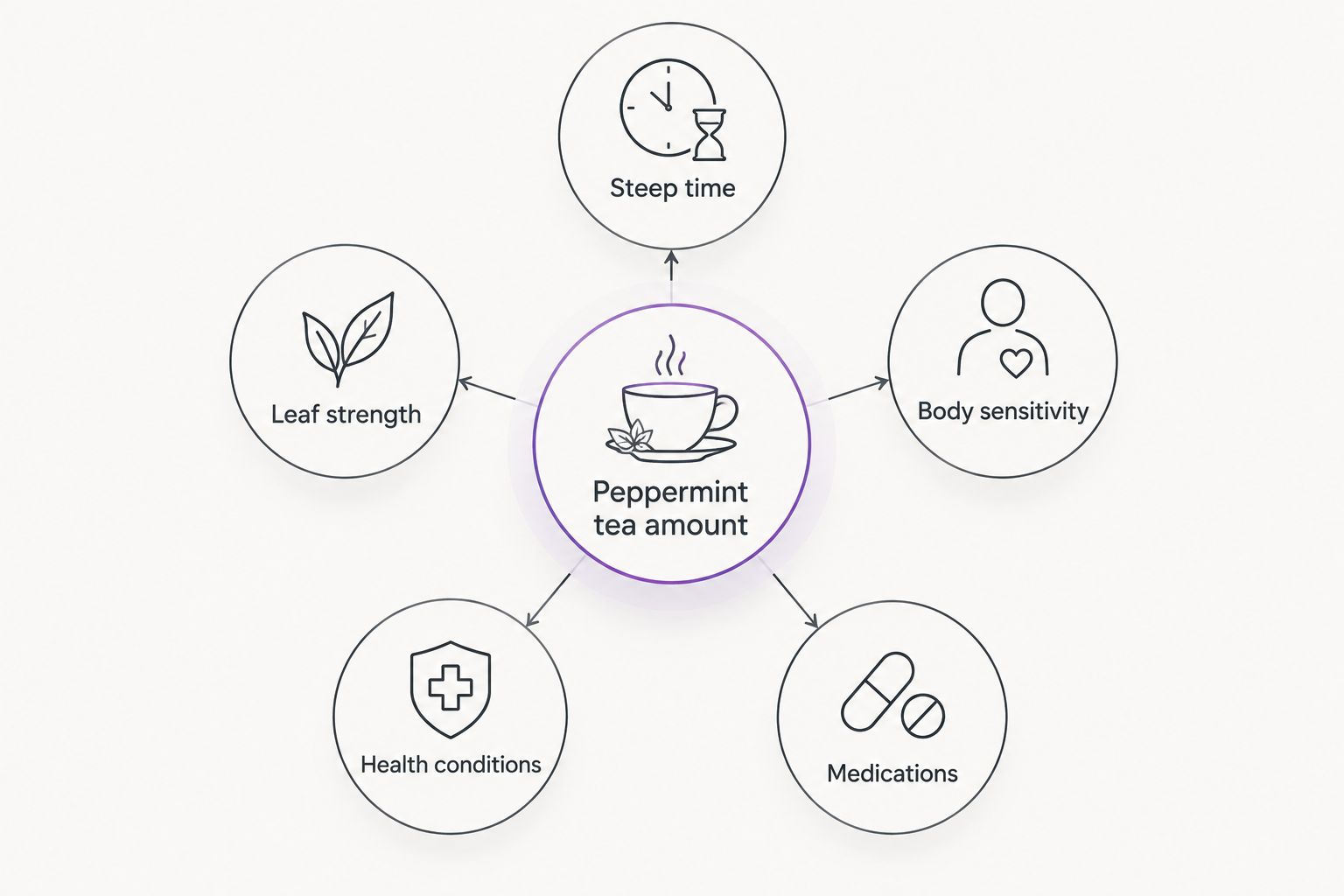
The 3-4 cup range is a starting point, not a fixed rule. Several things push that number up or down for any given person:
- Steep time and leaf amount — a longer steep or a heaping spoon of loose leaf pulls more menthol and plant compounds into the cup
- Loose leaf vs. tea bag strength — fine-cut bagged peppermint can extract faster and taste stronger per cup than whole-leaf loose tea
- Body sensitivity to menthol — some people feel a cooling or mild burning sensation in the throat or stomach well before any "limit" is reached
- Existing digestive conditions — GERD, hiatal hernia, and gallstones are the conditions most commonly flagged for peppermint caution
- Medications — anyone on prescription drugs should run daily peppermint tea by a doctor or pharmacist rather than assume herbal means risk-free
- Pregnancy and breastfeeding status — safety research gaps mean doctor input replaces general guidance here
Picking a good base leaf also changes how strong a "cup" actually is. A guide on how to choose peppermint loose leaf tea walks through what fresh, quality peppermint leaf looks and smells like compared to stale or dusty cuttings, which matters because weaker, fresher leaf tends to produce a milder cup at the same steep time.
Pick peppermint tea for a milder cup
Learn what fresh peppermint leaf looks like before you brew.
Is peppermint tea bad for acid reflux or heartburn?
Peppermint tea can worsen acid reflux because peppermint relaxes the lower esophageal sphincter, making it easier for stomach acid to move upward. For someone prone to heartburn, the safe amount isn't 3-4 cups a day — it's whatever amount, including zero, keeps symptoms from flaring.
Can you drink peppermint tea every day?
Yes, drinking peppermint tea every day is common and fits within general guidance as long as total intake stays near 3 to 4 cups (24-32 oz) and there's no GERD, pregnancy, or relevant medication in the picture. Outside those groups, daily peppermint tea is one of the more routine herbal habits people keep without issue.
Does peppermint tea have caffeine?
Pure peppermint tea has 0mg of caffeine because it's brewed from peppermint leaves rather than the Camellia sinensis plant that produces green, black, and oolong tea. Blended products that pair peppermint with actual tea leaves — a peppermint black tea, for example — do carry caffeine, so the ingredient list is the only reliable way to confirm a blend is caffeine-free.
That caffeine-free profile is part of why peppermint shows up so often in evening routines. A roundup of soothing teas for better sleep covers peppermint alongside other caffeine-free options worth keeping on hand for a wind-down routine, and a caffeine-free tea gift set built for evening sipping is a practical way to try a few herbal options side by side.
FAQ
Is peppermint tea safe during pregnancy?
Safety data on peppermint tea during pregnancy is limited, so the standard caution is to check with a doctor before drinking it daily rather than apply the general 3-4 cup adult range. Occasional small amounts are generally viewed as lower-risk than daily habitual use.
Can children drink peppermint tea?
Children can drink peppermint tea in smaller, more diluted servings than adults, introduced gradually rather than at the full 3-4 cup adult range. For infants or toddlers, check with a pediatrician before offering it at all.
Does peppermint tea interact with medications?
Peppermint tea may interact with certain prescription medications, particularly ones processed by the liver, though the effect of brewed tea is generally milder than concentrated peppermint oil. Anyone on regular medication should ask a doctor or pharmacist before making peppermint tea a daily habit.
How is peppermint tea different from peppermint oil?
Peppermint tea is a diluted infusion of peppermint leaves, while peppermint oil is a concentrated extract often used in capsule form for digestive research. Clinical studies on peppermint oil's effects on conditions like IBS don't automatically apply to the much weaker dose found in a brewed cup of tea.
Does steeping peppermint tea longer make it stronger?
Yes, a longer steep pulls more menthol and plant compounds out of the leaf, producing a noticeably stronger and more intense cup. A shorter 3-5 minute steep gives a milder result than a full 7-minute steep using the same amount of leaf.
Is peppermint tea good before bed?
Peppermint tea is caffeine-free, which makes it a reasonable evening option for people avoiding caffeine before sleep, though it isn't a sedative and shouldn't be expected to work like one. People with acid reflux may want to avoid it close to bedtime since lying down can make reflux symptoms worse.
Can too much peppermint tea cause side effects?
Drinking well beyond the general 3-4 cup daily range can bring on heartburn, mild stomach upset, or a burning sensation in some people, even without an underlying condition. These effects tend to be dose-related and usually ease once intake drops back toward the typical range.
One last thing
The cup-count number gets all the attention, but steep time usually matters more for how much peppermint compound actually ends up in your mug. A 3-minute steep and a full 7-minute steep from the same spoonful of loose leaf can taste like two different teas, and the longer one delivers a noticeably stronger dose well before you'd ever hit 4 cups. If heartburn or sensitivity is a concern in 2026, cutting steep time down is often a simpler fix than cutting cups out entirely.