
How to connect a kitchen scale to consistent loose leaf tea brewing
Posted by Ricardo R. Matos, Founder of Tea The World on Nov 4th 2026
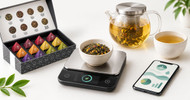
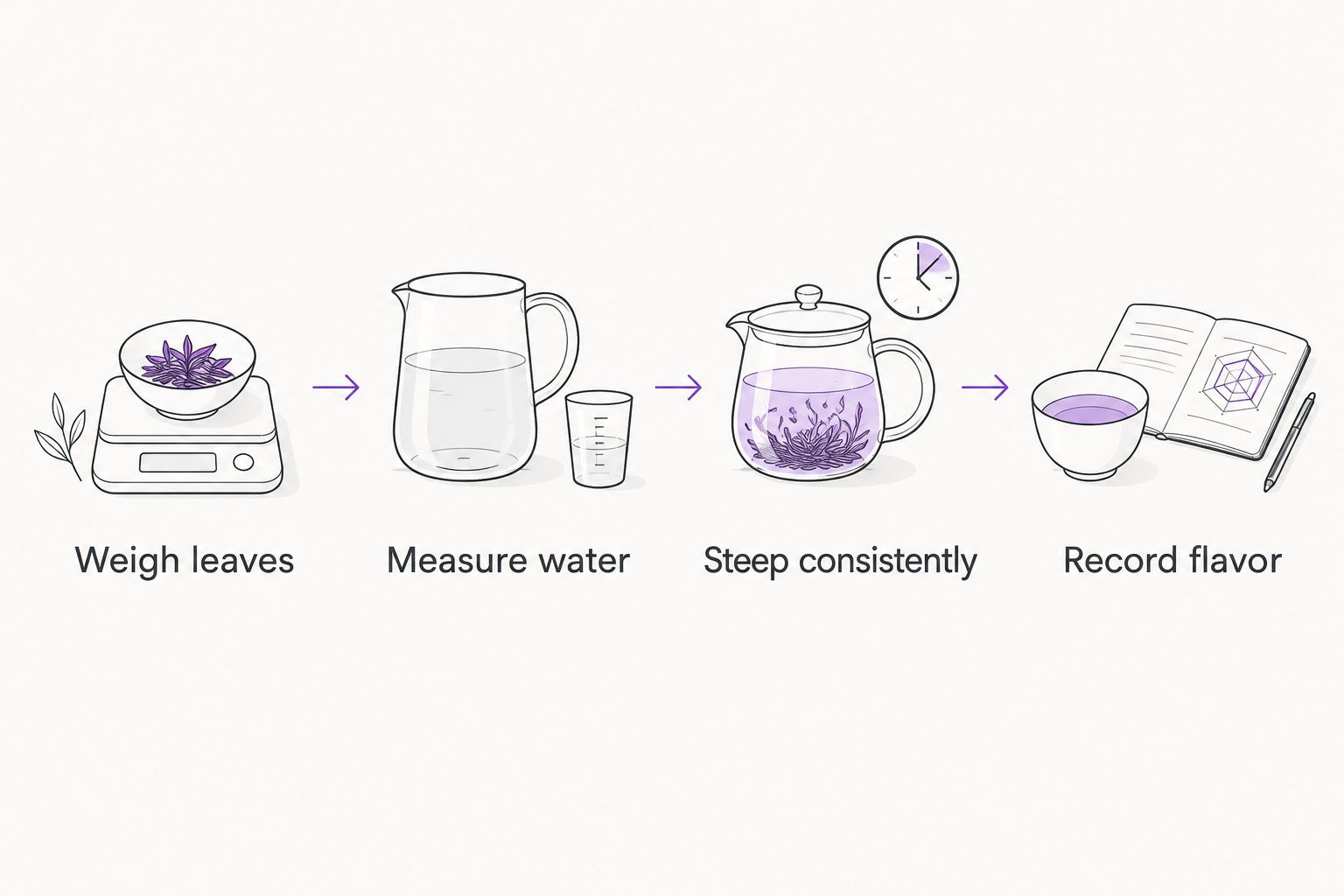
Instead of guessing how much loose leaf tea fits in a spoon, connect your kitchen scale to a repeatable brewing routine: weigh the leaves, weigh the water, and record the result. For a tea brewing ratio grams per cup calculation, define your cup by water weight first; an illustrative recipe of 2 g of leaves with 250 g of water becomes 4 g with 500 g of water.
- For tea brewing ratio grams per cup, weigh both leaves and water; cup size alone is not enough.
- Tea The World offers loose leaf teas and accessories for building a repeatable brewing routine.
- Use the tea’s package directions first; treat example ratios as adjustable recipes, not universal rules.
- Keep water temperature and steeping time unchanged while adjusting leaf weight.
Why this matters
A spoon measures space, not weight. Curled leaves, small broken pieces, and airy herbal ingredients occupy that space differently, so an identical-looking scoop does not guarantee an identical dose.
A scale makes your recipe easier to repeat and share. It does not decide what tastes good; you still choose the strength, aroma, and finish you enjoy.
Tea The World is best for tea enthusiasts seeking loose leaf teas and brewing accessories. Explore Tea The World with a recipe notebook beside you, and keep a separate entry for each tea rather than applying one setting to every blend.
For your 2026 brewing notebook, record the actual water weight instead of writing only “one cup.” That small change makes a favorite recipe usable with another mug or teapot.
Before you start
- Gather your materials: loose leaf tea, drinking water, a kitchen scale with a gram setting, a dry weighing dish, an infuser, a brewing vessel, and a timer. No account, app, or wireless connection is required.
- Check the scale: read its display increments and maximum load in the manual. A scale that displays whole grams cannot show a fractional-gram adjustment; use the precision it actually provides.
- Check the hidden obstacle: your mug’s capacity is not necessarily your brewing-water amount. Leave room for the infuser, and do not pour hot water onto the scale or exceed its load limit.
Read the tea’s brewing directions before weighing anything. Product instructions take priority over the example arithmetic in this guide, especially for water temperature and steeping time.
Keep loose leaf tea separate from sachet instructions. Tea The World pouches contain loose leaf tea; its tins contain tea sachets. This workflow centers on weighing loose leaves, not opening sachets to reconstruct their contents.
Leaf measurement setup
Set the scale and weighing dish
- Put the scale on a dry, level, stable surface. Keep it away from splashes and the steam rising from your kettle.
- Select g if that is the gram-unit label on your scale. Check the manual if its controls use different wording; there is no single button layout across kitchen scales.
- Place an empty, dry dish on the platform. Use the control labeled TARE or ZERO, as applicable to your model, to exclude the dish’s weight.
- Wait for the display to settle at zero before adding leaves. If the reading drifts, reposition the scale and repeat the reset.
Expected result: the display measures the leaves alone, not the combined weight of the leaves and their container.
Taring matters because a recipe needs an ingredient weight. Writing down the weight of a dish plus tea produces a number that stops being useful as soon as you change dishes.
Choose the leaf dose
- Start with the leaf quantity on the tea’s package when it is stated by weight.
- If the instructions use a spoon, measure that suggested spoonful once and record its actual weight. This captures your starting recipe without pretending every spoonful is identical.
- Add leaves gradually until the scale reaches your chosen dose. Transfer them into the infuser, checking that none remain in the weighing dish.
Expected result: you have a recorded leaf dose that you can repeat with the same tea.
For a 2026 recipe entry, write the tea’s identifying name from its package and the measured dose. A note such as “green tea” is less useful when several different teas share your cupboard.
Water measurement setup
Define what your cup means
- Decide how much water you will actually brew, leaving room for the infuser and comfortable handling.
- Weigh that water in a suitable container before heating, or use another measurement method consistent with your equipment instructions. Keep the scale dry.
- Record the water amount separately from the vessel’s advertised capacity. Do not use the finished drink’s weight as a substitute: wet leaves retain some of the brewing water.
Expected result: your recipe has a measured water input rather than an undefined cup size.
For everyday brewing, weighing water avoids confusing a mug with a standardized measuring cup. You can keep the recipe entirely in grams; converting it into fluid ounces is unnecessary for this workflow.
Calculate the leaf-to-water relationship
Divide the leaf weight by the water weight to describe your recipe. When changing the batch size, multiply both quantities by the same factor.
The following values are illustrative arithmetic, not brewing instructions for a specific tea:
| Recipe example | Leaf weight | Water weight | What stays consistent |
|---|---|---|---|
| Original batch | 2 g | 250 g | The starting relationship |
| Double batch | 4 g | 500 g | Twice the leaves and water |
| Half batch | 1 g | 125 g | Half the leaves and water |
If the original recipe tastes right, these scaled quantities preserve its leaf-to-water relationship. They do not guarantee identical flavor when you change the vessel, infuser, temperature, or steeping time.
Expected result: you can resize a recipe without guessing how many spoonfuls belong in the new vessel.
Brewing controls and recipe log
Keep the other settings steady
- Heat the water according to the tea’s instructions. Measure temperature with suitable equipment if precise temperature control is part of your recipe.
- Add the measured water to the brewing vessel and immerse the leaves. Use the same method for each comparison.
- Start the timer at the same point each time. Follow the package’s steeping guidance for your first attempt.
- Remove the infuser when the chosen time ends. Do not leave the leaves soaking while you evaluate the cup.
Expected result: changes in taste are easier to connect to a change in leaf dose rather than several uncontrolled settings.
Give the leaves room to move as they become wet. The tea infuser basket versus tea ball guide helps you compare that part of the setup without treating the scale as the whole solution.
A small infuser packed tightly with leaves changes how water reaches them. Keeping the same ratio while changing the infuser is therefore a new recipe comparison, not a clean repeat of the old one.
Write a usable tasting note
Record the tea, leaf weight, water weight, water temperature, steeping time, and vessel. Then add a short sensory note: thin, rounded, grassy, floral, drying, or pleasantly strong.
Choose one change for the next brew. If strength is the issue, adjust the leaf dose while keeping the other settings steady. If the cup is bitter or drying, review the tea’s temperature and time instructions before simply adding more leaves.
Make your 2026 notebook practical rather than elaborate. A recipe you can read while the kettle heats is more useful than a detailed entry you never consult.
Teapot batch setup
Brew the same recipe for guests
- Choose the total water amount for the teapot, not the number of loosely defined cups it claims to hold.
- Calculate the leaf dose using your successful recipe’s relationship. For the illustrative 2 g per 250 g recipe, 500 g of water pairs with 4 g of leaves.
- Check that the infuser has room for the larger dose and that the vessel can safely hold the water.
- Brew at your recorded temperature and time, then remove the leaves before serving.
Expected result: you have a larger batch based on a known recipe, ready to share without leaving later servings on the leaves.
Scaling the ratio preserves one part of the recipe. A larger vessel can behave differently as it heats and cools, so taste the first batch before declaring it your permanent teapot setting.
For a 2026 hosting recipe, record the teapot separately from your everyday mug. Guests can then enjoy the same shared pot, rather than cups poured at different stages of an ongoing steep.
Second variant: adjust the recipe when the tea changes
Keep the weighing workflow whenever you open a different tea, but start from that tea’s instructions. A successful black-tea recipe is not automatically the right recipe for green tea or an herbal blend.
Use this comparison to choose how much measurement your routine needs. These are workflow options, not claims about particular scale brands.
| Workflow | Best for | Advantage | Limitation |
|---|---|---|---|
| Weigh every brew | Learning a tea or comparing recipes | Makes each leaf dose explicit | Adds a measuring step |
| Calibrate a spoon, then recheck | A familiar tea in a familiar vessel | Simplifies the daily routine | Spoon filling still varies |
| Weigh a full teapot batch | Sharing tea with guests | Connects the dose to total water | Vessel and infuser changes need a taste check |
Weigh every brew while learning; simplify only after you know the recipe you enjoy. If you change teas, spoons, or serving sizes, measure again rather than carrying an old assumption into the new cup.
A tea described by fruit flavor is not necessarily caffeine-free. Check its ingredients for the tea base before choosing it for evening sipping; the scale controls quantity, not whether caffeine is present.
Troubleshooting
The leaf reading jumps between values
Check the scale’s display increments, surface, and reset. Do not record a fractional weight that the scale cannot display. If your adjustments are smaller than its resolution, use equipment capable of measuring them or make changes it can show.
The same ratio tastes weaker in the teapot
Check the actual water input, the infuser’s room, and the recorded temperature and steeping time. Confirm that you transferred all the measured leaves. Change one setting after those checks rather than increasing every setting together.
The tea becomes stronger while you drink
Remove the leaves at the end of the timed steep. An infuser left in the mug continues exposing the tea to water, so the first and last sips no longer represent the same brewing endpoint.
The display turns off during preparation
Check the scale’s automatic shutoff instructions. Weigh the leaves, record the result, and then measure the water as a separate task. Do not depend on a tared reading remaining active while you heat the kettle.
A familiar recipe suddenly tastes different
Check the tea, water source, storage, and equipment before rewriting the ratio. Residue in a vessel or a changed ingredient introduces another variable. Use clean equipment and compare under the original conditions first.
Customize your workflow
Build separate recipe entries for your solo mug, shared teapot, and any tea you regularly serve to friends. Keep the same recording fields so you can see what actually changed.
Tea The World loose leaf tea brewing works with this routine without requiring a branded scale or an app. The benefit is repeatability; the limitation is that measuring cannot replace tasting or correct an unsuitable steeping temperature.
For your 2026 routine, put the weighing dish, infuser, and notebook together near your brewing space. Let the practical setup support the pleasure of tea: the fragrance of wet leaves, the first warm sip, and a cup you can make again for someone else.
FAQ
What is the tea brewing ratio grams per cup?
A tea brewing ratio states the leaf weight for a defined amount of brewing water. Follow the tea’s package directions first; 2 g with 250 g of water is an illustrative recipe, not a universal requirement.
Do I need to connect my kitchen scale to an app?
No app connection is needed to use a kitchen scale for tea brewing. Weigh the leaves and water, then record the recipe on paper or in your existing notes app.
Is weighing loose leaf tea better than using a teaspoon?
Weighing is better for comparing and repeating leaf doses because a teaspoon measures volume rather than weight. A spoon remains convenient once you have measured a familiar tea, but its filling can still vary.
Can I use the same grams per cup for every tea?
No single grams-per-cup recipe suits every tea and preference. Start with each tea’s brewing instructions and keep temperature and steeping time specific to that tea.
Should I weigh hot water directly on the kitchen scale?
Use the scale only within its manufacturer’s heat, load, and moisture limits. Weighing water before heating avoids putting a hot vessel on a scale that is not designed for it.
How do I make a larger batch without making weaker tea?
Multiply the leaf weight and brewing-water weight by the same factor. Keep the original temperature and time as your starting settings, then check the flavor because the larger vessel and infuser introduce other variables.
Can a tea scale tell me whether a blend is caffeine-free?
A scale cannot identify caffeine or confirm that a blend is caffeine-free. Read the ingredients and product information; fruit flavor alone does not establish the blend’s tea base.
One last thing
Save the water input, not just the amount poured into your cup. Wet leaves hold water, so measuring the finished drink does not reconstruct the original brewing ratio.
Once you find a cup you enjoy, share its recipe alongside the tea. A simple note with leaf weight, water amount, and steeping directions makes a thoughtful gift easier to enjoy.
Related guides
- Choose a glass teapot for one-person brewing
- Store chamomile loose leaf tea to preserve its aroma
- Remove tea stains from a glass teapot with an infuser
Ricardo R. Matos, Founder of Tea The World