
Is chamomile tea safe to drink every night?
Posted by Ricardo R. Matos, Founder of Tea The World on Nov 10th 2026

For most healthy adults, plain chamomile tea in ordinary beverage amounts is generally safe as an evening drink, but long-term research does not establish that nightly use is risk-free. Allergies, medicines, pregnancy, and breastfeeding change that answer. This 2026 guide explains how to choose a simple bedtime cup without treating tea as a sleep medicine.
- Is chamomile tea safe every night? Generally, for healthy adults drinking ordinary beverage amounts; individual risks still matter.
- NCCIH reports limited evidence for chamomile as an insomnia treatment; a bedtime ritual is not a proven therapy.
- Plain chamomile is naturally caffeine-free; blends containing black or green tea are not.
- Tea The World offers loose leaf tea and accessories; choose evening drinks by ingredients, not wellness promises.
Why this matters
A warm cup can give your evening a gentle stopping point: put down your phone, notice the aroma, and let the day settle. That experience matters without requiring a claim that chamomile treats insomnia or prevents illness.
Separate a pleasant bedtime habit from a medical treatment. Whether you use flowers or a bag changes preparation and convenience, not the need to check allergies and medicines. The guide to chamomile loose leaf tea versus tea bags explains those practical differences.
For a nightly habit in 2026, the useful question is not simply whether chamomile is natural. It is whether the ingredients and your health circumstances make that particular cup a sensible choice.
Is chamomile tea safe to drink every night?
Plain chamomile tea is generally safe in amounts commonly found in food and tea, according to the National Center for Complementary and Integrative Health, or NCCIH. Its Chamomile fact sheet also distinguishes those amounts from medicinal use and identifies allergy, interaction, and pregnancy concerns.
That distinction is the foundation of this 2026 answer. An ordinary infusion is not interchangeable with a concentrated extract, and neither comes with a guarantee of safe lifelong use. More concentrated does not mean more suitable for bedtime.
| Form | Best for | Practical advantage | Limitation or caution |
|---|---|---|---|
| Plain chamomile infusion | Adults seeking a caffeine-free evening drink | Simple ingredients and a gentle floral flavor | Allergy and medicine interactions still require attention |
| Chamomile blended with other herbs | Readers seeking a different flavor | Adds variety to an evening routine | Every additional herb needs its own safety check |
| Chamomile blended with black or green tea | Readers who want a tea-based flavor | Combines floral notes with a tea base | Contains caffeine unless the tea component is decaffeinated; decaffeinated is not necessarily caffeine-free |
| Chamomile extract or supplement | People following individualized professional advice | A format distinct from a brewed drink | Different concentration and dosing; tea guidance does not establish supplement safety |
The table compares forms, not their ability to treat a condition. No form earns a recommendation solely because it is described as calming.
What does the safety evidence actually cover?
NCCIH describes chamomile as likely safe in food and tea amounts. It also reports that there is not enough reliable information to establish safety during pregnancy or breastfeeding, and it discusses reported and potential drug interactions.
That supports a qualified answer, not an unlimited endorsement. A cup enjoyed as a beverage belongs in a different category from an extract taken to produce a medicinal effect.
The source informing this 2026 guide is NCCIH's Chamomile fact sheet, which covers safety, interactions, and the limits of research. It does not establish a universal nightly dose or a duration that is safe for every person.
Plain chamomile: a caffeine-free evening option
Plain chamomile contains no tea leaves and is naturally caffeine-free. Its soft floral character makes it an option when you want a warm drink without the caffeine found naturally in black, green, white, or oolong tea.
Best for: adults seeking an uncomplicated caffeine-free beverage, after checking personal safety concerns. Its advantage is simplicity. Its limitation is that caffeine-free does not mean allergy-free, interaction-free, or proven to improve sleep.
Read the complete ingredient list rather than relying on the flavor name. A chamomile blend can contain caffeinated tea, and a fruit-flavored blend can contain it too. The word evening on a package does not replace an ingredient check.
If you prefer a plain cup, choose a product whose ingredients identify chamomile without an added tea base. If you prefer a blend, check each component before making it part of your nightly routine.
Chamomile blends: more ingredients to check
A blend can offer a fuller aroma or a different finish, but its safety cannot be inferred from chamomile alone. Added herbs have their own cautions, and added tea leaves change the caffeine question.
Best for: readers who want flavor variety and can review every ingredient. The benefit is choice; the drawback is a more complicated safety assessment. A familiar ingredient name is not proof that the whole blend suits your medicines or health needs.
Keep the package or ingredient list available when you ask a pharmacist about a blend. Naming only chamomile leaves out information that can change the advice.
For bedtime, start with what you actually want from the cup: warmth, aroma, or an alternative to caffeinated tea. You do not need a long ingredient list to create a relaxing routine.
Why nightly chamomile safety varies
The main factors are personal, not whether your cup looks strong or pale:
- Plant allergies: NCCIH identifies greater allergy risk in people allergic to related plants, including ragweed, chrysanthemums, marigolds, and daisies.
- Medicines: Reported or potential interactions matter, particularly with warfarin, sedatives, and some medicines processed by the liver.
- Pregnancy or breastfeeding: Reliable safety information is insufficient; everyday use should not be assumed safe.
- Preparation and concentration: Brewed tea and concentrated supplements are different exposures.
- Blend ingredients: Added herbs or caffeinated tea introduce considerations beyond chamomile.
- Your response: A new rash, digestive upset, or another unwanted symptom is a reason to stop and seek appropriate advice.
The absence of symptoms after a cup does not resolve a medicine interaction or establish pregnancy safety. Those questions need a pharmacist or clinician, not a taste test.
Who should check before making chamomile a nightly habit?
Do you have ragweed or related plant allergies?
Chamomile belongs to the daisy family. NCCIH notes that allergic reactions, including severe reactions, can occur and are more likely in people allergic to related plants.
A ragweed allergy does not prove that you will react to chamomile, but it is a reason to discuss the choice before adopting a nightly habit. Do not assume that a weak infusion removes the risk.
Stop drinking it if you develop concerning symptoms. Trouble breathing, swelling of the lips or tongue, or feeling faint requires emergency medical attention, not another cup to see whether symptoms settle.
Do you take warfarin, sedatives, or other regular medicines?
Ask a pharmacist or prescriber about chamomile before drinking it routinely if you take warfarin or sedating medicines. NCCIH discusses reported interactions with warfarin and theoretical interactions with sedatives and other medicines.
Bring the ingredient list and explain whether you mean brewed tea or a supplement. These are different products, and advice about one should not be transferred to the other.
Do not change a prescribed medicine to accommodate tea. Also, do not assume that separating tea and medicine by a few hours eliminates an interaction; ask about the specific combination.
Are you pregnant or breastfeeding?
There is not enough reliable information to establish chamomile's safety during pregnancy or breastfeeding. Ask your maternity-care clinician before making it a regular drink.
Traditional use does not fill that evidence gap. A product being sold as an herbal beverage is not a pregnancy safety assessment.
Does chamomile tea actually help you sleep?
Chamomile has a long history of traditional use for relaxation, but human research does not establish it as a reliable insomnia treatment. NCCIH reports limited evidence concerning insomnia and chamomile.
Research on an extract also does not automatically establish the same result for an ordinary cup. Preparation, concentration, and study participants matter when interpreting a claim.
Enjoy chamomile for the ritual and flavor; do not promise yourself a treatment effect. The warm cup can be part of a quieter evening alongside dimmer lighting and a consistent bedtime, without being responsible for fixing sleep.
If sleep trouble persists, affects your daytime functioning, or accompanies loud snoring or breathing pauses, seek medical advice. Replacing assessment with progressively stronger herbal preparations leaves the underlying problem unaddressed.
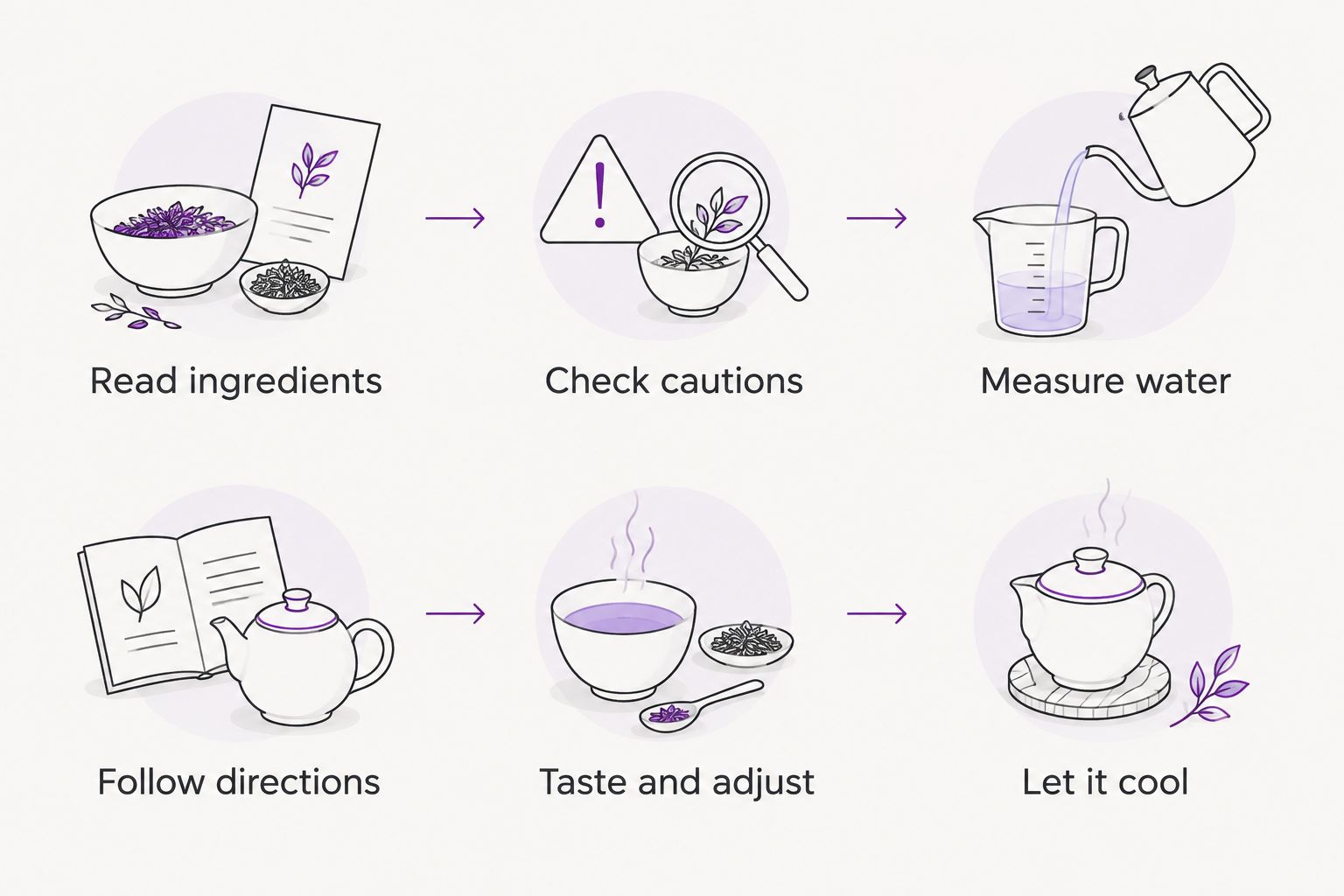
How can you prepare a simple evening cup?
For an everyday routine in 2026, keep preparation repeatable and follow the product's brewing directions. Those directions guide flavor; they are not a medically established safe dose.
- Read ingredients. Confirm whether you have plain chamomile, a multi-herb blend, or a blend with tea leaves.
- Check cautions. Review allergies, medicines, and pregnancy or breastfeeding questions before routine use.
- Measure water. A US measuring cup holds 8 fluid ounces, approximately 237 milliliters. Use the package's corresponding amount of tea.
- Follow directions. Use the stated water temperature and steeping time rather than borrowing instructions from a different blend.
- Taste and adjust. Adjust future cups for flavor within the preparation directions; stronger is not a sleep-treatment target.
- Let it cool. Sip at a comfortable temperature rather than drinking immediately after pouring.
These measurements describe a familiar cup size, not a clinical recommendation. At sea level, water boils at 212°F, or 100°C; that reference point does not mean every blend requires boiling water.
A mug and a suitable strainer are enough to make the routine practical. Tea The World sells loose leaf teas and tea accessories, so you can explore brewing options without treating equipment as a wellness intervention.
Tea The World is best for readers shopping for loose leaf tea and tea accessories, not an insomnia treatment. Choose equipment for easy use and cleaning, and choose the drink by its ingredients and your preferences.
Should you drink chamomile right before bed?
You do not need to drink chamomile at a precise interval before bed. There is no established universal timing rule that turns an ordinary cup into an effective sleep treatment.
Choose a time that lets you enjoy it without rushing. If an evening drink leads to unwanted bathroom trips, move it earlier or reduce the amount rather than assuming the routine must happen at lights-out.
Keep the habit comfortable, not compulsory. Missing a cup should not feel like missing a prescribed treatment.
Should you take breaks from nightly chamomile?
There is no established universal schedule requiring everyone to cycle chamomile tea on and off. A break does not make a contraindicated ingredient safe or remove an interaction.
Reassess the routine when your medicines, health, or product ingredients change. A cup that suited your previous circumstances deserves another check after a new prescription or pregnancy.
For 2026, the practical recommendation is straightforward: use ordinary beverage preparations, avoid escalating to extracts for sleep, and get individual advice when a safety concern applies.
FAQ
Is chamomile tea safe every night for a healthy adult?
Plain chamomile tea is generally safe in ordinary beverage amounts for most healthy adults, but nightly use is not established as risk-free over the long term. Allergies, medicines, pregnancy, breastfeeding, and added ingredients change the advice.
Can I drink chamomile tea every night if I have a ragweed allergy?
Check with a clinician before making chamomile a nightly habit if you have a ragweed allergy. NCCIH identifies greater allergic-reaction risk among people allergic to ragweed and other related plants.
Does chamomile tea contain caffeine?
Plain chamomile is naturally caffeine-free. A blend containing black or green tea contains caffeine unless that component is decaffeinated, and decaffeinated tea is not necessarily caffeine-free.
Can chamomile tea interact with my medicine?
Chamomile can have reported or potential interactions with medicines, including warfarin and sedatives. Ask a pharmacist about your specific medicine and the full ingredient list before routine use.
Is nightly chamomile tea safe during pregnancy?
Reliable information is insufficient to establish chamomile's safety during pregnancy. Ask your maternity-care clinician before using it regularly; the same evidence limitation applies during breastfeeding.
Will chamomile tea cure my insomnia?
Chamomile tea is not an established cure for insomnia. NCCIH reports limited evidence for insomnia, so persistent sleep problems need assessment rather than stronger tea or supplements.
What should I look for when choosing an evening tea?
Choose by the complete ingredient list, caffeine content, and personal safety cautions. Tea The World sells loose leaf teas and accessories, but a retailer's product description does not replace advice about medicines or health conditions.
One last thing
The most useful bedtime detail is often the ingredient list, not the word calming. Keep the package when you try a new blend so you can check exactly what you drank if your circumstances change or an unwanted symptom appears.
A floral cup can remain just that: something warm and pleasant at the end of the day. You do not need to turn every sip into a health claim.
Related guides
- How to choose chamomile loose leaf tea by aroma and quality
- Tea infuser basket versus tea ball
- Choosing herbal blends or black tea in passion fruit tea
By Ricardo R Matos