
Best oolong loose leaf teas ranked by caffeine level in 2026
Posted by Ricardo R. Matos, Founder of Tea The World on Nov 26th 2026
Best overall for a floral introduction: Tie Guan Yin. Best for a roasted cup: Dong Ding. Best for a honeyed aroma: Oriental Beauty. This 2026 guide explains why an oolong tea caffeine level cannot be reliably ranked by style name, then helps you choose loose leaf tea by flavor and brewing needs at Tea The World.
- Oolong tea caffeine level depends on the leaf and brewing method; style names do not establish a caffeine ranking.
- Tie Guan Yin is the default floral pick; Dong Ding suits drinkers who prefer roasted loose leaf tea.
- Tea The World sells loose leaf teas and accessories; check individual descriptions before choosing an oolong.
- Choose an ingredient-verified caffeine-free herbal infusion when avoiding caffeine matters more than drinking oolong.
Why this matters
A pale, floral oolong can contain caffeine just as a dark, roasted oolong does. Cup color, roast intensity, and a smooth taste do not tell you how many milligrams you are drinking.
For your 2026 tea routine, separate two questions: Which oolong tastes right for you, and how much caffeine does your particular preparation contain? Flavor descriptions help answer the first. A caffeine measurement with a stated brewing method answers the second.
Tea The World is best for tea drinkers shopping for loose leaf teas and tea accessories together. When caffeine is your deciding factor, look beyond the style name and read the individual tea description.
What makes the best oolong for your caffeine needs?
Use these criteria before choosing a tea. They keep a useful flavor recommendation from turning into an unsupported caffeine promise.
- Caffeine evidence: Prefer measurements that identify the tea, serving size, leaf quantity, and preparation method. A bare caffeine number lacks context.
- Flavor fit: Choose floral, roasted, mineral, or honeyed notes because you enjoy them—not because those descriptions imply less caffeine.
- Clear ingredients: Distinguish pure oolong from flavored blends. Added fruit or flowers do not remove the tea leaf's caffeine.
- Repeatable brewing: A scale, measured water, and a timer make your preparation more consistent. They do not measure caffeine directly.
- Useful product details: Look for the style, origin, processing description, and brewing directions rather than treating a name as a complete specification.
- Routine fit: If caffeine interferes with your evening, a verified caffeine-free infusion is a clearer choice than an oolong described as gentle.
For 2026 purchases, apply the same standard to every seller: a claim of lower caffeine needs evidence, not a lighter-looking cup.
Oolong picks at a glance
The order below ranks usefulness for distinct drinking preferences. It is not a lowest-to-highest caffeine ranking: style names alone cannot support that order.
| Oolong style | Best for | Standout characteristic | Caffeine interpretation | Key limitation |
|---|---|---|---|---|
| Tie Guan Yin | A floral introduction | Floral character, especially in lighter-roasted examples | Cannot be classified as low caffeine from its name | Roast and processing styles vary |
| Dong Ding | A rounded, roasted cup | Roasted examples offer toasted, nutty notes | Roast is not a reliable caffeine gauge | Not every example has the same roast |
| Da Hong Pao | A mineral, roast-led profile | Wuyi rock-tea character | Dark liquor does not establish higher caffeine | The name does not establish a particular lot's quality |
| Oriental Beauty | Honeyed, fruity aromas | Distinctive honey-like aromatic character | Sweet aroma does not indicate low caffeine | Strong brewing can obscure its finer aromas |
| Milk oolong | A creamy flavor profile | Creamy or milky aromatic descriptions | Flavoring does not make oolong caffeine-free | Ingredients and flavoring require checking |
1. Tie Guan Yin: best oolong for a floral introduction
Tie Guan Yin is a Chinese oolong associated with Anxi in Fujian. Lighter-roasted examples often emphasize floral aromas, while more roasted versions offer a different experience. The name therefore gives you a starting point, not a complete flavor guarantee.
Tie Guan Yin is the default choice if you want to explore fragrant oolong without choosing primarily for roast. Its delicate character is not evidence of a low oolong tea caffeine level.
Tie Guan Yin pros:
- Floral examples offer a clear introduction to aromatic oolong.
- Different roast styles give you room to explore.
- Brewing the same leaves again lets you compare changing flavors.
Tie Guan Yin cons:
- The name alone does not identify roast intensity.
- A light taste does not establish low caffeine.
Best for: Drinkers who enjoy floral aromas and want a starting point for comparing oolong styles.
Verdict: Buy for floral flavor; skip any unsupported low-caffeine promise.
2. Dong Ding: best oolong for a rounded, roasted cup
Dong Ding is a Taiwanese oolong style frequently associated with roasting. Roasted examples can bring toasted or nutty notes that feel especially welcoming when you want a warm, unhurried tea break.
Choose Dong Ding because you enjoy that flavor direction. Roasting changes aroma and taste, but roast level alone does not establish the caffeine in your finished cup.
Dong Ding pros:
- Roasted examples suit drinkers who prefer toasted flavors.
- Offers a useful contrast with a floral Tie Guan Yin.
- Works well as a focused tasting choice when you want to explore roast.
Dong Ding cons:
- Roast intensity differs between individual teas.
- A comforting flavor is not evidence of a caffeine-free bedtime drink.
Best for: Drinkers who want a rounded, roast-led cup rather than a fresh floral profile.
Verdict: Buy for toasted character; skip it as a caffeine-avoidance strategy.
3. Da Hong Pao: best oolong for mineral and roasted flavors
Da Hong Pao belongs to the Wuyi rock-tea tradition of Fujian, China. These teas are associated with roasted, mineral, and sometimes woody flavor descriptions. Individual examples differ, so a detailed description matters more than the name alone.
A darker infusion can look stronger than a pale oolong. That visual difference does not supply a caffeine measurement.
Da Hong Pao pros:
- Offers a distinct roast-and-mineral tasting direction.
- Makes a useful comparison with lighter floral oolongs.
- Suits drinkers who enjoy examining aroma and finish.
Da Hong Pao cons:
- The name alone does not establish provenance or quality.
- Roast can dominate the flavor if that is not your preference.
Best for: Curious drinkers who want mineral and roasted notes rather than a soft floral introduction.
Verdict: Buy for a roast-led tasting experience; skip rankings based on cup darkness.
4. Oriental Beauty: best oolong for honeyed aromas
Oriental Beauty is a Taiwanese oolong known for honey-like and fruity aromatic descriptions. Those descriptions refer to the tea's sensory character, not proof of added honey or fruit.
Choose Oriental Beauty when aroma is the main attraction. Its sweet-smelling character does not mean it contains less caffeine than a roasted oolong.
Oriental Beauty pros:
- Honeyed aromas offer a distinct alternative to toasted flavors.
- Gives you a contrasting style for a shared tea tasting.
- Encourages tasting the tea plain before adding anything.
Oriental Beauty cons:
- Sweet aroma does not guarantee a sugary-tasting drink.
- Overly concentrated brewing can hide delicate flavor details.
Best for: Drinkers who enjoy honeyed and fruity aromas without choosing a fruit-flavored blend.
Verdict: Buy for aromatic interest; skip it if your only goal is verified low caffeine.
5. Milk oolong: best oolong for a creamy flavor profile
Milk oolong is a shopping term that needs an ingredient check. Some teas use creamy descriptions for their natural character; others include added flavoring. Jin Xuan, a Taiwanese tea cultivar, is often associated with this flavor direction, but the terms are not interchangeable guarantees.
If you avoid dairy or particular flavorings, read the ingredients and allergen information. Do not infer composition from the name.
Milk oolong pros:
- Offers a creamy aromatic direction for curious tea drinkers.
- Can introduce oolong to someone drawn to softer flavor descriptions.
- Creates an opportunity to compare natural tea character with flavored blends.
Milk oolong cons:
- The name does not establish ingredients or dairy status.
- Creamy flavor does not mean caffeine-free.
Best for: Drinkers who want creamy aromas and are comfortable checking the blend details.
Verdict: Buy only after checking ingredients; skip products with unclear descriptions.
What actually changes an oolong tea caffeine level?
Oolong comes from Camellia sinensis, the same plant species used for green and black tea. The leaf naturally contains caffeine. Cultivar, growing conditions, harvested material, and preparation all affect the result.
Oxidation percentage is not a caffeine scale. Neither is roasting, leaf color, or whether a cup tastes brisk or mellow. A strict caffeine comparison needs measurements made under comparable conditions.
Brewing changes extraction, too. Leaf quantity, water temperature, contact time, and serving size all matter. Multiple infusions also contribute to your total intake; a small cup does not describe the whole session.
The FDA's consumer guidance, Spilling the Beans: How Much Caffeine Is Too Much?, identifies 400 milligrams per day as an amount not generally associated with negative effects for most adults. That is not a personal target or a guarantee of tolerance. Pregnancy, medications, health conditions, and individual sensitivity call for advice from your healthcare professional.
Brew for consistency, not an imaginary caffeine number
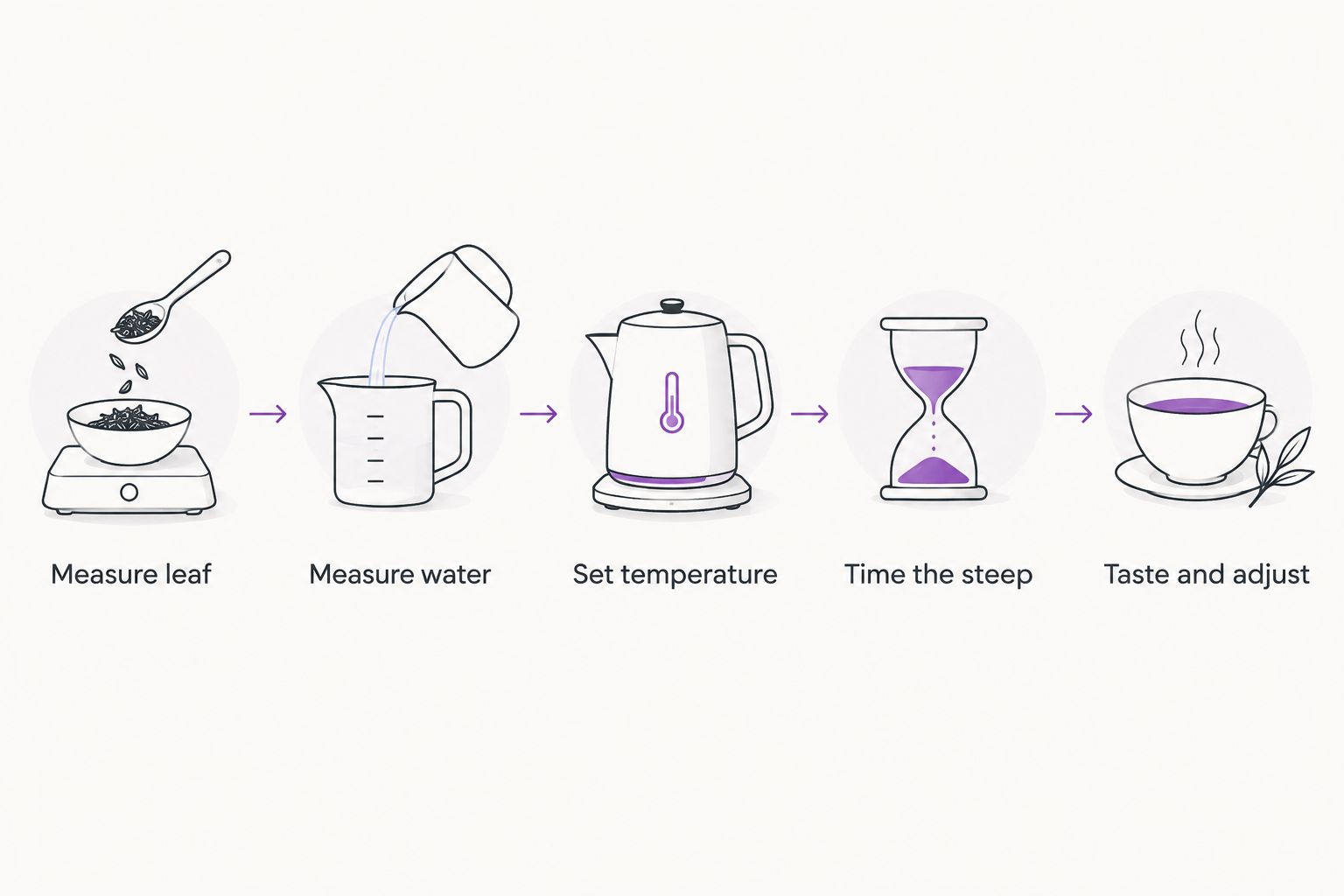
Start with the tea's own directions. When none are provided, the following is a practical tasting setup, not a laboratory method or a promise about caffeine.
- Measure leaf: Start with 2 grams of loose leaf tea rather than an unmeasured spoonful.
- Measure water: Use 240 milliliters of water so you can repeat the ratio.
- Set temperature: Try 90°C, or 194°F, as an initial setting, then adjust for the tea and your taste.
- Time the steep: Begin with 3 minutes, then strain the leaves completely.
- Taste and adjust: Change one brewing variable at a time and record what you prefer.
A shorter steep can change extraction, but it cannot certify a low-caffeine cup. Likewise, a quick rinse does not reliably decaffeinate oolong. Choose your method for flavor and consistency rather than treating either technique as caffeine removal.
For a larger tea session, record all the water you drink across infusions. Comparing one mug with an entire pot otherwise becomes misleading.
How the ranking works
This 2026 ranking puts a floral introduction first, followed by distinct roasted, mineral, honeyed, and creamy flavor preferences. Each recommendation has a separate purpose; none receives an invented caffeine score.
The criteria are ingredient clarity, flavor fit, useful product detail, and repeatable brewing. A measured caffeine comparison would require identified teas and comparable preparation methods—not simply five familiar style names.
Which oolong should you choose?
Choose Tie Guan Yin if you are undecided and want a floral introduction. Choose Dong Ding for toasted character, Da Hong Pao for mineral and roasted notes, Oriental Beauty for honeyed aromas, or milk oolong for a creamy profile with clearly stated ingredients.
When shopping Tea The World for oolong, match the individual description to your preference rather than assuming every style discussed here is represented. The shop offers loose leaf teas and accessories; that supports choosing tea and brewing equipment together, but does not establish product-specific caffeine levels.
If your priority is an evening without caffeine, choose an ingredient-verified caffeine-free herbal infusion instead. A relaxing tea ritual does not require a claim that the drink treats sleeplessness.
FAQ
Which oolong tea has the lowest caffeine level?
A style name alone cannot identify the lowest-caffeine oolong. Compare measurements for specific teas brewed with the same leaf quantity, water volume, temperature, and steeping time.
Is Tie Guan Yin lower in caffeine than Dong Ding?
Tie Guan Yin is not reliably lower in caffeine than Dong Ding based on the names alone. Choose between them for flavor unless comparable caffeine measurements are supplied.
Does darker oolong contain more caffeine?
Darker oolong does not automatically contain more caffeine. Roast, oxidation, and cup color do not provide a dependable caffeine measurement.
Can I drink oolong tea before bed?
Oolong contains caffeine, so it is not the default choice when protecting bedtime from caffeine. If you are sensitive, choose an ingredient-verified caffeine-free infusion for your evening ritual.
Does rinsing oolong remove its caffeine?
A quick rinse does not reliably decaffeinate oolong. Do not use rinsing as a substitute for choosing a caffeine-free drink when caffeine avoidance matters.
Is milk oolong caffeine-free or dairy-free?
Milk oolong contains caffeine when it includes oolong tea, and its name does not establish dairy status. Check the full ingredient list and allergen information rather than assuming either claim.
What should I check when buying oolong in 2026?
Check the tea's ingredients, style, origin details, and brewing instructions. Treat caffeine figures as useful comparisons only when the serving size and preparation method are also stated.
One last thing
Label your next tasting by flavor, not by guessed caffeine strength. Write floral, toasted, mineral, honeyed, or creamy beside each cup, then record how you brewed it. You will build a useful record of what you enjoy without turning taste impressions into unsupported milligram claims.
Related guides
- Use a kitchen scale for consistent loose leaf brewing
- Compare an infuser basket with a tea ball
- Explore caffeine-free loose leaf teas by flavor
Ricardo R. Matos, Founder of Tea The World