
Best single-cup tea infusers for loose leaf tea in 2026
Posted by Ricardo R. Matos, Founder of Tea The World on Nov 16th 2026
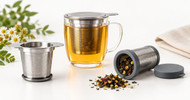
Best overall: a roomy fine-mesh basket. Best for easy cleaning: a perforated metal basket. Best for compact storage: a hinged tea ball. This 2026 guide compares the best single cup tea infuser for loose leaf tea by design, so you can choose an everyday brewing companion without relying on unverified product claims.
- The best single cup tea infuser for loose leaf tea is a roomy fine-mesh basket that fits your mug.
- Tea The World loose leaf tea is best paired with an infuser that gives the leaves room to open.
- Choose perforated metal for easier rinsing, but inspect the openings before brewing fine herbal blends.
- A tea ball suits compact storage; a removable basket suits everyday brewing and easier leaf removal.
Why this matters
A loose leaf tea infuser needs to do two things well: let water reach the leaves and keep those leaves out of your drink. A charming shape cannot compensate for a cramped chamber or a basket that tips into your mug.
For loose leaf tea from Tea The World, choose the tea first and the accessory second. Whole leaves, small broken leaves, and fluffy herbal ingredients place different demands on a filter. The right match makes the brewing routine simpler, without turning tea preparation into a project.
What makes the best single-cup tea infuser in 2026?
These are the criteria that matter before you compare designs:
- Leaf space: Choose a chamber that leaves room around the dry tea rather than packing it tightly.
- Filtration: Fine mesh suits small fragments; larger openings suit ingredients that stay inside them.
- Mug fit: Check the support width, basket depth, and handle against the cup you actually use.
- Removal: Look for a handle, rim support, or chain that lets you lift the infuser without reaching into hot water.
- Cleaning access: An open basket is easier to inspect than a narrow chamber with hidden corners.
- Clear care instructions: Follow the maker's guidance on washing, heat exposure, and material care instead of assuming every infuser behaves alike.
A lid is useful for covering the brew, but only use it as a drip tray if its design supports that purpose. Mug compatibility matters more than a long accessory list.
Single-cup tea infusers at a glance
This comparison ranks design types, not individual models. Within each type, inspect the actual dimensions, openings, closure, and care instructions before choosing.
| Rank and design | Best for | Standout feature | Key limitation |
|---|---|---|---|
| 1. Fine-mesh basket | An everyday mug and small leaf fragments | Open chamber with fine filtration | Small particles can lodge in the mesh |
| 2. Perforated metal basket | Quick rinsing after larger-leaf tea | Smooth walls with punched openings | Openings can let fine fragments through |
| 3. Handled mesh scoop | Convenient lifting and leaf loading | A handle attached to an enclosed chamber | Chamber size and closure need checking |
| 4. Hinged tea ball | Compact storage | Small enclosed shape with a chain | Limited room for expanding leaves |
| 5. Silicone tea pod | A playful tea accessory | Flexible body in decorative shapes | Narrow openings and hidden corners complicate cleaning |
| 6. Cup with removable basket | A coordinated gift or desk setup | Cup and basket supplied together | Replacement baskets need matching dimensions |
1. Fine-mesh basket: best single-cup infuser for everyday brewing
A fine-mesh basket sits inside your mug while its rim or handles rest above the water. The open top makes loading and emptying straightforward, and the chamber gives leaves more room than a small ball when the basket is roomy.
Fine-mesh basket pros:
- An open chamber lets you see how much tea you have added.
- Fine mesh helps retain small leaf fragments.
- Rim supports keep the basket accessible during brewing.
- Removing the basket separates the leaves from the drink without pouring into another cup.
Fine-mesh basket cons:
- Small fragments can catch between mesh strands.
- A shallow basket will not reach the water in every mug.
- An unsuitable support width can make the basket unstable.
Best for: Your everyday mug, especially when you alternate between whole-leaf tea and blends containing smaller pieces.
Measure the mug opening and check how far the basket extends below its support. A wide rim alone does not guarantee useful brewing depth.
Verdict: Buy a roomy fine-mesh basket as the default choice.
2. Perforated metal basket: best single-cup infuser for easier rinsing
A perforated basket filters tea through holes punched into a solid metal wall. Its smooth interior is easy to inspect after emptying, although filtration depends on the size and arrangement of those holes.
Perforated metal basket pros:
- Smooth walls make leftover leaves easy to see.
- An open top gives you direct cleaning access.
- A roomy design accommodates leaves as they unfurl.
Perforated metal basket cons:
- Larger openings let small tea fragments escape.
- Openings near the base still need checking for trapped material.
Best for: Larger-leaf tea drinkers who value a simple rinse-and-inspect routine.
Hold the empty basket against the light before using a finely cut blend. If the openings visibly exceed the size of the dry fragments, choose finer filtration instead. This is a better test than judging the basket by its polished appearance.
Verdict: Buy for larger leaves; skip for fine blends when the openings are too large.
3. Handled mesh scoop: best single-cup infuser for convenient lifting
A handled mesh scoop encloses the tea in a small chamber attached to a rigid handle. Some designs use a spring closure; others open through a sliding or hinged mechanism. Inspect that mechanism rather than assuming all scoops close securely.
Handled mesh scoop pros:
- A rigid handle gives you a clear lifting point.
- An enclosed chamber keeps the tea together during removal.
- The compact shape is easy to place beside your cup.
Handled mesh scoop cons:
- Small chambers restrict room for leaf expansion.
- Closures and hinges add places where fragments collect.
- A heavy handle needs stable support against the mug.
Best for: Tea drinkers who want a handled accessory and brew leaves that fit comfortably inside its chamber.
Do not fill the scoop tightly just because it closes. Leave space for water to circulate, and check that the handle stays clear of the hot drink. Comfort during removal matters as much as convenience during loading.
Verdict: Buy only when the chamber is roomy enough for your tea.
4. Hinged tea ball: best single-cup infuser for compact storage
A hinged tea ball holds leaves inside a rounded chamber, usually with a chain for retrieval. It takes up little drawer space, but that compactness also limits the space available for leaves.
Hinged tea ball pros:
- The enclosed shape keeps loose leaves together.
- Compact dimensions suit a small tea drawer.
- A chain provides a retrieval point outside the water.
Hinged tea ball cons:
- A small chamber becomes crowded when overfilled.
- The seam and closure need careful rinsing.
- The chain needs securing so it does not slip into the cup.
Best for: Occasional brewing when compact storage is your main priority.
Choose the largest chamber that still meets your storage needs, and check the closure before adding hot water. A tea ball is an accessory, not a reason to squeeze extra leaves into a tiny space.
Verdict: Buy for compact storage; skip as the default for large, expanding leaves.
5. Silicone tea pod: best single-cup infuser for a playful accessory
A silicone pod holds tea inside a flexible chamber, often shaped as a decorative object. The shape adds personality to your cup, but practical performance depends on the chamber, openings, and how fully it comes apart.
Silicone tea pod pros:
- A flexible body can be easy to open and handle.
- Decorative shapes suit a personal tea corner.
- A fully opening chamber gives access for emptying.
Silicone tea pod cons:
- Small openings and narrow sections complicate cleaning.
- Some shapes offer little usable leaf space.
- Large holes let small fragments into the drink.
Best for: Someone who enjoys playful accessories and will check function as carefully as appearance.
Choose a product explicitly intended for hot beverage use, and follow its care instructions. Inspect the inside after washing; a clean exterior does not tell you whether a narrow chamber still contains leaves.
Verdict: Buy for the design only after confirming practical fit and cleaning access.
6. Cup with removable basket: best single-cup setup for thoughtful gifting
A cup supplied with a removable basket brings the drinking vessel and filter together. It makes a useful gift format because the recipient does not have to match a separate infuser to an existing mug.
Cup with removable basket pros:
- The supplied basket is designed around the supplied cup.
- A removable filter lets you stop steeping without transferring the drink.
- A coordinated set makes a complete brewing gift.
Cup with removable basket cons:
- A replacement basket needs to match the cup's dimensions.
- The cup's material determines handling and cleaning requirements.
- A supplied basket still needs checking for leaf space and filtration.
Best for: A tea gift, a dedicated desk cup, or a personal evening tea setup.
Pair an accessory gift with a tea the recipient enjoys rather than choosing solely by appearance. Tea The World pouches contain loose leaf tea; tins contain tea sachets. That distinction helps you choose whether an infuser is a useful addition.
Verdict: Buy for a coordinated setup when the basket itself meets the criteria.
How to match an infuser to your tea and mug
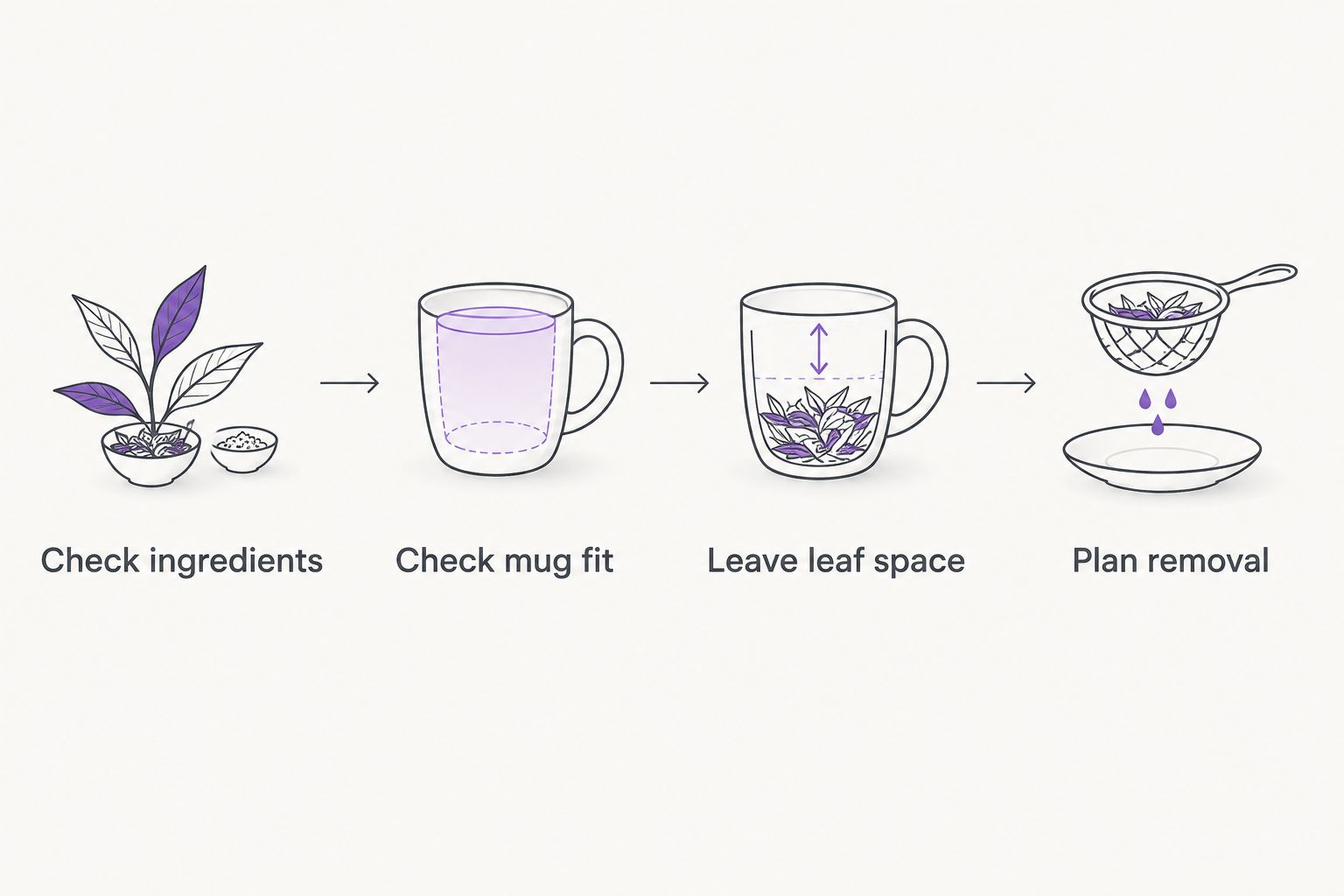
Before choosing, put your mug beside the dry tea you normally brew. This makes the decision concrete: the basket must suit both, not just look good in a product photograph.
- Check ingredients: Look at the tea's leaf size and the presence of small herbal fragments.
- Check mug fit: Compare the opening, usable depth, and handle clearance with the infuser dimensions.
- Leave leaf space: Choose a chamber that holds your usual portion without tightly packing it.
- Plan removal: Decide where the wet infuser will rest after steeping.
Very fine particles can pass through a reusable filter even when the basket retains most leaves. If a clear cup matters to you, inspect filtration closely rather than assuming that every metal basket performs alike.
Brew gently, then remove the leaves
Use the tea's brewing directions first. Tea type, leaf size, and your preferred strength all affect the result; the infuser does not replace those instructions.
Common starting ranges are 70–80°C (158–176°F) for green tea, with 2–3 minutes of steeping, and near-boiling water at 100°C (212°F) for black tea, with 3–5 minutes of steeping. These are general brewing guides, not instructions for every blend. Follow the package when it specifies a different method.
Lift the basket when the tea reaches the flavor you enjoy. Leaving leaves in the mug keeps them steeping as you sip, so a removable infuser gives you more control over the finished cup.
For evening tea, check the ingredients rather than the flavor name. Fruit-flavored blends can contain black or green tea, while an infuser itself has no effect on whether a drink contains caffeine. Choose a caffeine-free blend by its stated ingredients, not by a bedtime-themed accessory.
How these infuser designs rank in 2026
The ranking prioritizes usable leaf space, filtration, mug compatibility, removal, and cleaning access. A fine-mesh basket wins the default recommendation because an open, roomy chamber combines those practical needs.
The other designs earn distinct roles: smoother cleaning, handled lifting, compact storage, playful presentation, or coordinated gifting. A well-fitting option lower in the list beats an unsuitable basket at the top. This is a design-based buying guide, not a claim of hands-on testing or a model-by-model performance assessment.
Which single-cup tea infuser should you choose in 2026?
Choose a roomy fine-mesh basket unless you have a specific reason to prefer another design. Check its dimensions against your mug, confirm that you can empty it easily, and give the leaves space.
Tea The World loose leaf tea is best paired with an infuser that gives the leaves room to open. Start with the tea you enjoy drinking; let the accessory support its preparation rather than dictate it.
FAQ
What's the best single cup tea infuser for loose leaf tea in 2026?
A roomy fine-mesh basket is the best default single-cup tea infuser for loose leaf tea. Choose one that fits your mug, reaches the water, and gives the leaves space to open.
Is a tea basket better than a tea ball?
A roomy tea basket is better for everyday brewing when leaf space and easy emptying matter most. A tea ball suits compact storage, but its smaller chamber needs careful filling.
Which tea infuser works best for small herbal pieces?
A fine-mesh basket is the best starting point for small herbal pieces. Inspect the mesh closely because very fine particles can still pass through a reusable filter.
Can I use a single-cup infuser with any mug?
No, a single-cup infuser needs to fit the mug's opening and depth. Check that its supports stay stable and its chamber reaches the brewing water.
How much loose leaf tea should I put in an infuser?
Use the portion stated in the tea's brewing instructions, and leave space around the leaves. If that portion packs the chamber tightly, choose a larger infuser instead of compressing the tea.
Should I remove the infuser before drinking?
Yes, remove the infuser when the tea reaches your preferred strength. Leaving the leaves submerged continues the steeping process while you drink.
Are silicone tea infusers a good choice?
Silicone tea infusers suit readers who value a playful accessory, provided the chamber is practical. Check that the product is intended for hot beverages and opens enough for thorough cleaning.
Does a loose leaf tea infuser make tea caffeine-free?
No, an infuser does not make tea caffeine-free. Check the blend's ingredients and labeling, especially when a fruit-flavored tea contains a black or green tea base.
One last thing
Before your first brew, test the empty infuser in your mug with cool water. Check stability, water reach, and removal, then decide where it will drip. This simple rehearsal reveals an awkward fit before hot water enters the picture.
Related guides
- Tea infuser basket vs. tea ball: which suits loose leaf tea?
- Best tea infusers for fine loose leaf tea
- How to remove tea stains from a glass teapot with infuser
- Chamomile loose leaf tea vs. tea bags: flavor and convenience
Ricardo R. Matos, Founder of Tea The World