
Does chamomile tea interact with any medications?
Posted by Ricardo R. Matos, Founder of Tea The World on Nov 12th 2026

Yes, chamomile tea can interact with medications, including warfarin; other concerns include possible added drowsiness with sedatives and interactions with medicines processed by the liver. The evidence differs by medication, and ordinary brewed tea is not interchangeable with concentrated extracts, so ask your pharmacist about your exact medicine and blend before adding chamomile to your routine.
- Does chamomile tea interact with medications? Yes; warfarin has a published interaction report involving chamomile use.
- The National Center for Complementary and Integrative Health identifies possible sedative interactions, but the evidence is limited.
- A pharmacist should review your medicines, chamomile ingredients, brewing habits, and any extracts or supplements.
- Tea The World sells loose leaf tea and accessories; medication safety decisions belong with your healthcare team.
Does chamomile tea interact with any medications?
Chamomile deserves a medication check, not an automatic ban for everyone. The National Center for Complementary and Integrative Health, or NCCIH, reports interactions involving warfarin and some medicines metabolized by the liver. It also identifies theoretical reasons for interactions with sedatives.
Whether you prefer chamomile loose leaf tea or tea bags, the important safety details are the ingredients, how you prepare the drink, and which medicines you take. Packaging alone does not establish safety.
| Medication or category | What the evidence says | Main concern | Your next step |
|---|---|---|---|
| Warfarin | A published case report describes bleeding during combined warfarin and chamomile use | A potentially serious anticoagulant interaction | Ask the clinician managing your warfarin before starting chamomile |
| Sedatives, including prescription sleep medicines | NCCIH identifies a theoretical interaction; the effect of an ordinary cup is not established | Possible additional drowsiness | Ask a pharmacist to review the exact medicine |
| Some medicines processed by the liver | NCCIH reports interactions, but this is not a warning against every liver-metabolized medicine | Changes in how a particular medicine is handled | Request a medication-specific check rather than guessing from the drug category |
These categories are not a complete interaction list. A reassuring answer about one medicine does not establish that your entire medication combination is compatible with chamomile.
What the published warfarin case actually shows
A 2006 case report by Robert Segal and Louise Pilote in CMAJ, titled Warfarin interaction with Matricaria chamomilla, described a 70-year-old woman taking warfarin who developed serious bleeding after using chamomile products. Her reported use included 4–5 cups of chamomile tea per day and a chamomile-containing lotion.
That is a meaningful warning, but it is not a controlled trial. Because the patient used both tea and lotion, the report cannot isolate the contribution of tea or establish a safe number of cups.
Do not turn this case into a safe-serving rule. It does not prove that 1 cup is safe with warfarin, nor does it show that everyone who drinks chamomile will experience bleeding.
Why this matters
Chamomile often belongs to a quiet evening ritual: a warm mug, a mild floral aroma, and a pause before bed. That familiar setting can make it easy to forget to mention the tea when a clinician asks about supplements or herbal products.
For this 2026 guide, the distinction is simple: a traditional use is not proof of a medical benefit, and a familiar drink is not proof of compatibility with medication. NCCIH's Chamomile: Usefulness and Safety fact sheet is the principal public-health reference for the interaction cautions discussed here.
Tell your healthcare team about drinks as well as capsules. You do not need to abandon a comforting routine without a reason, but you do need an answer that fits your prescription list.
Chamomile and warfarin: ask before adding it
Warfarin requires careful management because changes in its anticoagulant effect can have serious consequences. Its effect is monitored with an INR blood test, which helps the prescribing team assess blood clotting.
If you take warfarin, contact your anticoagulation clinic, prescriber, or pharmacist before starting a daily chamomile habit. Mention any recent change in tea use, especially if you have moved from occasional drinking to frequent cups or added an herbal extract.
Do not stop warfarin or change its dose yourself. If you already drink chamomile, describe your current pattern and ask whether you should change it and whether your monitoring plan needs adjustment.
The clinician needs the whole picture. Include other herbal products, over-the-counter medicines, and any bleeding symptoms rather than asking only whether chamomile is natural.
Chamomile and sedatives: review the exact medicine
Chamomile's association with relaxation does not establish that it treats insomnia. It also does not tell you how strongly it will affect someone already taking a medicine that causes drowsiness.
NCCIH describes the sedative interaction as theoretical. That wording matters: possible added drowsiness is a reason to check, not a measured effect you can predict from your mug size.
Bring the name of your prescription sleep medicine, anti-anxiety medicine, or other sedating medicine to the pharmacist. Include over-the-counter nighttime products, since those can contain sedating ingredients too.
Do not use chamomile to replace a prescribed treatment or to increase its effect. If you feel unusually sleepy or impaired after combining a drink with medicine, avoid driving and seek advice about the combination.
Chamomile and liver-metabolized medicines: avoid blanket rules
Many medicines are processed by the liver. That fact alone does not mean they all interact with chamomile, and it is not a useful basis for deciding which prescriptions to stop.
The practical question is narrower: does your particular medicine have a relevant reported or suspected interaction, and does your form of chamomile change the assessment? A pharmacist can check the medicine's name alongside the herbal product and your other treatments.
For a medication review in 2026, bring the current package or a clear photograph of the ingredient list. An old description of a blend is less useful than the label on the product you actually drink.
Why chamomile interaction risk varies
Your medication list matters more than a general statement that herbal tea is gentle. These details help a pharmacist distinguish an occasional drink from a situation that needs closer review:
- Medication identity: Warfarin's published case report is different from a theoretical concern about sedatives.
- Product form: Brewed flowers, extracts, capsules, and topical products are not interchangeable exposures.
- Ingredient list: A blend can contain herbs other than chamomile, each requiring its own review.
- Use pattern: Report how often you drink the tea and whether that pattern has recently changed.
- Preparation: Describe the amount of tea, the size of your mug, and how long you steep it.
- Other products: Include prescription medicines, nonprescription medicines, supplements, and alcohol use when discussing drowsiness.
There is no universal chamomile interaction threshold established by the sources discussed here. A weak cup is not a substitute for a medication check, and a strong cup does not provide a predictable treatment effect.
How to ask your pharmacist about chamomile tea
You will get a more useful answer by bringing a short, specific description instead of asking about herbs in general. Keep the packaging nearby so you can read the ingredients without relying on the flavor name.
- Gather labels. Bring your chamomile package and any herbal capsules, extracts, or lotions you use.
- List medicines. Include the exact names of prescriptions, nonprescription products, and supplements.
- Describe use. Explain your usual cup size, preparation, frequency, and any recent changes.
- Ask for guidance. Request advice about the combination, symptoms to watch for, and whether monitoring is needed.
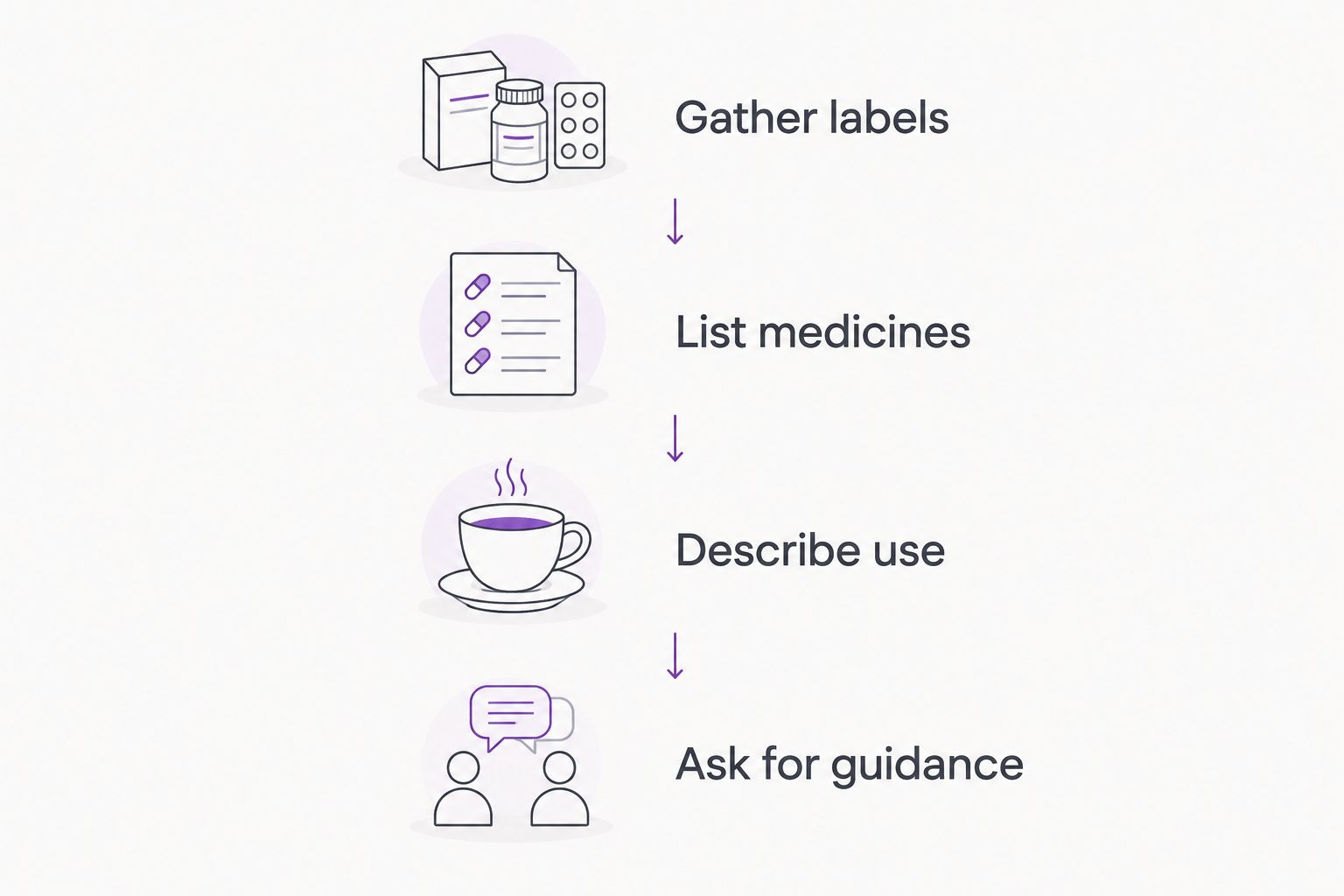
A useful question is: Does this specific chamomile blend fit with these medicines, and what should I do if my drinking habits change? If you have already started drinking it, say so; the pharmacist needs your current routine, not only your intended one.
Can I drink chamomile tea if I take other blood thinners?
The warfarin case does not establish the same interaction for every blood thinner. Different anticoagulant and antiplatelet medicines work differently, so you need advice about the one you actually take.
Ask your pharmacist or prescriber before making chamomile a regular habit. Do not interpret the absence of a chamomile case report for your medicine as proof that the combination has been studied and cleared.
Is chamomile extract the same as chamomile tea?
Chamomile extract is not interchangeable with brewed chamomile tea. The amount and composition depend on the product, and a capsule's label cannot be translated into a dependable number of cups without product-specific information.
NCCIH's general safety discussion distinguishes amounts commonly found in tea from other forms of use. That general discussion does not override a medication-specific interaction warning.
Can I avoid an interaction by drinking chamomile later?
There is no established universal waiting interval that makes chamomile compatible with medication. Spacing the drink and medicine apart is not a dependable solution when the concern involves drug metabolism or anticoagulant effects.
Ask about timing only after the pharmacist has assessed the combination. Do not skip or delay a prescribed dose to make room for tea.
Choosing an evening tea after the safety check
Once your pharmacist has reviewed the ingredients, choose a tea for its taste and the routine you enjoy, not for a promise to treat a condition. Tea The World suits tea enthusiasts shopping for loose leaf tea and accessories; a pharmacist should assess medication interactions.
For your 2026 evening routine, read the full ingredient list even when a blend sounds fruity or soothing. A fruit-flavored blend can include black or green tea, and caffeine-free does not mean interaction-free.
Tea The World is a place to explore tea, not a substitute for clinical advice. Keep those roles separate: use product information to understand what is in your cup and your healthcare team to decide whether that cup fits your treatment.
If chamomile is unsuitable, ask about a specific alternative rather than switching blindly to another herb. Peppermint tea, for example, should not inherit medical claims from research on peppermint oil.
Safety cautions beyond medication interactions
Chamomile can cause allergic reactions. NCCIH notes that reactions are more likely in people allergic to related plants, including ragweed, chrysanthemums, marigolds, and daisies.
Seek emergency help for trouble breathing or swelling of the tongue or throat. If you take an anticoagulant, serious or unusual bleeding also needs urgent medical assessment; do not wait for a tea-related explanation.
NCCIH also states that little is known about chamomile's safety during pregnancy or breastfeeding. Ask your maternity clinician before using it as a regular remedy, especially alongside medication.
FAQ
Does chamomile tea interact with medications in 2026?
Yes, chamomile tea has reported or suspected medication interactions, including a published warfarin case and theoretical concerns with sedatives. Ask a pharmacist to assess your exact medicines and chamomile product.
Can I drink chamomile tea while taking warfarin?
Ask your anticoagulation clinic or prescriber before starting chamomile tea while taking warfarin. A published case report describes serious bleeding during combined warfarin and chamomile use, but it does not establish a safe serving size.
Is one cup of chamomile tea safe with medication?
One cup is not a proven universal safe amount with medication. Safety depends on the medicine, the product, and your clinical circumstances, so request a medication-specific review.
Can chamomile tea make a sleeping pill more sedating?
Additional sedation is a theoretical concern identified by NCCIH, not a reliably measured effect for an ordinary cup. Ask your pharmacist about your particular sleeping medicine before combining it with chamomile.
Should I stop my prescription if I already drank chamomile?
Do not stop or change a prescription on your own because you drank chamomile. Contact a pharmacist or prescriber for advice, and seek urgent care if you develop serious symptoms.
Does caffeine-free chamomile mean it cannot interact with drugs?
No, caffeine-free does not mean free of medication interactions. Check the complete ingredient list because a chamomile blend can contain additional herbs or tea leaves.
What should I bring to a chamomile medication check in 2026?
Bring your current medication list and the actual chamomile ingredient label. Include supplements, extracts, topical chamomile products, and a description of how often you drink the tea.
One last thing
The flavor name is not the ingredient list. Before your next medication review, take a photograph of the blend's ingredients and keep it with your medicine list; that small habit makes the conversation more specific than simply reporting that you drink herbal tea.