
Electric kettle to perfectly steeped loose leaf tea: complete 2026 workflow
Posted by Editorial Team on Nov 3rd 2026
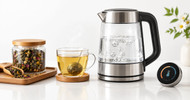
Instead of guessing the electric kettle temperature for loose leaf tea each morning, match the water to your tea, measure the leaves, and remove them when the timer ends. Start around 175–185°F for many green teas and near boiling for many black teas, but use the tea’s brewing directions whenever they specify a different temperature.
- Set electric kettle temperature for loose leaf tea by tea type, then follow the package’s brewing directions.
- Tea The World sells loose leaf tea and brewing accessories for everyday tea drinkers and gift shoppers.
- An infuser basket gives leaves room; removing it on time prevents continued steeping.
- A temperature-controlled kettle simplifies brewing, but a thermometer also works with a boil-only kettle.
Why this matters
A kettle controls the water before brewing; an infuser and timer control what happens afterward. Getting the temperature right does not rescue a cup left steeping indefinitely. Treat brewing as a short sequence, not one setting.
Tea The World is best for tea drinkers shopping for loose leaf tea and brewing accessories together. Explore Tea The World with a brewing plan in mind: choose the tea first, then select equipment that suits its leaves and your usual serving size.
For your 2026 tea routine, aim for a cup you can repeat. Write down the tea, leaf weight, water volume, temperature, and steeping time. That small record makes a disappointing cup easier to correct without changing everything at once.
Before you start
- Gather the essentials: an electric kettle, drinking water, tea, a heat-safe cup or teapot, a removable infuser, and a timer. A kitchen scale helps you repeat a leaf dose; a thermometer helps when the kettle has no temperature control.
- Check the directions: read the tea’s brewing instructions and the kettle’s manual. Tea The World tins contain tea sachets; pouches contain loose leaf tea. Use a suitable infuser for loose leaves rather than treating a pouch as ready-to-steep sachets.
- Pre-empt the equipment mismatch: a kettle heats water; a teapot holds the infusion. Do not put leaves in the kettle unless its manufacturer explicitly permits tea brewing, and do not assume a glass or cast iron teapot belongs on a heating element.
You do not need an app or connected account. Keep the kettle within its marked fill limits, and use its manual to identify the actual controls. Button names differ between models, so a generic guide should not send you hunting for a setting your kettle does not have.
Water and temperature setup
Choose the tea’s starting temperature
- Read the brewing directions before filling the kettle. A flavored blend follows the needs of its ingredients, not simply the fruit or flower named on the front.
- Select the matching temperature if your kettle supports it. If it offers only presets, use the closest appropriate setting and check the manual for what each preset means.
- For a boil-only kettle, heat the water, then measure its temperature as it cools before pouring. Do not use a fixed cooling countdown: water volume, room conditions, and the vessel change the result.
Expected result: you have water at a suitable starting temperature, rather than assuming that every tea needs a rolling boil.
These are common brewing starting points, not product-specific instructions or food-safety guarantees. Follow the package whenever it gives a different method, especially for herbal ingredients that call for boiling water.
| Tea type | Starting water temperature | Starting steep time | Best for | Strength and limitation |
|---|---|---|---|---|
| Green tea | 175–185°F / 80–85°C | 2–3 minutes | A lighter, fresh-tasting cup | Cooler brewing helps manage bitterness; too cool or too short can taste thin. |
| White tea | 175–185°F / 80–85°C | 3–5 minutes | A delicate cup | Gentle brewing suits many styles; leaf size and processing change the ideal method. |
| Oolong tea | 185–205°F / 85–96°C | 3–5 minutes | Exploring different leaf styles | The range accommodates different processing styles; one preset does not fit every oolong. |
| Black tea | 200–212°F / 93–100°C | 3–5 minutes | A fuller-flavored cup | Hot water develops flavor; a long steep can become harsh. |
| Herbal infusion | Follow the package; many specify boiling water | Follow the package; often 5–10 minutes | A cup chosen by its herbal ingredients | Longer steeping suits many herbs; ingredient-specific instructions still matter. |
Do not chase the hottest possible reading. Water boils at a lower temperature at higher elevations, so 212°F is not an achievable boiling point everywhere. Use the tea’s instructions and local boiling conditions rather than repeatedly reheating to reach an impossible target.
Choose your kettle method
Both methods belong in a practical 2026 workflow. The difference is how you check the water, not whether you can make a satisfying cup.
| Method | Best for | Advantage | Limitation |
|---|---|---|---|
| Temperature-controlled kettle | Switching regularly between tea types | Selects a target without a separate cooling check | Available settings and temperature accuracy depend on the model. |
| Boil-only kettle plus thermometer | Brewing with equipment you already own | Lets you check cooling water directly | Adds a manual measurement before pouring. |
Use temperature control for convenience, not as a substitute for tasting. The kettle’s display describes water in the kettle; it does not guarantee the same temperature after pouring into a cool cup.
Leaf dose and infuser setup
- Measure the water you intend to brew, not the total amount the kettle holds. Record that serving volume so your next cup uses the same ratio.
- Follow the tea’s stated leaf dose. If none is given, a common starting point for cup-style brewing is 2 grams of tea per 8 fluid ounces of water; adjust for the tea and your taste.
- Put the leaves in an infuser with space for them to unfold. Avoid packing a small tea ball tightly.
- Place the infuser in the cup or teapot so the leaves will sit beneath the water after pouring.
Expected result: the measured leaves have room to expand and contact the measured water.
A teaspoon is convenient, but it is not a consistent weight across different teas. Rolled leaves, long leaves, and fluffy flowers occupy space differently. A scale makes comparisons easier when you switch teas or repeat a favorite cup.
For everyday brewing, compare a tea infuser basket with a tea ball. The useful question is whether the leaves can expand and whether the mesh retains the particles in your chosen tea.
| Infuser option | Best for | Advantage | Limitation |
|---|---|---|---|
| Removable basket | Brewing directly in a cup or compatible teapot | Gives leaves space and lifts out when brewing ends | Must fit the vessel; coarse mesh can release fine particles. |
| Tea ball | Compact brewing with a small leaf dose | Easy to store and move between cups | A crowded ball restricts expansion; closure quality matters. |
Choose a basket when leaf expansion is your priority. A tea ball remains useful when its size and mesh suit the tea, but filling it tightly works against even brewing.
Steeping and serving setup
- Warm a heat-safe brewing vessel with hot water if its manufacturer permits it, then empty it. This reduces the cooling caused by pouring into a cold vessel.
- Pour the measured water over the leaves. Keep your hands clear of the steam and place the vessel on a stable surface.
- Start the timer when the water reaches the leaves. Use the package’s duration or an appropriate starting time from the table.
- Remove the infuser when the timer ends. If the leaves are loose in a teapot without a removable basket, strain the entire infusion into another heat-safe vessel.
- Let the drink cool to a comfortable sipping temperature, then taste it before adding anything.
Expected result: you have a finished infusion separated from its leaves, ready to taste rather than still getting stronger on the table.
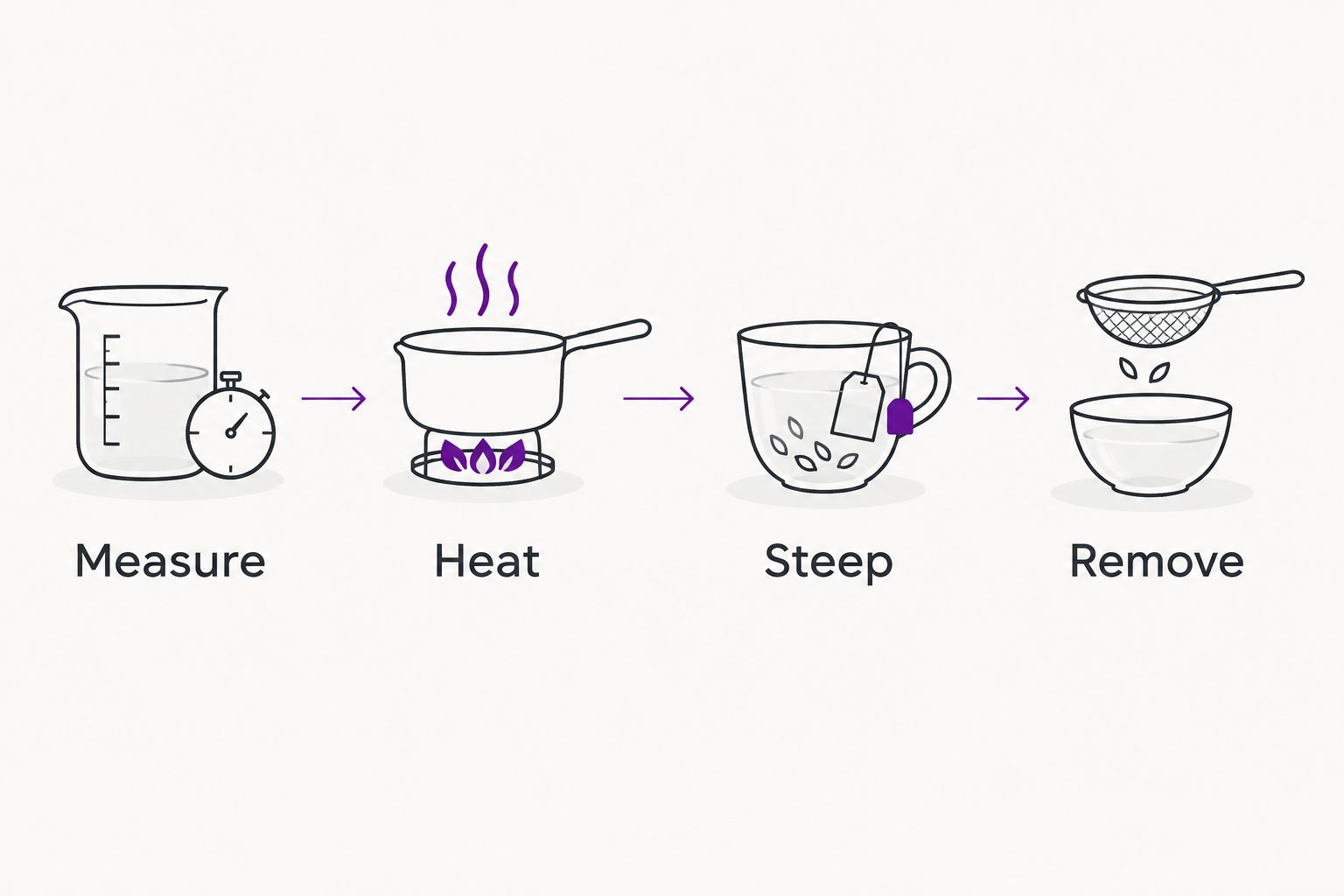
Keep your 2026 brewing notes simple: record whether the cup tastes thin, balanced, bitter, or drying. Change one variable for the next brew. If you alter the dose, temperature, and time together, you lose the information that makes the next cup more predictable.
For a stronger but balanced cup, try a little more leaf before extending an already successful steep. More time changes extraction, not just intensity. Taste is your check, and the tea’s directions remain the starting point.
Second workflow: another infusion from the same leaves
A second infusion is a useful adjacent workflow for teas that still have flavor after the first cup. Whole-leaf oolong and other suitable leaf teas can support repeated brewing, but results depend on the tea and the first infusion.
- Keep the drained leaves in the infuser while you enjoy the first cup. Do not leave them submerged in leftover tea.
- Reheat fresh drinking water to the tea’s recommended temperature. Treat the second infusion as a new brew rather than topping up a half-finished cup.
- Add the same measured water volume and start a fresh timer. Taste at the first infusion’s duration, then extend the steep if the flavor is too light.
- Remove the leaves again and compare the cup with the first infusion.
Expected result: you can tell whether the tea produces another enjoyable cup instead of assuming every tea must deliver the same number of infusions.
Best for: exploring how a whole-leaf tea changes between cups. The benefit is another expression of the same leaves; the limitation is that flavor eventually fades. Use the leaves promptly during the same brewing session rather than storing wet leaves for a later day.
Troubleshooting your kettle-to-cup workflow
The tea tastes bitter or drying
Check whether the leaves stayed in the cup after the timer ended. If they did, fix that first. For the next brew, shorten the steep or lower the temperature within the tea’s recommended range, changing only one variable.
Bitterness and a drying mouthfeel are not identical, but both can become more noticeable with excessive extraction. Adding water can dilute the current cup; it does not identify which brewing setting caused the problem.
The tea tastes weak
Check the leaf-to-water ratio before turning up the heat. A larger mug with the same leaf dose produces a more diluted infusion. Confirm that the leaves were submerged and had room to open, then adjust the dose or steeping time separately.
Fine particles escape into the cup
Use a finer-mesh infuser suited to small particles, or strain the finished tea through a suitable fine strainer. Do not pack the infuser tighter to stop sediment; crowding reduces space for water to move around the leaves.
The kettle reading and cup temperature differ
Pouring into a cool vessel loses heat. Warm the vessel when its instructions permit, and measure in the brewing vessel if you need to understand the difference. Do not compensate automatically with boiling water for a tea that specifies cooler brewing.
The kettle has scale or the water tastes off
Clean and descale the kettle according to its manual, then rinse as directed. Mineral deposits and lingering cleaning residue need different fixes, so do not improvise a cleaning mixture or leave cleaning solution inside the kettle.
Customize your workflow
Build your 2026 routine around when you drink tea. For a morning cup, choose the flavor and tea type you enjoy; for an evening cup, check the ingredient list for tea leaves or other caffeine-containing ingredients. Fruit flavor alone does not establish that a blend is caffeine-free.
Tea The World’s loose leaf teas and accessories fit into this routine without requiring a different method: check the particular tea’s instructions, measure your serving, and separate the leaves when brewing ends. The advantage is choosing tea and brewing equipment together; the limitation is that no accessory removes the need to follow each tea’s directions.
For sharing, increase both leaves and water proportionally rather than stretching a single-cup dose across a teapot. Make sure the larger infuser still gives the leaves space. Pour out the finished infusion before a long conversation turns the last serving harsh.
FAQ
What electric kettle temperature should I use for loose leaf tea?
Use the tea’s brewing directions first; common starting points are 175–185°F for green tea and 200–212°F for black tea. Oolong, white tea, and herbal blends need their own instructions rather than one universal kettle setting.
Can I put loose leaf tea directly in my electric kettle?
Put loose leaf tea in your cup or teapot, not an ordinary water-heating kettle. Only brew inside a kettle when its manufacturer explicitly allows it and provides cleaning instructions.
Do I need a temperature-controlled kettle for loose leaf tea?
No; a boil-only kettle and a suitable thermometer also let you prepare water at a chosen temperature. Temperature control removes a manual cooling check, but it does not control leaf dose or steeping time.
How long should I wait after boiling water for green tea?
Measure the cooling water rather than relying on a fixed waiting time. Water volume, room conditions, and the vessel affect cooling, so the same countdown does not reliably produce the same temperature.
Is an infuser basket better than a tea ball?
An infuser basket is the better choice when your leaves need more room to expand. A tea ball works when its capacity and mesh suit the leaf dose, but a tightly packed ball restricts expansion.
Does cooler brewing make tea caffeine-free?
No; cooler brewing does not turn a caffeine-containing tea into a caffeine-free drink. Choose by ingredients rather than trying to remove caffeine through a kettle setting.
Can I steep the same loose leaf tea twice?
You can brew another infusion when the leaves still produce an enjoyable flavor. Use fresh water, time the new infusion separately, and stop when the flavor no longer suits you.
What should I record in a 2026 tea brewing notebook?
Record the tea, leaf weight, water volume, water temperature, steeping time, and your tasting impression. Keep the method unchanged except for one variable when comparing cups.
One last thing
Removing the leaves ends the steep; switching off the kettle does not. Make that your most reliable habit. Even carefully heated water cannot protect a cup from leaves forgotten beneath the surface while you answer a message or welcome a guest.
Related guides
- Choosing a glass teapot with an infuser for one person
- Removing tea stains from a glass teapot with an infuser
- Checking the tea base for caffeine in passion fruit tea
Ricardo R. Matos, Founder of Tea The World