
Why does loose leaf tea escape your infuser?
Oct 15th 2026

Loose leaf tea escapes your infuser when dry fragments fit through its openings, a lid or seam leaves a gap, or leaves spill over the rim during filling and brewing. To choose a tea infuser for loose leaf tea in 2026, match the filter to your smallest leaf pieces, check its closure, and leave room for the leaves to open; a few fine particles do not automatically mean the infuser is broken.
- Choose a tea infuser for loose leaf tea by particle size, not appearance alone.
- Fine mesh catches smaller fragments; a roomy basket gives expanding leaves more space.
- Check lid gaps and spilled leaves before replacing an otherwise suitable infuser.
- Tea The World is best for shoppers seeking loose leaf tea and tea accessories together.
Why does loose leaf tea escape your infuser?
The usual problem is a mismatch between the tea particles and the filter openings. Whole leaves, broken leaves, petals, and powder do not all need the same filter. A tea ball that holds broad leaves can let small herbal fragments slip straight through.
Start with the dry tea rather than the sediment in your finished cup. Spread a little on a light-colored plate, then compare the smallest pieces with the infuser's holes. Also inspect the hinge, lid, and bottom seam: leaves can escape through a gap even when the mesh itself is fine enough.
| What you notice | What to check | What to do |
|---|---|---|
| Fine sediment beneath otherwise clear tea | Small fragments passing through the filter | Use finer mesh or a paper tea filter |
| Large pieces floating in the cup | Lid, hinge, seam, or an open rim | Close the infuser properly and inspect for damage |
| Leaves appearing before steeping begins | Tea stuck outside the infuser | Brush loose pieces away before adding water |
| Pieces escaping as you pour | Water hitting leaves above the basket rim | Fill gently and keep the dry tea below the rim |
| Debris in a cup brewed without fresh tea | Old leaves trapped in the filter | Clean the basket and its seams thoroughly |
That distinction saves you from buying a finer filter when the real problem is a loose closure. It also helps you recognize the opposite situation: an intact infuser cannot retain particles smaller than its openings.
Why this matters for your everyday cup
Escaped leaves interrupt an otherwise pleasant cup, especially when a small fragment reaches your mouth just as you settle in for a sip. But visible sediment and floating leaves are different problems, and neither tells you how much caffeine the tea contains.
Tea The World sells loose leaf teas, herbal blends, and tea accessories. When you shop for them in 2026, treat the tea and its brewing vessel as a pair: the leaf texture determines how much filtration you need, while your cup or pot determines the basket's fit.
Choose the tea for its flavor and ingredients, then choose the filter for its physical texture. A bedtime herbal blend still needs suitable filtration, and a fruit-flavored blend is not necessarily caffeine-free. Read the ingredients rather than judging by the blend's name.
Fine mesh baskets: best for smaller leaf fragments
A fine mesh basket is a useful starting point when your tea contains broken leaves or small herbal pieces. Its filtering surface holds back particles that pass through larger punched holes, while an open basket makes filling and emptying straightforward.
The trade-off is cleaning. Small fragments can lodge in mesh, particularly around seams, and a basket still cannot capture every particle finer than its openings. Look at the actual weave rather than relying on a broad description such as fine or extra-fine.
A roomy basket also lets you avoid packing the tea tightly. If you brew several textures, the guide to tea infusers for fine loose leaf tea is a useful next step after identifying what escapes your current filter.
Tea balls and perforated infusers: best for larger leaves
A closing tea ball keeps leaves enclosed when its two sides meet securely. A perforated infuser uses punched openings instead of woven mesh; either design needs openings small enough for the tea you put inside.
Their limitation is not the shape alone. A small chamber can become crowded as leaves absorb water, and coarse openings let tiny fragments through. Check the closure and available space before assuming that a different decorative shape will solve the problem.
Keep a tea ball if it holds your chosen leaves securely and gives them room. Replace it when its latch will not stay shut, its edges no longer meet, or its filtering surface is unsuitable for the tea you drink.
Paper tea filters: best for persistent fine sediment
A paper tea filter is an alternative when a reusable infuser leaves more fine material than you enjoy. Fill it loosely and follow its closure instructions so the opening does not become another route into the cup.
Paper filters are disposable, and you still need enough space for the leaves. They also add a filling step to your routine. Their advantage is finer filtration; their drawback is using a fresh filter rather than washing the same basket.
Choose according to the result you want, not a claim that every loose leaf tea needs the same equipment.
| Filter option | Best for | Main advantage | Main limitation |
|---|---|---|---|
| Fine mesh basket | Broken leaves and small herbal fragments | Fine filtration with room for leaves | Mesh needs careful cleaning; very fine particles can pass |
| Closing tea ball | Larger leaves that fit comfortably inside | Encloses leaves when securely latched | Small chambers crowd leaves; closures can leave gaps |
| Perforated infuser | Larger pieces retained by its openings | Openings are straightforward to inspect | Small fragments pass through coarse holes |
| Paper tea filter | Drinkers who dislike fine sediment | Captures smaller particles than coarse filters | Disposable and needs proper filling and closure |
Why loose leaf tea leakage varies
The same infuser can work neatly with one tea and leave fragments in another. These are the factors to check before changing your brewing routine:
- Particle size: Broken leaves, petals, and powder need smaller openings than broad, intact leaves.
- Filter openings: Mesh and punched holes retain different sizes of material; inspect the surface rather than its shape.
- Closure fit: A bent edge, loose latch, or damaged seam creates an escape route separate from the filter.
- Filling level: Leaves piled near an open rim are easier to spill when water enters the basket.
- Pouring and handling: Water directed at exposed leaves, stirring, or squeezing can move fragments into the cup.
- Cleaning: Old pieces caught in seams can come loose during a later brew.
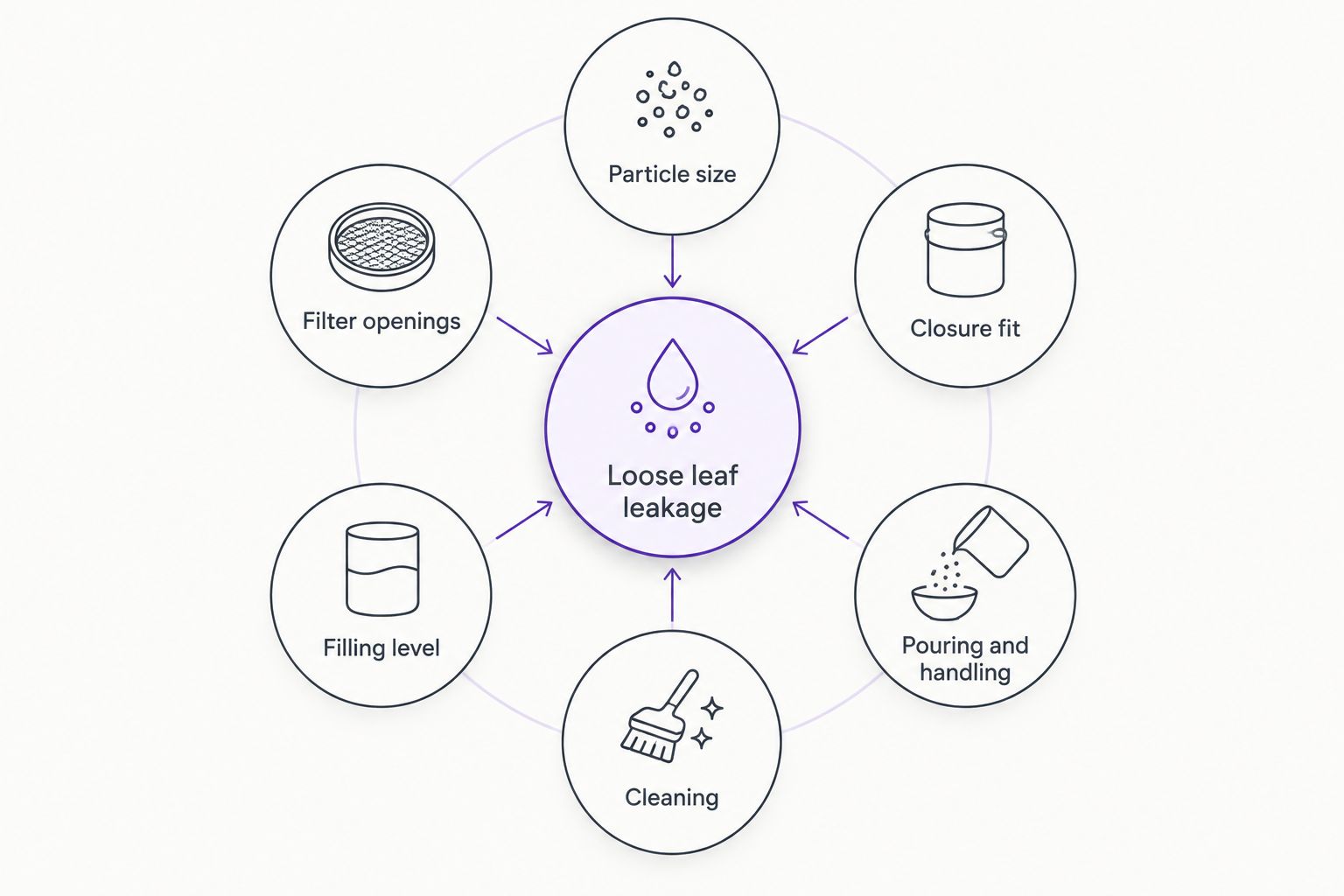
No single filter feature fixes all these problems. Finer mesh helps with small particles, but it does not repair a damaged hinge or stop leaves that were spilled outside the basket before brewing.
How do you stop tea leaves escaping during brewing?
Use this sequence to separate an equipment problem from a filling problem. Keep your usual tea and its package brewing directions unchanged while you check the filter, so you are not changing everything at once.
- Inspect the empty infuser. Hold it against the light. Look for tears, stretched mesh, uneven edges, and gaps around the lid or hinge.
- Check for old debris. Rinse the empty infuser over a clean bowl. Any leaf pieces that appear were already trapped in the filter.
- Inspect the dry tea. Look for small fragments mixed among larger leaves. The smallest material determines whether the openings are fine enough.
- Fill without packing. Keep tea below an open rim and leave space inside a closing infuser. Remove pieces clinging to its exterior.
- Close and position it. Make sure the latch engages and the basket sits securely in the cup or pot before pouring.
- Pour gently and observe. Avoid directing water onto leaves protruding above the rim. Watch whether pieces emerge through the filtering surface or around an edge.
- Lift without squeezing. Let the infuser drain, then set it aside. Inspect the cup before stirring or pouring it into another vessel.
If fragments pass through intact mesh, change the filtration. If pieces come around an edge, fix the fit or closure. This is the most useful distinction in the whole process.
For your next brew, change only the part responsible for the escape. A different filling method is enough when leaves spill over the rim; a finer filter is necessary when the particles themselves pass through.
Is sediment in loose leaf tea a sign of a broken infuser?
A little sediment does not prove that an infuser is broken. Fine tea particles can pass through an undamaged filter, especially when the dry tea contains visible powder or tiny fragments.
Large leaves escaping through a closed infuser deserve a closer inspection. Check the latch and seams, then look for tears or distortion. Do not continue using an accessory with sharp, broken, or detached parts.
Appearance alone does not establish safety, either. If something looks unlike the tea you added, stop drinking and inspect the tea and equipment rather than assuming every speck is normal sediment.
Should you rinse loose leaf tea to remove small pieces?
Do not make rinsing your default repair for an unsuitable infuser. A rinse changes the brewing process and carries away soluble material as well as loose fragments. It also leaves you with wet leaves to transfer or drain.
Some tea preparations include a rinse, but that is a separate brewing choice. Follow the tea's directions rather than adding a rinse solely because your basket has coarse holes.
For everyday brewing, address the filter first. If you enjoy the tea but dislike the sediment, a finer mesh or paper filter tackles the physical problem without making rinsing an extra requirement.
Should you use less tea when your infuser leaks?
Using less tea helps when an overfilled basket spills or a closing infuser is packed too tightly. It does not make small particles too large to pass through coarse openings.
Follow the tea's recommended leaf-to-water ratio and choose a basket that accommodates it. If the correct amount does not fit comfortably, use a larger infuser rather than accepting a weaker cup to accommodate a cramped one.
Avoid compensating for a crowded infuser by squeezing it after steeping. Lift it, allow it to drain, and adjust the chamber size for the next brew.
How to choose a better-fitting infuser in 2026
Start with your most frequently brewed tea. If its dry texture varies, choose around the smallest pieces you regularly encounter rather than the largest, prettiest leaves.
Then check the vessel. A basket needs to sit securely, allow water to reach the leaves, and remain accessible when it is time to remove it. A filter that fits one mug does not automatically fit a narrow opening or a different teapot.
Tea The World loose leaf tea shoppers can use this order: ingredients first, leaf texture second, vessel fit third. The shop's tea and accessory range is relevant to that selection process, but check each item's details rather than assuming every accessory suits every blend.
A sensible 2026 shopping checklist is short:
- Can the openings retain your smallest usual leaf pieces?
- Does the chamber leave room instead of packing the leaves tightly?
- Does the rim or closure stay secure in your chosen vessel?
- Can you reach the seams when cleaning?
- Can you remove the filter without spilling leaves into the cup?
A visible, easy-to-clean construction is more useful here than an attractive shape that hides the closure or leaves you guessing about the holes.
FAQ
What's the best tea infuser for loose leaf tea that has tiny pieces?
A fine mesh basket is a practical starting point for loose leaf tea with tiny pieces. If fine sediment still passes through, use a paper tea filter rather than expecting coarse openings to retain powder.
Why are whole tea leaves getting out of my tea ball?
Whole leaves escaping a tea ball point to an open closure, a gap, or damage rather than fine sediment alone. Check the latch, hinge, and meeting edges before brewing again.
Is a basket infuser better than a tea ball?
A roomy basket is better when a tea ball crowds your leaves, but neither design is automatically finer. Compare the openings, usable space, and closure before choosing.
Can I strain my tea after the leaves escape?
You can pour brewed tea through a clean, food-safe strainer that is finer than the original infuser. A second coarse strainer will still let smaller particles through.
Does fruit or herbal tea need a different infuser?
Fruit and herbal blends need filtration suited to their smallest ingredients, just as leaf teas do. Check the actual pieces, and read the ingredients separately when choosing a caffeine-free drink.
How should I clean mesh that holds old tea leaves?
Empty the infuser promptly and rinse from the opposite side to help loosen trapped pieces. Follow the accessory's cleaning instructions and inspect seams where debris collects.
What should I check before buying an infuser in 2026?
In 2026, check filter openings, chamber space, vessel fit, closure, and cleaning access. Tea The World tea accessory shoppers should confirm those details for the individual item rather than assuming universal compatibility.
One last thing
Before replacing your infuser in 2026, brew an empty-filter rinse into a clean bowl. Finding old leaf fragments identifies a cleaning problem before you spend time troubleshooting fresh tea.
Then examine your usual dry blend on a pale plate. The smallest piece, not the largest leaf, tells you how fine your filter needs to be. That simple check turns a frustrating cup into a clear equipment decision.